MOXIE
Yes. NASA's MOXIE split Martian CO2 into 122 g of oxygen over 16 runs, 2021 to 2023. Tiny on purpose: the real target is rocket oxidiser.
TL;DR· 19 min read
MOXIE, an instrument bolted inside NASA's Perseverance rover, split Martian carbon dioxide into oxygen on sixteen occasions between April 2021 and August 2023, making 122 grams in all at up to 12 grams an hour and 98 per cent purity or better. Every gram was vented straight back into the Martian atmosphere. The quantity was never the point: MOXIE existed to show that solid oxide electrolysis survives real Martian conditions, because a crew leaving Mars needs tens of tonnes of oxygen as rocket oxidiser.
Yes. A device NASA has described as microwave-oven-sized made oxygen out of Martian air sixteen times between April 2021 and August 2023, and the running total for the entire history of the species is 122 grams. That is about what a small dog breathes in ten hours, in NASA's own comparison, and none of it was kept: MOXIE measured each batch for quantity and purity and then let it go. Nobody was disappointed, because MOXIE was not built to supply anything to anyone. It was built to prove that one specific chemical process, solid oxide electrolysis of carbon dioxide, works in the actual atmosphere of another planet, at every hour and in every season, so that a version several hundred times larger can one day fill the tanks of the rocket that brings a crew home.
- 122 gall the oxygen ever made from another planet's air, across 16 runs
- 12 g/hrbest rate reached, twice MOXIE's own 6 grams an hour requirement
- 22.6 to 33.2 tpublished estimates of the oxygen one crewed ascent from Mars needs
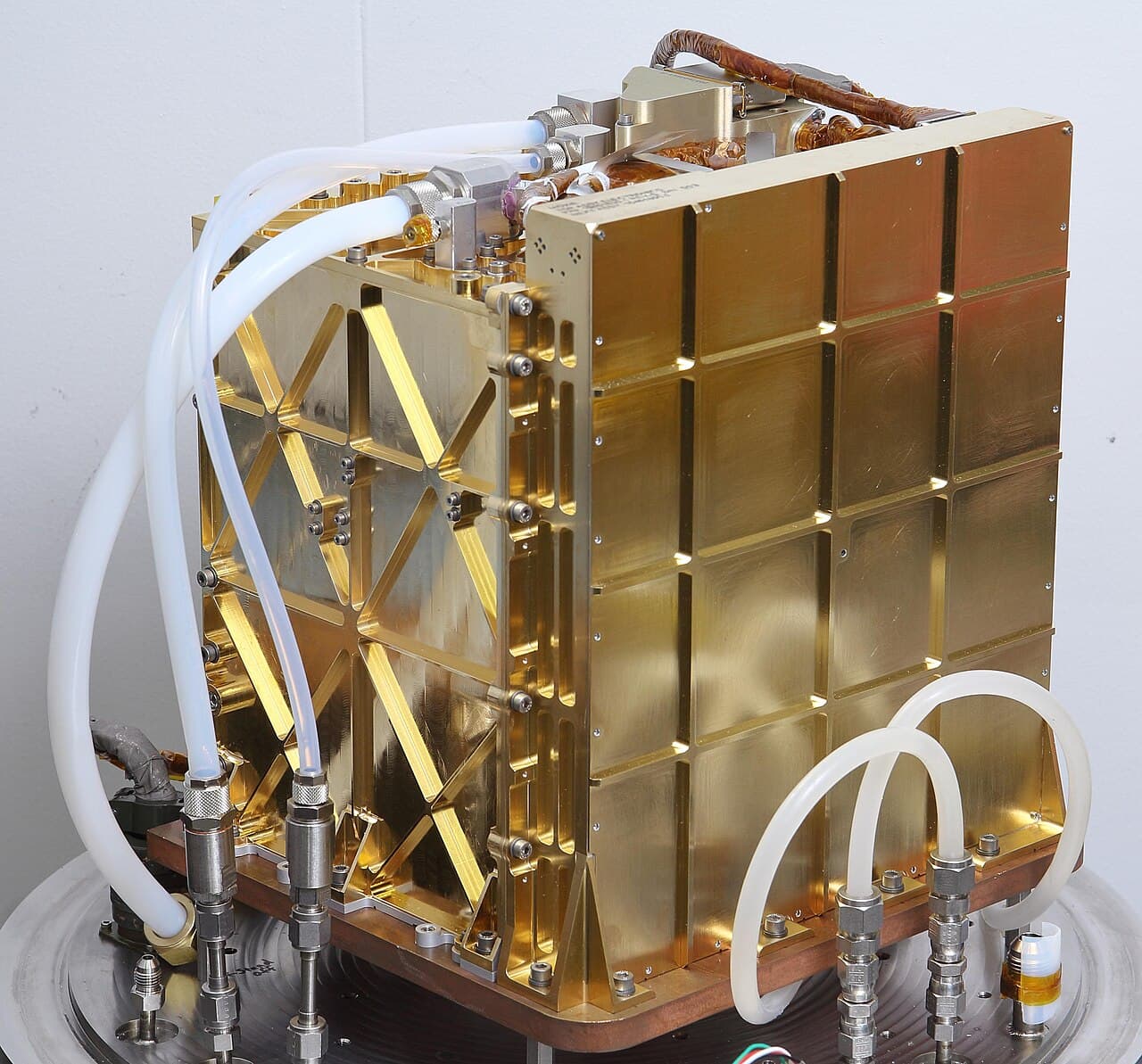
The process inside the box is simpler than its name. Martian air is about 95 per cent carbon dioxide, and a carbon dioxide molecule is one carbon atom holding two oxygen atoms. MOXIE pulled that air in through a baffle and a HEPA filter to keep the dust out, squeezed it with a scroll compressor which in the nominal case took the ambient 5 Torr up to about 567 Torr, roughly three quarters of Earth sea-level pressure, and heated it to about 800 degrees Celsius. At that temperature it passed the gas over a nickel cathode, which strips an oxygen atom off each CO2 and leaves carbon monoxide behind. The freed oxygen, now an ion carrying a negative charge, is pulled through a ceramic wafer of scandia-stabilised zirconia, a material that at 800 degrees will conduct oxygen ions and essentially nothing else. On the far side the ions give up their charge and pair off into ordinary O2. That ceramic sieve is the whole trick: it is what makes the product pure without any separation step. MOXIE had ten such cells, 22.7 square centimetres of working area apiece, 227 square centimetres in total for the entire experiment. Everything else in the 17-kilogram box, the heaters, the insulation, the 3D-printed heat exchangers, the sensors, the compressor, existed to hold those ten wafers at the right temperature and feed them at the right pressure.
Now the honest arithmetic. Sixteen runs spread over the better part of two and a half years produced 122 grams. JPL's own comparison is that this is about what a small dog breathes in ten hours; running the same conversion NASA used for the first run, where about 5 grams was called ten minutes of breathing for one astronaut, the entire career output would keep one person alive for roughly four hours, which is also what Hecht's separate figure of a tonne a year for four astronauts works out to. And nobody breathed it. MOXIE had no tank, no liquefier and no plumbing to anywhere; each batch was measured for volume and purity by onboard sensors and then vented back into the Martian atmosphere, along with the carbon monoxide. Perseverance itself has no use for oxygen: it is nuclear-powered and it has no crew. So MOXIE was a passenger that consumed rover resources rather than providing any, roughly 1,000 watt-hours per run, a full sol's payload energy allowance, of which only 30 to 60 watts was the chemistry and about 130 watts was the compressor, with at least two hours of preheating swallowing about half the total. Judged as a supply of oxygen it is a rounding error. Judged as an experiment it beat its own requirement twice over: the specification asked for 6 grams an hour and it reached 12.
Propellant is the reason anyone cared. Air comes a distant second. A rocket has to carry its own oxidiser, and for a methane engine that oxidiser outweighs the fuel by roughly three and a half to one, so oxygen is roughly 78 per cent of the propellant mass of a Mars Ascent Vehicle. The published figures for how much that is depend entirely on crew size and on which study you read: Design Reference Architecture 5.0 gives about 31 tonnes of oxygen for a six-person ascent vehicle massing around 50 tonnes; Polsgrove and colleagues give 22.6 tonnes for a crew of four and 33.2 tonnes for a crew of six; JPL's press release quotes about 25 tonnes for four astronauts; Rapp rounds to about 30. None of these is the number, and anyone quoting a single one without saying whose mission it is has flattened something. Against that, the same crew breathing for a year on the surface uses about one tonne between them. The propellant demand is twenty to thirty times the life-support demand, and it all has to arrive somehow. Getting mass to the Martian surface costs somewhere between 8 and 13 tonnes in low Earth orbit per tonne landed, depending again on whose figures you take, which turns 40 tonnes of ascent propellant into somewhere between about 320 and about 520 tonnes that must be launched from Earth for every single mission; the MOXIE team's own paper, using the higher multiplier, puts it at roughly 500 tonnes. Making the oxidiser on site deletes about three quarters of that.
So the sixteen runs were not about volume, they were about coverage and confidence. MOXIE ran at night and in the afternoon, at the annual maximum atmospheric density and at the annual minimum, at published run pressures from 631 to 768 pascals, and the performance differences were no larger than the changing air density predicted. It ran diagnostic runs that had nothing to do with making oxygen: one to pin down the resistance of the internal wiring, another to map how oxygen purity responds to the pressure difference between the two sides of the stack, which turned out to be the whole story of purity. Keep the oxygen side at higher pressure than the gas side and the carbon dioxide cannot leak across, and the product comes out at essentially 100 per cent. It also had to thread a needle every time it ran: too little voltage and no oxygen comes out, too much and solid carbon deposits on the cathode, blocking it and possibly cracking it. At MOXIE's reference operating point the safe band between those two limits is about 170 millivolts per cell, and the uncertainty in the wiring resistance alone ate 15 of them. The team ran conservatively on the assumption that the coolest cell in the middle of the stack, up to 10 degrees colder than its neighbours, was the one at risk. Cell resistance crept upward with every heating cycle, but slowly enough to project more than 60 cycles of useful life.
MOXIE was not the first attempt. The idea is 48 years old: Ash, Dowler and Varsi argued in 1978 that making ascent propellant on Mars beat carrying it, and coined the term ISPP for it. The first flight hardware was not MOXIE either. The Mars In-situ Propellant Production Precursor, MIP, was built for the Mars Surveyor 2001 lander with a one-kilogram zirconia cell designed to make 0.04 grams of oxygen an hour, using the same underlying technology. Its qualification unit was tested into August 2000 and its flight unit completed, by which point the lander had been cancelled because Mars Polar Lander had crashed, and MIP went into a box. Between 1978 and 2014 Mars ISRU work was, in Rapp's description, sporadic, intermittent and always at low technology readiness. What changed was an announcement of opportunity in late 2013 for a roughly 30 million dollar demonstration that would ride piggyback on a rover already going to Mars, avoiding the cost of a dedicated mission entirely. MOXIE cost perhaps 55 million dollars in the end, on Rapp's own uncertain estimate, of which about 6 million went into the electrolysis stack itself and the rest into the engineering needed to survive launch, cruise, landing and a rover's power budget.
What MOXIE did not settle is as important as what it did. It never ran continuously: a full-scale plant would operate for around 10,000 hours without stopping, and MOXIE had passed 1,000 minutes of production by its thirteenth run and went through more than twenty thermal cycles in all, so the degradation data it produced measures cycling and says nothing about endurance. It never liquefied, stored or transferred a single gram, and liquefaction and storage are where a real propellant plant becomes hard. Its compressor was not designed for long life and nobody knows what the full-scale replacement should be; scaling this one linearly would demand 42 kilowatts. The eleven stacks built for the programme varied widely from one another, which is a manufacturing question nobody has answered for the 60-cell and 65-cell stacks a full-scale plant would use. And there is a live argument about what should happen next. Rapp, a MOXIE co-investigator for nine years, argues that atmospheric processing is the only Mars ISRU that is ready, that the first crewed landings will be equatorial where near-surface water is very unlikely, and that NASA's pivot toward lunar ISRU and toward Martian water mining is putting the cart before the horse; he notes pointedly that a 2023 NASA ISRU overview did not mention MOXIE at all. The counter-position, which is NASA's programme of record, is that the Moon comes first and that lunar experience feeds forward. Meanwhile SpaceX's Mars architecture assumes methane synthesised from atmospheric CO2 and mined water ice, which needs exactly the water Rapp thinks an equatorial first landing site will not have. Both Starship and the broader case for sending people to Mars turn on that question. As of August 2026 we have found no announced flight successor to MOXIE, and no other machine anywhere that has made oxygen out of another world's own material.
What we know
What MOXIE was
The Mars Oxygen In-Situ Resource Utilization Experiment, one of seven instruments NASA selected for the Mars 2020 rover on 31 July 2014 out of 58 proposals. Principal investigator Michael Hecht of MIT; built and operated with NASA's Jet Propulsion Laboratory, with the electrolysis stacks made by Ceramatec, later OxEon Energy. Its authors describe it as the first demonstration of in-situ resource utilisation, the harvesting of native materials, on another planetary body. The announcement of opportunity behind it appeared in late 2013 for a roughly 30 million dollar demonstration; the project ran from late 2014 to its formal close on 30 September 2023, at an estimated total runout of about 55 million dollars, of which about 6 million went on the electrolysis stack. Rapp, a co-investigator for nine years, gives those cost figures while stating plainly that the team is not certain of the final number.↗
The reaction
2CO2 becomes 2CO + O2. Martian air enters through a dust-trapping HEPA filter, is compressed by a scroll pump, heated to about 800 degrees Celsius and passed over a nickel-based catalysed cathode, where carbon dioxide breaks into oxygen ions and carbon monoxide. A ceramic electrolyte of scandia-stabilised zirconia passes only the oxygen ions through to the anode, where they recombine as O2. The oxygen was metered for quantity and purity, then released. So was the carbon monoxide.↗
Size, mass and power
A box 23.9 by 23.9 by 30.9 cm, with an external inlet filter adding 23 by 9 by 12 cm. NASA's public specification gives 17.1 kg and 300 watts. The instrument team's own paper gives an allocation of 18 kg and states the mass of the combined system as 17.8 kg.↗
The electrolysis stack
Ten cells of 22.7 square centimetres of active area each, wired in series with a centre tap so they could be driven as two five-cell halves. That is 227 square centimetres of working electrode for the whole experiment. Eleven near-identical flight-equivalent stacks were delivered to JPL in 2017 and the one with the lowest resistance and the smallest spread of cell voltages was the one sent to Mars.↗
The compressor
A custom scroll compressor running to 3,500 rpm, which in the nominal operating case took Martian ambient air at 5.00 Torr up to 567 Torr at its exhaust, a compression of about 113 times, to roughly three quarters of Earth sea-level pressure. It was also the single largest power draw at about 130 watts, and thermodynamic compression accounted for only about 21 per cent of that, the rest being scroll tip and bearing friction.↗
What it was required to do
Three top-level requirements: produce at least 6 grams of oxygen an hour with an intake at 5 Torr and 0 degrees Celsius, produce it at better than 98 per cent purity, and keep meeting both for at least 10 operational cycles after delivery. NASA's public page separately quotes a capability of up to 10 grams an hour. The best rate actually achieved on Mars was 12 grams an hour, which JPL described as twice the original goal.↗
The first run
Sol 60, 20 April 2021, at night, with ambient pressure 751 Pa and temperature 201 K. Fifty-nine minutes of oxygen production yielded about 5.4 grams, after a warm-up of roughly two hours. JPL put that at about ten minutes of breathing for one astronaut.↗
The whole campaign
Sixteen oxygen-producing runs. Seven in 2021 totalling 49.9 grams, published in Science Advances in August 2022. Thirteen runs and more than 100 grams over more than 1,000 minutes of operation by 31 March 2023, including a then-record 10.56 grams an hour on 28 November 2022. The sixteenth and last run, on 7 August 2023, made 9.8 grams. Career total 122 grams, peak 12 grams an hour, 98 per cent purity or better.↗
Coverage across the Martian year
The scientific goal was breadth rather than volume: oxygen produced at night and in the afternoon, and at both the annual maximum and the annual minimum of atmospheric density at Jezero. Hoffman's 2023 keynote abstract records that MOXIE had done all four within the rover's first two Earth years on the surface. NASA's own March 2023 note listed running during a Martian dust storm as a hoped-for next step, and we have found no published account confirming that it happened.↗
Purity, and the number behind the number
MOXIE's own requirement was better than 98 per cent, and NASA reported 98 per cent or better. The Science Advances paper states that better than 99.6 per cent is what is recommended for oxygen actually used as propellant or as breathing gas, and Rapp and Inglezakis report purity of about 100 per cent whenever anode pressure was held above cathode pressure. The impurity, when there was one, was carbon dioxide leaking across internal seals, and it disappeared when the anode was kept at the higher pressure.↗
The narrow voltage window
MOXIE had to run above the Nernst potential for splitting CO2 and below the Nernst potential for depositing solid carbon out of CO, a phenomenon called coking that raises cell resistance and can crack the cathode. At the reference operating point that safe band is only about 170 millivolts per cell, and uncertainty in the resistance of the leads alone accounted for about 15 millivolts of it. Roughly 6 per cent of the CO-rich cathode exhaust was recirculated to the intake to stop the nickel oxidising; Rapp and Inglezakis give that figure as 2 per cent.↗
Where the power went
About 300 watts for the whole system, of which the electrochemistry itself was only 30 to 60 watts. Heating the stack to 800 degrees Celsius took at least two hours and about half the energy budget for the sol. A MOXIE run was designed to be energy-neutral for the rover, spending roughly 1,000 watt-hours, a full sol's payload allocation. After delivery it was found that the rover's computer had to stay awake to watch for shorts in MOXIE's heater and compressor controllers, costing another 155 watts.↗
How much oxygen a crew actually needs
Published figures differ and none of them is wrong, they measure different missions. Design Reference Architecture 5.0 gives a six-person Mars Ascent Vehicle of about 50 tonnes total, of which about 31 tonnes is oxygen and 9 tonnes methane. Polsgrove and colleagues in 2015 give 22.6 tonnes of oxygen and 6.0 tonnes of methane for a crew of four, and 33.2 tonnes and 9.0 tonnes for a crew of six. JPL's 2021 release quotes about 25 tonnes for four astronauts. Rapp gives about 30 tonnes. Oxygen is roughly 78 per cent of the propellant mass in every version.↗
How much oxygen a crew breathes
Very little by comparison. Hecht's figure, quoted by JPL, is that four astronauts spending a year on the surface would use about one tonne between them. That is between a twentieth and a thirtieth of the ascent oxygen. This is why MOXIE is described as a propellant experiment that happens to make breathable gas, rather than a life-support experiment.↗
What a real plant would have to be
Several hundred times larger. Hecht and colleagues put the required increase in cell area at about a factor of 400 and the required production at 2.2 kg an hour for a crew of four or 3.3 kg an hour for a crew of six, sustained over roughly fourteen months; the Science Advances paper phrases it as 2 to 3 kg an hour against MOXIE's 6 to 8 grams. Intake flow would rise about 200-fold, and the plant would run about 10,000 hours instead of MOXIE's tens. Scaling MOXIE's compressor linearly to that intake would need 42 kilowatts, which the team calls unacceptable, so a different compressor is required. Dust scales too: MOXIE's baffle and HEPA filter were expected to admit only about 0.01 grams of dust across the whole mission, while a worst-case full-scale filter could need a pleated face area of up to 4 square metres, though wind tunnel tests captured less than one per cent of the predicted dust loading and the team suspects the test geometry rather than the estimate.↗
The atmosphere it fed on
Curiosity's mass spectrometer measured the annual mean Martian air as 95.1 per cent carbon dioxide, 2.59 per cent nitrogen, 1.94 per cent argon, 0.161 per cent oxygen and 0.058 per cent carbon monoxide by volume. There is already free oxygen in Martian air, but sieving it out of the 55 to 69 grams an hour MOXIE ingested would have yielded under a tenth of a gram an hour. Breaking the carbon dioxide is what makes the numbers work. Surface pressure at Jezero was expected to swing from about 4.5 to 6.0 Torr across the year and the seven runs published in detail spanned 631 to 768 Pa. The Viking 1 page sets out the surface pressures measured from the ground.↗
What happened, and when
- Jul to Sep 1976The Viking 1 and Viking 2 landers make the first in-place measurement of Martian air and find it about 95.3 per cent carbon dioxide, 2.7 per cent nitrogen and 1.6 per cent argon. Their oxygen and carbon monoxide figures carry large uncertainties, which is why Curiosity's mass spectrometer had to do the job again decades later. The raw material for everything that follows is confirmed to be there, and to be everywhere.
- Sep 1978Ash, Dowler and Varsi publish Feasibility of rocket propellant production on Mars in Acta Astronautica, arguing that making ascent propellant on the surface beats hauling it, and coining the term ISPP, in-situ propellant production. This is the paper every later Mars ISRU study traces itself back to. We confirmed the citation but read it only through the accounts of Rapp and of Landis.
- 1999 to Aug 2000The Mars In-situ Propellant Production Precursor, MIP, reaches completed and qualification-tested flight hardware for the Mars Surveyor 2001 lander. Its oxygen generator was a 1 kg zirconia solid-oxide cell designed to make 0.04 grams of oxygen an hour. The lander was cancelled after Mars Polar Lander crashed, and MIP went into storage.
- 31 Jul 2014NASA selects seven instruments for the Mars 2020 rover from 58 proposals. MOXIE is among them, with Michael Hecht of MIT as principal investigator. It is the only one of the seven whose job is not to study Mars but to rehearse living there.
- 2017OxEon Energy delivers eleven flight-equivalent electrolysis stacks to JPL. They vary widely in resistance, in the spread of their individual cell voltages and in internal leakage; the best one is chosen for Mars. That variation is still, years later, one of the open questions about manufacturing these things at scale.
- 18 Feb 2021Perseverance lands in Jezero crater with MOXIE inside its belly.
- 20 Apr 2021Sol 60, at night, in 201 K air at 751 Pa: MOXIE runs for 59 minutes and makes about 5.4 grams of oxygen. Its authors call it the first demonstration of in-situ resource utilisation on another planetary body.
- 1 Jun 2021Sol 100: the first daytime run, in air 57 kelvin warmer and therefore thinner than the run three weeks before, produces the same 6.9 grams that the nighttime run did. Day and night turn out not to matter much, which is exactly the sort of boring result the experiment existed to get.
- 31 Aug 2022Hoffman, Hecht, Rapp and 22 colleagues publish the first seven runs in Science Advances: 49.9 grams, day and night, across a falling seasonal density curve, with cell resistance creeping up slowly enough to project more than 60 cycles of useful life.
- 28 Nov 2022MOXIE sets what was then its record production rate, 10.56 grams an hour. By the end of March 2023 it has done thirteen runs, more than 1,000 minutes of production and more than 100 grams, and has worked at both the annual maximum and the annual minimum atmospheric density.
- 7 Aug to 6 Sep 2023The sixteenth and final run makes 9.8 grams. NASA announces the retirement on 6 September with a career total of 122 grams, a best rate of 12 grams an hour and purity of 98 per cent or better. The project formally closes on 30 September 2023.
- 12 Jan 2024Rapp and Inglezakis publish a review that lists six gaps MOXIE left open, from the absence of any 10,000-hour degradation data to the undefined full-scale compressor, and argues that NASA has turned its ISRU attention to the Moon and to future Martian water mining while the one thing already demonstrated on Mars sits unfunded.
In pictures
Tap a photo to enlarge.
Sources
- J. A. Hoffman, M. H. Hecht, D. Rapp and 22 others, Mars Oxygen ISRU Experiment (MOXIE): Preparing for human Mars exploration, Science Advances 8(35), eabp8636 (31 Aug 2022)
- M. Hecht, J. Hoffman, D. Rapp and colleagues, Mars Oxygen ISRU Experiment (MOXIE), Space Science Reviews 217:9 (2021)
- D. Rapp and V. J. Inglezakis, Mars In Situ Resource Utilization with Focus on Atmospheric Processing for Near-Term Application: A Historical Review and Appraisal, Applied Sciences 14(2), 653 (12 Jan 2024)
- NASA JPL, 6 September 2023: NASA's Oxygen-Generating Experiment MOXIE Completes Mars Mission
- NASA JPL, 21 April 2021: NASA's Perseverance Mars Rover Extracts First Oxygen From Red Planet
- NASA Science blog, 31 March 2023: MOXIE Celebrates 2 Years on Mars, Discoveries and Work Left To Do
- NASA Science: Perseverance science instruments
- NASA, 31 July 2014: NASA Announces Mars 2020 Rover Payload
- M. G. Trainer and others, Seasonal Variations in Atmospheric Composition as Measured in Gale Crater, Mars, JGR Planets 124(11), 3000 to 3024 (2019)
- G. A. Landis, MIP: the First ISRU Flight Experiment, AIAA ASCEND 2020 (AIAA 2020-4234)
- R. L. Ash, W. L. Dowler and G. Varsi, Feasibility of rocket propellant production on Mars, Acta Astronautica 5, 705 to 724 (Sep 1978)
- J. A. Hoffman, keynote abstract, Electrochemistry on Mars: Two Years of MOXIE Operations, ECS Meeting Abstracts MA2023-01, 2739 (2023)
- J. A. Hoffman, E. Hinterman, M. H. Hecht, D. Rapp and J. Hartvigsen, 18 Months of MOXIE operations on the surface of Mars, Acta Astronautica 210, 547 to 553 (Sep 2023)
Checked on 24 August 2026. Where the science is unsettled this page says so rather than picking a winner.