Moon Time
As of 22 September 2026 there is no operational lunar time scale. The IAU defined Lunar Coordinate Time (TCL) in 2024, the CGPM is scheduled to consider a draft lunar time resolution at its meeting of 13 to 15 October 2026, and an April 2024 White House memo gives NASA until 31 December 2026 to deliver its Coordinated Lunar Time strategy.
TL;DR· 20 min read
A lunar day, sunrise to sunrise, lasts 29.53 Earth days, so landers face about two weeks of sunlight and then two weeks of night at around minus 173 °C. A clock on the Moon's surface gains about 56 microseconds a day on Earth clocks. The IAU defined Lunar Coordinate Time in 2024, but as of 22 September 2026 no operational lunar time exists: a 2024 White House memo gives NASA until 31 December 2026 for its strategy, and the CGPM is scheduled to consider a draft resolution on 13 to 15 October 2026.
A day on the Moon, from one sunrise to the next, lasts about 29.5 Earth days, so a spot near the equator gets roughly two weeks of sunlight and then two weeks of night. Clocks there also run fast, by about 56 microseconds a day compared with clocks on Earth, and as of 22 September 2026 nobody has yet agreed on an official lunar time to deal with it. Those are the two meanings of Moon time. The first decides whether a lander lives or dies: most are built to finish their work before sunset, a few carry nuclear heat through the night, and Japan's SLIM came back after three nights it was never designed to survive. The second decides whether precise navigation around the Moon will work, and it is being settled now, between a 2024 White House memo, a 2024 resolution of the International Astronomical Union, European and Chinese work on the mathematics, and a metrology conference due to vote on a draft resolution in October 2026.
- from one lunar sunrise to the next: the synodic month, which is the length of a day on the Moon
- 29.53 daysfrom one lunar sunrise to the next: the synodic month, which is the length of a day on the Moon
- how much faster a clock on the lunar surface runs than a clock on Earth
- 56 µs a dayhow much faster a clock on the lunar surface runs than a clock on Earth
- deadline for NASA's Coordinated Lunar Time strategy under the April 2024 White House memo
- 31 Dec 2026deadline for NASA's Coordinated Lunar Time strategy under the April 2024 White House memo
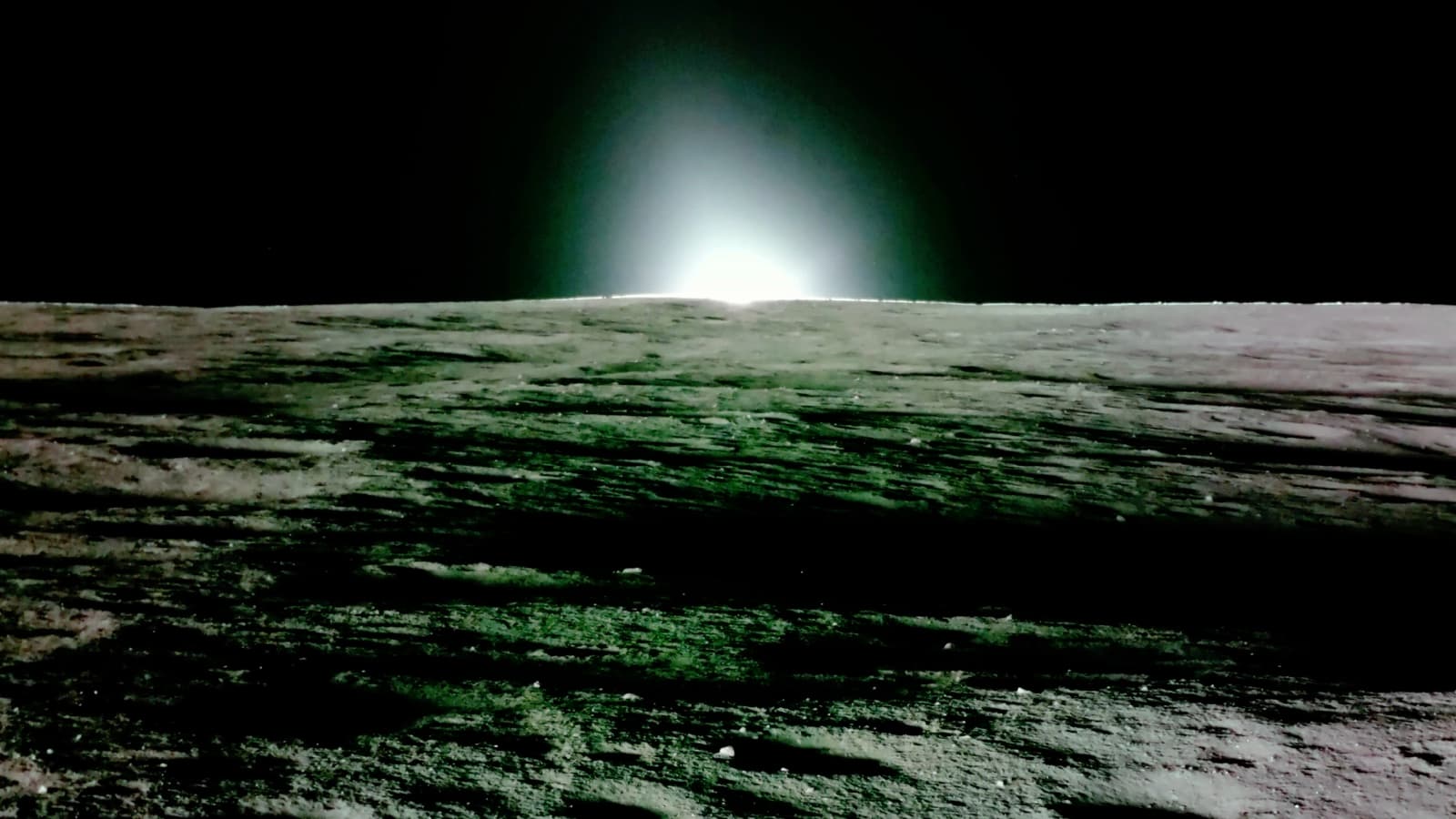
Lunar time has two halves, and the calendar is the one you can see with your own eyes. Measured against the stars, the Moon goes once around Earth in 27.32166 days, and it spins once on its axis in the same time, which is why the same face always points our way. But a day in the everyday sense, from one sunrise to the next, takes longer: 29.53059 days on average, the same as the interval from one new moon to the next. The extra 2.21 days come from the trip around the Sun. Earth and Moon move along their orbit together, so after one full turn against the stars the Moon has to turn a little further before the Sun is back in the same place in its sky. Astronomers call the first period the sidereal month and the second the synodic month, or lunation, and even the lunation is only an average: NASA's eclipse tables show individual ones running up to about seven hours longer or shorter.
On the ground near the equator that works out at roughly fourteen and three quarter Earth days of sunlight followed by the same again of darkness. The Sun crawls: it moves about 12 degrees a day, half a degree an hour, so it takes more than a week to climb from the horizon to noon. Bernhard Hufenbach of ESA's Moonlight team put the problem for future crews plainly in 2023: in the equatorial region each day is 29.5 days long, including freezing fortnight-long lunar nights. From the near side, Earth hangs in roughly the same patch of sky all month, rocking a little as the Moon librates; from the far side it never rises at all, though the far side gets just as much sunlight. Near the poles the pattern changes. The Moon's spin axis is tilted only about 1.5 degrees, so the polar Sun skims along the horizon, and some crater floors near both poles are permanently shadowed.
The night is the hard part. NASA gives lunar surface temperatures of about 127 °C in full Sun and about minus 173 °C in darkness, and the first night reading from China's Chang'e 4 lander, in January 2019, bottomed out at minus 190 °C. For a solar-powered spacecraft, sunset means two weeks with no power at those temperatures. Mission designers have three ways to deal with it: finish the job within one lunar day, carry a heat source that does not depend on the Sun, or switch everything off and hope.
Most landers take the first route. India's Chandrayaan-3 lander and rover were specified by ISRO for a mission life of one lunar day, about 14 Earth days. Intuitive Machines' Odysseus touched down on 22 February 2024, worked for seven Earth days and fell silent once the Sun set; the company listened for it from 20 March, when it calculated that enough light might be reaching the solar arrays again, and on 23 March concluded that the lander had permanently faded. Firefly's Blue Ghost 1 shows what planning around the clock looks like when it goes right. It landed in Mare Crisium on 2 March 2025, worked through 346 hours of daylight, photographed the sunset from the surface and kept operating for just over five hours into the night before the mission ended on 16 March.
The second route is older than most people assume. The Soviet Lunokhod 1 rover drove on solar power by day and parked at night with a polonium-210 radioisotope heater keeping it warm; it was meant to work for three lunar days and worked for eleven, until operations ended on 4 October 1971. China followed the same principle four decades later. According to a 2020 review by engineers at the China Institute of Atomic Energy, China's use of plutonium-238 in space began with Chang'e 3, which carried heater units imported from Russia: six were bought in 2009, three rated at 120 watts of heat, one at 8 and two at 4. Chang'e 4 carried plutonium-238 heat sources and a plutonium-238 generator, both developed with Russia, and the generator powered the thermometer that logged that first minus 190 °C night. When the Sun came back to Von Kármán crater, the Yutu-2 rover woke itself at about 20:00 Beijing time on 29 January 2019 and the lander followed at 20:39 the next evening.
Nuclear heat produced the longest records on the Moon. In September 2024 Chinese state television reported that Yutu-2 had finished its 71st lunar day and driven 1,613 metres against a design life of three months, and Zuo Wei, a deputy chief designer of the Chang'e 4 ground application system, said both the Chang'e 3 and Chang'e 4 landers were still active. Those were the most recent official figures available when this page was checked.
The third route produced the strangest result of recent years. Japan's SLIM landed on 20 January 2024 within about 10 metres of its target, but one of its two main engines most likely lost thrust near the end of the descent and it came to rest on its nose, with its solar cells facing west. JAXA had expected surface operations to last only a few days, and power returned only on 28 January, once the Sun had moved round. The lander was never designed to survive a lunar night. It answered Earth after its first one anyway, in a window from 25 February to 1 March, and again from 27 to 30 March and from 23 to 29 April. JAXA's own announcement describes those three rounds of operation after crossing the night as something the mission had never planned, and its December 2024 briefing says it is difficult to determine how SLIM survived. Attempts to reach it in later lunar afternoons failed, and operations were formally ended on 23 August 2024.
Surviving the night matters for timekeeping too. Kevin Coggins, deputy associate administrator for NASA's Space Communications and Navigation programme, explained in an interview recorded on 10 March 2026 that the atomic clocks a lunar time system needs want a stable temperature and continuous power, because every shutdown means a fresh warm-up and resynchronisation. He expects some of the clocks on the surface to be "equipped to survive the night". This is where the two meanings of Moon time meet: the slow calendar of sunlight, and the rate at which a clock actually ticks.
The clock problem comes from relativity. A clock deeper in a gravity well ticks more slowly, and so does a clock that is moving fast. A clock on the Moon sits in a much shallower gravity well than one on Earth's surface, and once the gravity and velocity effects are added up it comes out ahead. NIST physicists Neil Ashby and Bijunath Patla calculated in 2024 that a clock on the lunar surface gains 56.02 microseconds a day on one at sea level on Earth, accumulated over a lunar orbit, and ESA, NASA and NIST all quote about 56. The White House memo that launched the American effort gave a different number: to an observer on the Moon, it said, a clock on Earth appears to lose on average 58.7 microseconds per Earth day, with additional periodic variations.
The two figures do not contradict each other, because they describe different clocks. The 58.7 figure matches the average rate of Lunar Coordinate Time, the idealised time scale the International Astronomical Union defined for the Moon in 2024, against Earth's time scales. China's LTE440 ephemeris puts that rate at 1 + 6.798 × 10⁻¹⁰ relative to barycentric dynamical time, which by its IAU definition keeps pace with Earth's Terrestrial Time on average, and 6.798 × 10⁻¹⁰ of a day is 58.74 microseconds. A real clock standing on the lunar surface sits in the Moon's own gravity well and runs about 2.7 microseconds a day slower than that ideal, according to Pascale Defraigne of the Royal Observatory of Belgium and her colleagues, which brings it to about 56. The exact rate also shifts with the clock's position, on the ground or in orbit, and with periodic terms that follow the Moon's orbit. As Defraigne's group puts it, a universal difference between lunar and Earth time does not exist; there are only differences between particular clocks.
Fifty-six microseconds sounds like nothing, but light covers about 17 kilometres in that time, and satellite navigation works by turning signal travel times into distances. NASA's lunar navigation lead Cheryl Gramling put it in football fields: an observer on Earth who ignored the effect for a day would place an astronaut orbiting the Moon about 168 of them away from where the astronaut really is. Earlier missions could live with it because each one ran on its own clock. Mercury, Gemini, Apollo and the shuttle ran their timelines on mission elapsed time counted from launch, and ESA noted in 2023 that each lunar mission until then had run on its own timescale exported from Earth, kept in step through deep space antennas. NASA planned Artemis II the same way. That stops working once several landers, rovers, relay satellites and crews have to share one time and fix their positions without waiting on Earth.
The most direct political push came from Washington. On 2 April 2024 the White House Office of Science and Technology Policy directed NASA, working with the Departments of Commerce, Defense, State and Transportation, to define and implement a Coordinated Lunar Time, abbreviated LTC, with four required features: traceability to UTC, accuracy good enough for precision navigation and science, resilience to loss of contact with Earth, and scalability to places beyond the Earth-Moon system. NASA has until 31 December 2026 to hand the White House a finalized implementation strategy. In September 2024 the agency said LTC would be set by a weighted average of atomic clocks at the Moon, with exactly where still to be determined. Congress has not written any of this into law. The Celestial Time Standardization Act (H.R. 2313), which would require it, was approved by the House Science Committee on 29 April 2025, and similar provisions sit in NASA authorization bills that House and Senate committees approved in February and March 2026, but as of 22 September 2026 none had passed either chamber.
The astronomers moved four months later. In August 2024 the International Astronomical Union's General Assembly adopted Resolution II, which defines a Lunar Celestial Reference System and its time coordinate, Lunar Coordinate Time (TCL), built with the same equations the IAU adopted for Earth's geocentric system in 2000, with lunar quantities put in place of Earth's. TCL runs in SI seconds and is tied to the other coordinate times by one arbitrary instant: it reads 1977 January 1, 0 h 0 m 32.184 s when Barycentric Coordinate Time reads the same at the centre of the Moon. The resolution adds that the same formulae work for any body in the Solar System, and a January 2026 paper in Metrologia notes that whatever is adopted for the Moon will be reused for Mars. TCL is a mathematical scale that real clocks are compared against. It still has to be realised by clocks on and around the Moon, and it does not by itself say what a lunar clock display should read.
Europe came at the problem through navigation. At a meeting at ESA's ESTEC centre in the Netherlands in November 2022, the agencies involved agreed on the importance and urgency of a common, internationally accepted lunar reference time, as part of LunaNet, a shared set of standards for lunar communication and navigation. ESA's Moonlight programme and NASA's Lunar Communications Relay and Navigation System are meant to broadcast positioning signals around the Moon, and ESA has said the two should use the same timescale; a 2024 report for Moonlight introduced TCL and proposed ways to realise it with clocks in orbit and on the ground. The current LunaNet Interoperability Specification, version 5 of 29 January 2025, written and approved by NASA, ESA and JAXA, requires every provider's signals to be referred to a LunaNet Reference Time. The standard that is supposed to define that reference time is still listed in it as to be determined, and version 5 was still the edition NASA was publishing on 22 September 2026.
China's most visible contribution so far is a piece of public mathematics. In December 2025 the Chinese Academy of Sciences' Purple Mountain Observatory released LTE440, a numerical lunar time ephemeris built on the IAU's definition of TCL and on JPL's DE440 planetary ephemeris, published in Astronomy & Astrophysics and posted openly on GitHub. It converts between TCL and the Solar System's barycentric time scales; the paper claims an accuracy better than 0.15 nanoseconds before 2050, and the Academy's announcement of 22 December 2025 says the accumulated error stays under one twenty-millionth of a second even after a thousand years. The observatory's own framing, reported in January 2026, is frank: it calls the definition of lunar standard time an international hot topic that is not yet settled and has become a focus of competition among the space powers. China is also studying its own Queqiao constellation of lunar orbiters and relay spacecraft, which the lunar programme's chief designer Wu Weiren said in April 2025 would provide communication, navigation, positioning and timing: one more system that will need to agree on time with the rest.
The live argument is over what, exactly, the official lunar time should be, and it has not been settled. Defraigne and her co-authors set out three options. The first is to use TCL exactly as defined, which is what they recommend: scaling it would force a matching rescaling of distances and mass values in every Earth-Moon calculation, and the lunar equivalent of sea level that one of the scaled versions would need has not been defined. The second would scale TCL so that its average rate matches a perfect clock on the lunar surface, the way Terrestrial Time is matched to clocks at sea level on Earth, so that a good surface clock would tick the reference time directly. The third would scale it so that it never drifts away from Earth time at all, leaving only periodic wobbles. The US memo describes Lunar Time only by analogy with Terrestrial Time, set by an ensemble of clocks, and ESA noted in 2023 that it was still open whether a single organisation should keep lunar time, and whether it should run independently on the Moon or stay synchronised with Earth.
The next decision point is in France. The General Conference on Weights and Measures, the body that oversees the SI and the international time scale UTC, meets at Versailles from 13 to 15 October 2026 with a Draft Resolution D on the definition of an international lunar reference time scale and its traceability to UTC. The latest published text, version 5 of 13 July 2026, says a proliferation of reference time scales must be avoided, that thorough studies have shown TCL without any scaling would meet the scientific requirements, and that space agencies' operational choices may add requirements of their own. It recommends that if a version of TCL scaled to a lunar geoid is considered, its offset be fixed by a conventional value set by bodies such as the IAU and the International Association of Geodesy, and it asks the metrology community to work with the agencies on the realisations of a single lunar reference time scale. It does not itself adopt one, and what the conference decides will not be known until it votes. The same meeting is also being asked to make UTC continuous, with no further leap seconds, from 20 May 2027, so the Earth time that lunar time must trace back to is changing as well.
So, as of 22 September 2026: the Moon has an internationally defined coordinate time, TCL, but no operational lunar time that clocks keep and people read. This page found no published NASA strategy, the LunaNet document meant to define the reference time is still a placeholder, and when Coggins was asked in March 2026 whether NASA knew how many lunar clocks it needed and where to put them, he answered: "We don't." Proposals keep arriving, among them a May 2026 paper in PNAS by Jun Ye and colleagues suggesting an ultrastable laser cavity inside a permanently shadowed crater to anchor a lunar time standard. None of it is on the Moon yet. Meanwhile the calendar half of Moon time keeps its own schedule, and every lander that arrives still has to plan around a sunset about two weeks away.
What we know
The sidereal month
27.32166 days (27 d 7 h 43 m 12 s): one trip around Earth measured against the stars. The Moon spins once on its axis in the same time, which is why one face stays turned toward Earth.↗
The synodic month, or lunar day
29.53059 days (29 d 12 h 44 m 03 s) on average, about 2.21 days longer than the sidereal month, because Earth and Moon travel together around the Sun. Individual lunations differ from the mean by up to about seven hours.↗
Daylight and night
Roughly two weeks each near the equator. JAXA's SLIM team summed it up as 14 days of daylight and 14 days of night, with a large temperature change between them.↗
Surface temperatures
About 127 °C in full Sun and about minus 173 °C in darkness, according to NASA. NASA's Moon fact sheet gives the equatorial range as 95 K to 390 K.↗
Chang'e 4's first night
Minus 190 °C, the lowest surface temperature logged during its first lunar night in January 2019, recorded by a sensor powered through the dark by the lander's radioisotope thermoelectric generator. Yutu-2 woke at about 20:00 Beijing time on 29 January and the lander at 20:39 on 30 January, according to the CNSA announcement as reported.↗
China's plutonium heaters
China's use of plutonium-238 in space began with Chang'e 3, which carried Russian-made radioisotope heater units; six were imported in 2009, three of 120 W, one of 8 W and two of 4 W. Chang'e 4 used plutonium-238 heat sources and a plutonium-238 power source developed with Russia (China Institute of Atomic Energy, 2020).↗
Longest-working rover
In September 2024 Chinese state television reported that Yutu-2 had completed its 71st lunar day and driven 1,613 m against a three-month design life, and that both the Chang'e 3 and Chang'e 4 landers were still active. These are the most recent official figures this page found.↗
Lunokhod 1
Designed to operate for three lunar days, it operated for eleven, drove 10,540 m and was officially retired on 4 October 1971, the anniversary of Sputnik 1.↗
SLIM and the night
Not designed to stay active through a lunar night, yet it functioned after three: contact windows ran 25 February to 1 March, 27 to 30 March and 23 to 29 April 2024. JAXA says it is difficult to determine how it survived.↗
Odysseus (IM-1)
Worked for seven Earth days after landing on 22 February 2024 and went silent after sunset. Intuitive Machines listened for it from 20 March and on 23 March said it would not call home again.↗
Blue Ghost 1
346 hours of daylight operations plus just over 5 hours into the lunar night, from landing on 2 March 2025; Firefly describes it as the longest commercial operations on the Moon to date.↗
The 56 microsecond figure
Ashby and Patla (NIST, The Astronomical Journal, August 2024): a clock on the Moon's surface (its selenoid) gains 56.02 µs a day on one at sea level on Earth (the geoid), accumulated over a lunar orbit.↗
The 58.7 microsecond figure
The White House memo of 2 April 2024: to an observer on the Moon, a clock on Earth appears to lose on average 58.7 µs per Earth day, with additional periodic variations.↗
Why the two figures differ
A perfect clock at rest on the lunar surface runs about 3.14 × 10⁻¹¹ slow against TCL (about 2.7 µs a day) and about 6.5 × 10⁻¹⁰ fast against a lunar time scale scaled to have no drift from Earth time (about 56 µs a day). That scaling would take about 6.8 × 10⁻¹⁰.↗
LTE440
Purple Mountain Observatory, Chinese Academy of Sciences, published December 2025 in Astronomy & Astrophysics. Mean rate of TCL against barycentric dynamical time: 1 + 6.798 × 10⁻¹⁰, or 58.74 µs a day; stated accuracy better than 0.15 ns before 2050.↗
IAU 2024 Resolution II
Defines a Lunar Celestial Reference System and Lunar Coordinate Time (TCL) with the same relations the IAU adopted for Earth in 2000, in SI seconds. TCL reads 1977 January 1, 0 h 0 m 32.184 s when TCB reads the same at the centre of the Moon.↗
What the White House asked for
Four features: traceability to UTC, accuracy for precision navigation and science, resilience to loss of contact with Earth, and scalability beyond the Earth-Moon system. The memo says NASA, with Commerce, Defense, State and Transportation, will deliver a finalized strategy no later than 31 December 2026.↗
LunaNet Reference Time
The LunaNet Interoperability Specification, version 5 of 29 January 2025, written and approved by NASA, ESA and JAXA, requires providers to refer their signals to a LunaNet Reference Time but lists the standard meant to define it as to be determined. Version 5 was still the edition on NASA's LunaNet page on 22 September 2026.↗
CGPM Draft Resolution D
The latest text on the BIPM site on 22 September 2026 sits in version 5 of the draft resolutions (13 July 2026), for the 28th CGPM at Versailles on 13 to 15 October 2026. It notes that a proliferation of reference time scales must be avoided and that TCL without scaling would meet scientific requirements, and it does not itself adopt a lunar time scale.↗
US legislation
H.R. 2313, the Celestial Time Standardization Act, was introduced on 25 March 2025 and ordered reported by the House Science Committee on 29 April 2025. Similar provisions sit in two NASA authorization bills, H.R. 7273 and S. 933, ordered reported by House and Senate committees on 4 February and 4 March 2026. As of 22 September 2026 none of the three had passed either chamber.↗
What happened, and when
- 17 Nov 1970 to 4 Oct 1971Lunokhod 1 works through eleven lunar days against three planned.
- Dec 2013Chang'e 3 lands carrying Russian-supplied plutonium-238 heater units, China's first use of plutonium-238 in space.
- 29 to 30 Jan 2019Chang'e 4 and Yutu-2 wake after their first far-side night, which bottomed out at minus 190 °C.
- 25 Feb 2024SLIM answers Earth after its first lunar night, which it was never designed to survive. It does so twice more, in March and April.
- 23 Mar 2024Intuitive Machines concludes that Odysseus will not wake after its first lunar night.
- 2 Apr 2024The White House Office of Science and Technology Policy directs NASA to define and implement a Coordinated Lunar Time (LTC).
- Aug 2024The IAU General Assembly adopts Resolution II, which defines Lunar Coordinate Time (TCL), and NIST physicists Neil Ashby and Bijunath Patla publish their calculation of lunar clock rates.
- 23 Aug 2024JAXA formally ends SLIM operations after months of failed attempts to regain contact.
- 29 Jan 2025NASA, ESA and JAXA baseline LunaNet specification version 5, which calls for a LunaNet Reference Time whose defining standard is still to be written.
- 16 Mar 2025Blue Ghost 1 photographs sunset in Mare Crisium, works a few hours into the night and ends its mission.
- 22 Dec 2025The Chinese Academy of Sciences announces that its Purple Mountain Observatory has released LTE440, a publicly available lunar time ephemeris built on TCL.
- 13 Jan 2026The BIPM publishes the CGPM draft resolutions, including Draft Resolution D on an international lunar reference time scale. Resolution D is amended in March and June; the current document is version 5 of 13 July 2026.
- 10 Mar 2026In an interview recorded that day and published on 24 April, NASA's Kevin Coggins says the number and placement of lunar clocks have not been decided and there is more math to do.
- 13 to 15 Oct 2026 (scheduled)The 28th General Conference on Weights and Measures meets at Versailles and considers Draft Resolution D.
- 31 Dec 2026 (deadline)NASA's finalized lunar time strategy is due at the Executive Office of the President.
In pictures
Tap a photo to enlarge.
Sources
- Fred Espenak, NASA GSFC, Eclipses and the Moon's Orbit (sidereal and synodic months, lunation variation)
- NASA NSSDCA, Moon Fact Sheet
- NASA Science, Earth's Moon: Facts
- NASA Scientific Visualization Studio, Moon Essentials: Seasons (1.5 degree axial tilt)
- White House OSTP, Policy on Celestial Time Standardization in Support of the National Cislunar S&T Strategy, 2 April 2024 (archived)
- International Astronomical Union, list of resolutions, 2024 Resolution II: to establish a standard Lunar Celestial Reference System (LCRS) and Lunar Coordinate Time (TCL)
- Neil Ashby and Bijunath Patla, A Relativistic Framework to Estimate Clock Rates on the Moon, The Astronomical Journal 168:112 (12 August 2024)
- NIST, What Time Is It on the Moon? (August 2024)
- Pascale Defraigne, Frédéric Meynadier and Adrien Bourgoin, Lunar Time (arXiv preprint, 4 November 2025)
- Adrien Bourgoin, Pascale Defraigne and Frederic Meynadier, Lunar reference timescale, Metrologia 63 (January 2026)
- Xu Lu, Tian-Ning Yang and Yi Xie, Lunar time ephemeris LTE440: Definitions, algorithm, and performance, Astronomy & Astrophysics 704 (December 2025)
- Chinese Academy of Sciences, 月球时间历表产品发布 (lunar time ephemeris product released), 22 December 2025
- IT之家, 我国发布全球首个月球计时软件 (Purple Mountain Observatory statement on LTE440), 14 January 2026
- China National Space Administration, 送“嫦娥”、架“鹊桥” 吴伟仁详解国际月球科研站新动态 (Wu Weiren on the Queqiao constellation system), April 2025
- BIPM, Draft Resolutions of the 28th CGPM, version 5 of 13 July 2026 (Draft Resolutions C and D)
- BIPM, CGPM 2026 documents and convocation (Versailles, 13 to 15 October 2026)
- BIPM, The 28th meeting of the CGPM (Palais des Congrès de Versailles, 13 to 15 October 2026)
- NASA, ESA and JAXA, LunaNet Interoperability Specification, version 5, 29 January 2025
- NASA SCaN, LunaNet Interoperability Specification page (current edition, checked 22 September 2026)
- ESA, Telling time on the Moon, 27 February 2023
- Agnes Fienga, Nicolas Rambaux and Krzysztof Sosnica, Lunar Reference Systems, Frames and Time-scales in the context of the ESA Programme Moonlight (2024)
- NASA, NASA to Develop Lunar Time Standard for Exploration Initiatives, 12 September 2024
- NASA, Houston We Have a Podcast episode 419, Telling Time on Other Worlds, with Kevin Coggins (recorded 10 March 2026)
- GovTrack, H.R. 2313 (119th Congress), Celestial Time Standardization Act
- GovTrack, H.R. 7273 (119th Congress), NASA Reauthorization Act of 2026, section 325 Celestial time standardization
- GovTrack, S. 933 (119th Congress), NASA Transition Authorization Act of 2025, section 307 Celestial time standardization
- Jun Ye and colleagues, Lunar silicon cavity, PNAS 123 (19), May 2026
- JAXA, 小型月着陸実証機(SLIM)の月面活動の終了 (end of SLIM surface operations), 26 August 2024
- JAXA, Outcome for SLIM's Moon Landing, 25 January 2024
- JAXA ISAS, SLIM press briefing, 26 December 2024
- 罗洪义 and others, 深空探测中的钚-238同位素电源 (plutonium-238 power sources in deep space exploration), Journal of Deep Space Exploration 7 (1), 2020
- 快科技, report of the CNSA announcement on Chang'e 4's first lunar night, 31 January 2019
- NASA NSSDCA, Chang'e 4
- Global Times, Yutu-2 becomes world's longest-working lunar rover, 18 September 2024
- NASA NSSDCA, Luna 17 and Lunokhod 1
- LROC, Lunokhod 1 revisited
- ISRO, Chandrayaan-3 details
- Space.com, Intuitive Machines' IM-1 mission ends (quoting the company's statements)
- NASA, NASA Science Continues After Firefly's First Moon Mission Concludes, 18 March 2025
- Firefly Aerospace, Blue Ghost Mission 1
- AIP FYI, Lunar Time Standard Taking Shape, 6 September 2024
- NIST, Shooting for the Moon: ultrastable lasers in dark craters, 18 May 2026
Checked on 22 September 2026. Where the science is unsettled this page says so rather than picking a winner.