How We Know Apollo Landed on the Moon
Six Apollo crews landed on the Moon between July 1969 and December 1972, and the physical traces they left are still being measured. NASA's Lunar Reconnaissance Orbiter camera team was still publishing new orbital images on 16 September 2026, and the Paris Observatory's public laser-ranging compilation (to 21 December 2024) logs 787 range measurements to the Apollo reflectors in 2024 alone.
TL;DR· 21 min read
Yes: six Apollo crews landed between 1969 and 1972 and twelve astronauts walked on the Moon. The proof is physical and much of it is held outside NASA: 382 kg of samples, some shared with the Soviet Academy of Sciences in 1971 and consistent with Chinese samples returned since 2020, laser reflectors ranged in every year from 1969 to 2024, and orbital photographs of all six sites, with Japanese, Indian and Korean orbiters adding their own looks. The usual objections about the flag, stars, shadows and radiation all have documented answers.
Apollo landed on the Moon six times between July 1969 and December 1972, and twelve astronauts walked on its surface. We know it from evidence that does not depend on taking NASA's word: 382 kilograms of rock whose properties lunar geochemists say could not be manufactured on Earth, mirrors on the Moon that observatories in France, Italy, the United States and China have bounced lasers off, orbital photographs of every landing site, and records made at the time by observatories outside the programme, such as Jodrell Bank in England. None of those lines settles the question alone, and this page says where each one stops. Together they agree with each other and with the 1969 to 1972 record down to where individual astronauts walked. The common objections, about the flag, the missing stars, the shadows and the radiation belts, each have a documented answer, and those are here too.
- of rock, core and soil returned by six Apollo landings, in about 2,200 separate samples
- 382 kgof rock, core and soil returned by six Apollo landings, in about 2,200 separate samples
- laser range measurements to the three Apollo reflectors in 2024 alone, from observatories in France, the United States and Italy
- 787laser range measurements to the three Apollo reflectors in 2024 alone, from observatories in France, the United States and Italy
- Apollo landing sites photographed from lunar orbit by LRO, each with its descent stage visible
- 6 of 6Apollo landing sites photographed from lunar orbit by LRO, each with its descent stage visible
It is a fair question, and it has a firm answer. Between July 1969 and December 1972 six Apollo crews landed on the Moon and twelve astronauts walked on it. What makes that knowable more than fifty years later is that the evidence does not rest on NASA's say-so. Some of it sits in laboratories in several countries, some of it is still on the Moon answering laser pulses, some has been photographed from lunar orbit by American, Japanese, Indian and Korean spacecraft, and some was recorded at the time by observers outside NASA, in England and elsewhere. It is worth being honest about the limits of each strand. A laser reflector proves that hardware sits on the Moon, and the Soviet Union showed with its Lunokhod rovers that a robot can put one there. An orbital photograph shows a lander, and a lander could in principle arrive empty. The case is strong because the independent strands agree with each other and with the 1969 to 1972 record in fine detail: the reflectors sit where the crews photographed them, and the footpaths in orbital images run where the astronauts said they walked.
The rocks are the hardest evidence to argue with. The six landings brought back 382 kilograms of rock, core, pebbles, sand and dust, about 2,200 separate samples, and the load grew with each mission, from 21.5 kg on Apollo 11 to 110.5 kg on Apollo 17. NASA's curators say they send out nearly 400 samples a year for research and teaching. The team that opened the first boxes in 1969 found rocks unlike any Earth rock or meteorite. The rocks held no water-bearing minerals at all, and their mix of metallic iron, iron sulfide and ilmenite showed they had crystallised with almost no oxygen, water or sulfur present. Every rock had tiny glass-lined pits on its surface, clearly made by something from outside and resembling high-speed impact craters, though the team wrote that their origin was still unknown. The soil and breccias were loaded with noble gases whose element and isotope ratios matched the solar wind, even deep inside breccia fragments, meaning the material had lain on an airless surface facing the Sun before it was welded into rock. Nuclides made by cosmic rays showed the rocks had sat within a metre of the surface for 20 to 160 million years, and radiometric clocks put their crystallisation at 3 to 4 billion years ago. Randy Korotev of Washington University in St. Louis, who has worked on lunar samples for more than half a century, says he could not make even a poor imitation of lunar soil or breccia in a laboratory, and says no government laboratory could either, even now that the real thing is well understood.
Nor were the rocks kept away from America's rival. In January 1971 Aleksandr Vinogradov, vice president of the Soviet Academy of Sciences and director of the Vernadsky Institute in Moscow, came to the Second Lunar Science Conference in Houston to present the results from Luna 16, the Soviet robot that had brought back lunar soil the previous September, and was shown an Apollo 12 rock in the Lunar Receiving Laboratory. On 10 June 1971, at the Academy in Moscow, NASA handed over 6 grams of Apollo 11 and Apollo 12 material in exchange for 3 grams of Luna 16 soil. The Soviet Union was well placed to catch a forgery: its three robotic sample returns, Luna 16, Luna 20 and Luna 24, brought back about 300 grams from three sites, and it now had Apollo soil to set beside its own. China later added independent collections of its own, from Chang'e-5 in 2020 and Chang'e-6 in 2024. When a Chinese-led team dated Chang'e-5 basalt in 2021 at 2,030 million years, plus or minus 4 million, they compared it with the Apollo collection and found that its mantle source's uranium-lead signature fell inside the range of the Apollo low- and high-titanium basalts. One alternative explanation, that the Apollo rocks were lunar meteorites picked up on Earth, fails on dates alone. The first rock recognised as a lunar meteorite, Allan Hills A81005, was found in Antarctica on 18 January 1982, more than nine years after the last crew came home, and scientists had been studying Apollo 11 samples since the autumn of 1969.
The second strand needs no power, which is why it still works. Apollo 11 left a panel about 46 cm square holding 100 fused-silica corner cubes, each 3.8 cm across, which send light straight back to where it came from. Apollo 14 left an identical array and Apollo 15 one with 300 cubes. On 1 August 1969 the Lick Observatory's 3 m telescope in California caught strong returns from the Apollo 11 panel and measured its range with an accuracy of about 7 metres; McDonald Observatory in Texas followed, and by 1973 ranging to the same reflector had been reported from the Pic du Midi Observatory in France and the Tokyo Astronomical Observatory in Japan. People sometimes point out that lasers bounce off the bare Moon anyway, and they do: MIT caught echoes from the lunar surface in 1962, and the Soviet Crimean Astrophysical Observatory reported more. The difference is the strength of the answer. A laser from Earth lights a spot 4 to 6 kilometres wide, and a reflector panel inside it returns 10 to 100 times more light than the ground around it. The Paris Observatory's public compilation holds 35,069 lunar ranging observations from 1969 to 21 December 2024, and 30,304 of them are to the three Apollo arrays, in every year of that span. In 2024 alone the Côte d'Azur Observatory at Grasse made 667, Apache Point in New Mexico 101 and Matera in Italy 19. On 22 January 2018 China's Yunnan Observatories joined in, picking up returns from the Apollo 15 array with a 1.2 m telescope. The Soviet Lunokhod 1 and Lunokhod 2 rovers carried reflectors too, and both were still being ranged in 2024, so a mirror on its own proves only that hardware was placed. The Apollo mirrors matter because they sit where the crews' own photographs and today's orbital images put them.
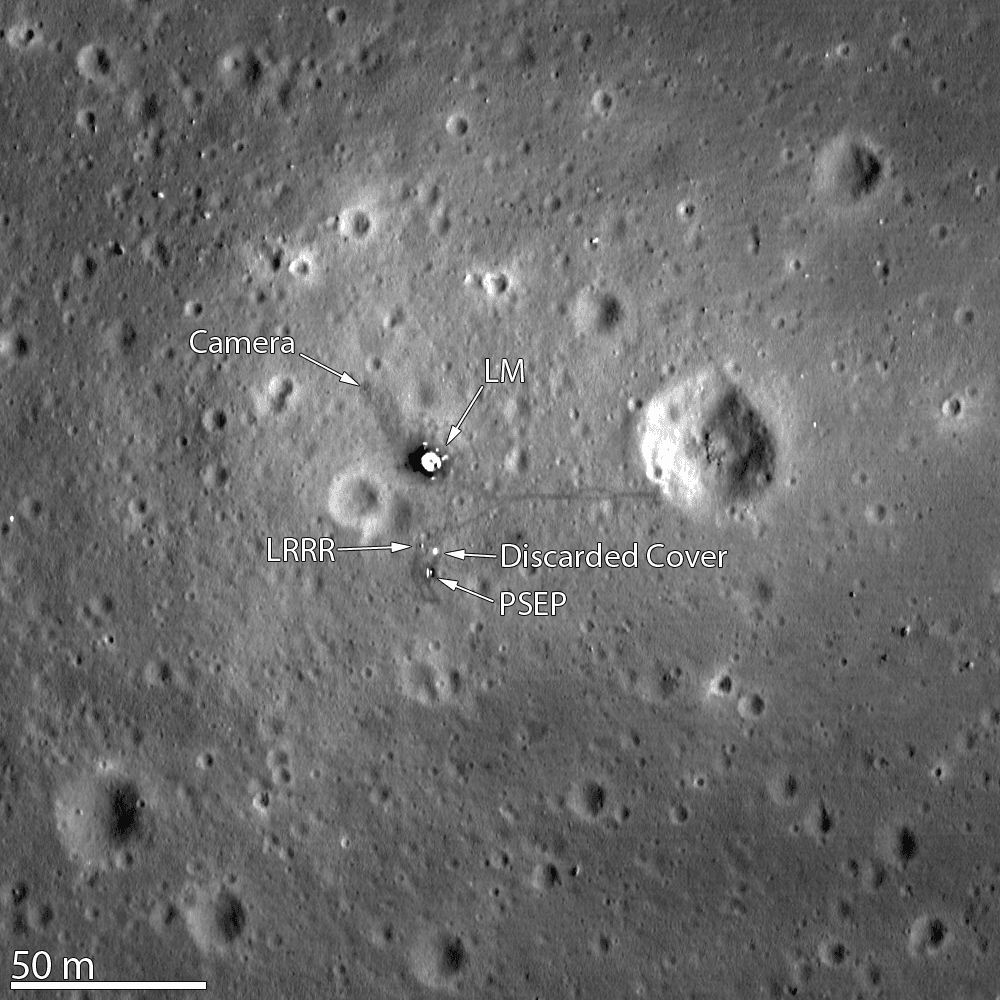
The third strand is photographic, and it is the one anyone can inspect. NASA's Lunar Reconnaissance Orbiter launched on 18 June 2009, and within weeks its Narrow Angle Camera had photographed five of the six landing sites in three days, the descent stages showing at first mostly as long shadows. In August 2011 its orbit was lowered so that the closest approach, about 22 km above the ground, fell over some of the Apollo sites, and the images sharpened to around 25 to 50 centimetres a pixel. At Tranquility Base the paths Armstrong and Aldrin trampled show as dark trails linking the lunar module, the seismometer and the laser reflector, with one trail running about 50 metres east to Little West crater, where Armstrong went to look inside near the end of the moonwalk. At the Apollo 12 site in the Ocean of Storms two missions share one frame: the Intrepid descent stage and the Surveyor 3 robot lander, which Conrad and Bean walked over to and took parts from about two and a half years after it arrived. At Apollo 17 the rover sits in its final parking spot. In July 2012 the camera's principal investigator, Mark Robinson, reported that the flags were still standing and casting shadows at every site except Apollo 11, where Aldrin had seen the flag blown over at liftoff; in images taken at different times of day, a flag's shadow can be watched circling it. LRO has kept working: on 16 September 2026 its camera team published images of a crater that formed in 2024, gathered over six months of observations that began in late summer 2025.
Three other space agencies have looked for themselves. On 20 May 2008 Japan's JAXA reported that the Terrain Camera on Kaguya had picked out, at the Apollo 15 site near Hadley Rille, what it identified as a patch of ground brightened by the lunar module's descent engine, a halo that also shows in the Apollo crew's own before and after photographs. The camera's 10 m resolution could not show the lander itself, so JAXA did something just as telling: it rebuilt the landscape in three dimensions from its own stereo images and rendered the view from the spot where an Apollo 15 astronaut had stood, and the shapes of the distant mountains closely matched the astronaut's photograph. India's Chandrayaan-2 orbiter carries the Orbiter High Resolution Camera, whose resolution ISRO gives as 28 centimetres on its data portal and 32 on its mission page. On 2 April 2021 it imaged the Apollo 11 site and on 5 April the Apollo 12 site. The frames are in ISRO's PRADAN archive, open to anyone who registers, and independent image processors working from them have found both descent stages. This page could not find an ISRO press release about the frames; the data themselves are the record. Korea's Danuri came next: its high-resolution camera photographed the Apollo 11 site on 30 March and 10 May 2023, and the frames, published on the Korea Aerospace Research Institute's Danuri website that September, mark the lunar module.
The flights were also followed from the ground as they happened, by observatories and amateur astronomers. When Apollo 8 left Earth orbit on 21 December 1968, a Smithsonian Astrophysical Observatory tracking camera on Maui photographed the burn, and amateur astronomers in England photographed the propellant cloud the spent third stage vented a few hours later; Sky and Telescope gathered many such reports for the early missions. During Apollo 11 a 50 cm refractor at Chabot Observatory in California detected the spacecraft outbound, and a 60 cm telescope at Table Mountain photographed it on the way home on 24 July. In England the telescopes at Jodrell Bank were tracking both Eagle and the Soviet robot Luna 15, which was trying to beat Apollo 11 home with a scoop of soil. Jodrell's recordings, released in 2009, have Sir Bernard Lovell narrating, with the Apollo 11 astronauts audible in the background, as Luna 15 comes down too fast and crashes at 15:50 on 21 July, a few hours before Eagle lifted off. As for the Soviet side, the cosmonaut Alexei Leonov told RIA Novosti in 2009 that a small group of Soviet space specialists watched the American broadcast of Armstrong and Aldrin on the surface over a closed channel run by a military unit in Moscow, while it was withheld from the Soviet public, and that only absolutely ignorant people could seriously believe the Americans had not been there. Leonov was describing the television feed, and he is not a flawless witness: in the same interview he repeated a story that a few scenes, such as Armstrong climbing down the ladder, were filmed later in a studio, when that climb was televised live from a camera mounted on the lander, as the Apollo Lunar Surface Journal records. Claims that Soviet ground stations independently tracked the Apollo spacecraft are often repeated, but this page found no primary Soviet record of such tracking and rests nothing on it.
Some of the science was built around people standing there. On Apollo 16 in 1972 the crew set up a far-ultraviolet camera and spectrograph from George Carruthers of the US Naval Research Laboratory in the shadow of the lunar module to point at targets that included Earth's outer hydrogen halo, the Milky Way, nebulae and star clusters; NASA's archive describes it as the first planetary-based astronomy observatory, and its film was carried home for analysis. On Apollo 11 Aldrin unrolled a sheet of aluminium foil for Johannes Geiss's solar wind experiment from the University of Bern, and it too came back for laboratory analysis. The seismometers kept working after the crews left: the Apollo 12 package, for one, sent data for more than seven years until it was switched off in September 1977.
That leaves the objections, and they deserve a calm answer, because most begin from a reasonable instinct about how things ought to look. The Van Allen belts are real zones of trapped protons and electrons, and NASA's planners worried about them before anyone flew. The plan was to cross them quickly and to measure. The crews carried dosimeters, and the average skin doses, published by J. Vernon Bailey of Johnson Space Center in 1975, run from 0.16 rad on Apollo 7 and 8 to 1.14 rad on Apollo 14, with Apollo 11 at 0.18 rad, against a mission limit of 400 rad. Those numbers sit well below the 5 rem a year then allowed for American radiation workers, and the report notes they stayed small partly because no major solar particle event happened during Apollo 7 to 17.
The flag looks as if it is flying because it was built to. Anne Platoff's 1993 NASA history of the lunar flag explains that the assembly had a horizontal crossbar to give the illusion of a flag in a breeze, since there is no air to hold one out. On Apollo 11 the telescoping crossbar would not extend fully, which left the ripples everyone remembers, and later crews left it partly retracted on purpose. The stars are missing for the same reason they are missing from a photograph of a floodlit sports ground at night. Surface photographs were taken at 1/250 of a second at f/5.6 to f/11, settings for a sunlit landscape, far too short to register faint stars. Venus, much brighter than any star, does appear in a series of Apollo 14 frames and in Apollo 16 frames, and the far-ultraviolet camera was the tool Apollo used when it wanted the sky. Shadows that are not parallel come from perspective: as Anu Ojha of the UK's National Space Centre explained in a 2019 lecture at Greenwich, parallel lines stop looking parallel when a three-dimensional scene is flattened into a picture, and shadows on Earth do the same when the Sun is low. The small crosses on the Hasselblad surface photographs come from a glass réseau plate, engraved with calibrated crosses and mounted just in front of the film. And nobody can settle the matter with the Hubble Space Telescope, because at the Moon's distance it can pick out only objects about 100 metres across, and about 40 metres even at its theoretical limit; seeing the hardware takes a camera in lunar orbit.
None of this asks anyone to take an agency's word. The LRO camera's data products are in NASA's Planetary Data System and in the public domain. The laser ranging archive is public, and the reflectors answer anyone with a large enough telescope and a pulsed laser, which is how Yunnan joined in 2018. Researchers can apply to NASA's curation office for Apollo samples, and the Soviet and Chinese collections give laboratories independent material to compare. What all of it supports, as of September 2026, is what the record has said since December 1972: six landings, twelve people on the surface, and a trail of physical traces that grows each time a new instrument looks.
What we know
What came back
The six landings returned 382 kg (842 lb) of rocks, core samples, pebbles, sand and dust, in about 2,200 separate samples from six sites, and NASA's curation office says it distributes nearly 400 samples a year for research and teaching (on a page last updated in August 2023). For comparison, three automated Soviet spacecraft, Luna 16, Luna 20 and Luna 24, returned about 300 grams from three other sites, which gave the Soviet Union its own lunar soil to set beside anything the Americans produced.↗
What the first examiners found
The 1969 preliminary examination of the Apollo 11 samples reported: no hydrated minerals at all; a probable iron, iron sulfide and ilmenite assemblage which, with the missing water-bearing minerals, showed the rocks formed at extremely low oxygen, water and sulfur pressures; glass-lined pits on the surfaces of all the rocks, clearly of external origin, though the team could not yet say what made them; large amounts of noble gases with the element and isotope ratios of the solar wind, even inside breccias; cosmic-ray-produced nuclides showing 20 to 160 million years within a metre of the surface; and crystallisation ages of 3 to 4 billion years.↗
A geochemist's verdict
Randy Korotev of Washington University in St. Louis, who has studied lunar rocks and soils for more than 50 years, writes that he could not make even a poor imitation of a lunar breccia, soil or mare basalt in the lab, and that no government laboratory could either. He lists formation in an extremely dry environment with essentially no free oxygen, solar-wind gases with non-terrestrial isotope ratios, cosmic-ray crystal damage and crystallisation ages older than any known Earth rock.↗
Mass by mission
NASA's Lunar Meteorite Compendium gives the Apollo returns as 21.5 kg from Apollo 11, 34.4 kg from Apollo 12, 42.3 kg from Apollo 14, 77.3 kg from Apollo 15, 95.7 kg from Apollo 16 and 110.5 kg from Apollo 17, 381.7 kg in all (after Vaniman and colleagues, 1991).↗
Apollo soil in Soviet hands
On 10 June 1971, at the USSR Academy of Sciences in Moscow, NASA's Lee Scherer received 3 grams of Luna 16 soil from Academician A. P. Vinogradov, the Academy's vice president, and presented the Academy with 6 grams of material collected by the Apollo 11 and Apollo 12 crews.↗
Chinese samples, same Moon
In 2021 a Chinese-led team (Li Qiu-Li and colleagues, Nature 600:54-58) dated basalt returned by Chang'e-5 at 2,030 plus or minus 4 million years, at the time the youngest crystallisation age reported for a lunar basalt by radiometric dating, and found its mantle source's uranium-lead signature (a mu value near 680) within the range of the low-titanium and high-titanium basalts from the Apollo sites.↗
Why they cannot be lunar meteorites
The first rock recognised as a lunar meteorite, Allan Hills A81005, was found in Antarctica on 18 January 1982, more than nine years after the last Apollo mission. Scientists were already studying Apollo 11 samples in the autumn of 1969, when nobody knew lunar meteorites existed on Earth.↗
The reflectors
Apollo 11 and Apollo 14 each left a panel of 100 fused-silica corner-cube prisms, 3.8 cm across, in a 10 by 10 grid; Apollo 15 left a larger array of 300. The Soviet rovers Lunokhod 1 and Lunokhod 2 carried smaller arrays of 14 larger cubes, and both were still being ranged in 2024, according to the Paris Observatory's compilation. So a reflector alone proves hardware was placed, but cannot say who placed it.↗
First echoes, and who else ranged
On 1 August 1969 the Lick Observatory's 3.0 m telescope in California obtained strong returns from the Apollo 11 reflector and measured its range with an accuracy of about 7 m; McDonald Observatory in Texas followed. By 1973 successful ranging to the Apollo 11 reflector had also been reported from an Air Force observatory in Arizona, the Pic du Midi Observatory in France and the Tokyo Astronomical Observatory in Japan.↗
Reflector versus bare ground
Laser light does come back from the bare Moon: MIT caught echoes from the lunar surface in 1962, and the Soviet Crimean Astrophysical Observatory reported similar measurements. But a laser from Earth lights a spot 4 to 6 km wide, and a reflector panel inside it returns 10 to 100 times more light than the surrounding surface, which is what makes precise ranging practical.↗
Fifty-five years of ranging
The Paris Observatory Lunar Analysis Center's compilation holds 35,069 lunar laser ranging observations from 1969 to 21 December 2024; 30,304 of them are to the three Apollo arrays, with Apollo ranges in every year of that span. In 2024 the Côte d'Azur Observatory at Grasse made 667 of them, Apache Point Observatory in New Mexico 101, and Matera in Italy 19.↗
China joins the ranging
On the night of 22 January 2018 a team at the Chinese Academy of Sciences' Yunnan Observatories used a 1.2 m telescope laser ranging system to detect returns from the Apollo 15 reflector several times, China's first lunar laser ranging. The report, from Science and Technology Daily as republished by CNSA, in the original: "2018年1月22日晚,该团组利用1.2m望远镜激光测距系统,多次成功探测到月面反射器Apollo15返回的激光脉冲信号".↗
LRO at the sites
From about 24 km up, LRO's Narrow Angle Camera shows the paths Armstrong and Aldrin walked as dark trails between the lunar module, the Passive Seismic Experiment and the Laser Ranging RetroReflector, plus a trail about 50 m east to Little West crater. The camera also caught the discarded cover of the reflector.↗
The flags
LROC principal investigator Mark Robinson reported on 27 July 2012 that time series of images taken at different times of day show the American flags still standing and casting shadows at every Apollo site except Apollo 11, where Buzz Aldrin had reported seeing the flag blown over by the ascent engine exhaust.↗
Japan's check
On 20 May 2008 JAXA reported that the Terrain Camera on Kaguya had picked out, at the Apollo 15 site, what it identified as a patch brightened by the lunar module's engine exhaust. JAXA's original: "アポロ15号のエンジンの噴射によって、表面の状態が変わり明るくなった「ハロー(噴射跡)」とみられるものが確認できます". The camera's 10 m resolution was too coarse to show the lander, so JAXA rebuilt the landscape from its stereo data and matched it to Apollo 15 photograph AS15-82-11122.↗
India's check
Chandrayaan-2's Orbiter High Resolution Camera covers a 3 km swath at a resolution ISRO gives as 28 cm on its data portal and 0.32 m on its mission page. It imaged the Apollo 11 site on 2 April 2021 and the Apollo 12 site on 5 April 2021. The frames are in ISRO's PRADAN archive, open to registered users, and independent processing of them shows both descent stages. This page found no ISRO press release about these frames.↗
Korea's check
Korea's Danuri orbiter photographed the Apollo 11 site with its high-resolution camera on 30 March and 10 May 2023, and the frames were published on the Korea Aerospace Research Institute's Danuri website on 27 September 2023 with the lunar module marked. The original title: "[고해상도카메라] 아폴로 11호 착륙지점" (high-resolution camera: Apollo 11 landing site); the label on the image: "아폴로11 착륙선 (Lunar Module)".↗
Tracked from England
In July 1969 Jodrell Bank's telescopes were tracking Apollo 11's Eagle and the Soviet Luna 15 at the same time. Recordings released on 3 July 2009 capture Sir Bernard Lovell narrating, with the Apollo 11 astronauts' transmissions audible in the background, as Luna 15 comes down too fast and crashes, at 15:50 on 21 July, a few hours before Eagle lifted off.↗
What a Soviet cosmonaut said
Alexei Leonov told RIA Novosti in July 2009 that a small group of Soviet space specialists watched the American broadcast of Armstrong and Aldrin on the surface over a closed channel provided by military unit 32103 in Moscow, while it was withheld from the Soviet public. In the original: "Всерьез верить в то, что американцы не были на Луне, могут только абсолютно невежественные люди" (only absolutely ignorant people can seriously believe the Americans were not on the Moon). In the same interview he also claimed, without evidence, that a few scenes were filmed later in a studio.↗
The radiation the crews took
Average skin doses measured on the crews, published by J. Vernon Bailey of Johnson Space Center in 1975, ranged from 0.16 rad (Apollo 7 and 8) to 1.14 rad (Apollo 14), with 0.18 rad on Apollo 11. The mission limit was 400 rad to the skin. The report concludes that radiation was not an operational problem during Apollo, and notes that no major solar particle event occurred during Apollo 7 to 17.↗
What happened, and when
- 21 Dec 1968As Apollo 8 leaves Earth orbit, a Smithsonian Astrophysical Observatory tracking camera on Maui photographs the translunar injection burn, and amateur astronomers in England photograph the propellant cloud vented by the spent third stage.
- 20 to 21 Jul 1969Jodrell Bank tracks Apollo 11's Eagle and the Soviet Luna 15 at once. Luna 15 crashes at 15:50 on 21 July, a few hours before Eagle lifts off.
- 1 Aug 1969The Lick Observatory in California receives strong laser returns from the Apollo 11 reflector, measuring its range with an accuracy of about 7 m. McDonald Observatory follows soon after.
- 1969NASA publishes the Apollo 11 Preliminary Science Report (SP-214): no hydrated minerals, glass-lined surface pits, solar-wind gases, cosmic-ray exposure ages of 20 to 160 million years.
- 10 Jun 1971In Moscow NASA gives the USSR Academy of Sciences 6 grams of Apollo 11 and 12 material and receives 3 grams of Luna 16 soil.
- 18 Jan 1982Allan Hills A81005 is found in Antarctica, the first rock recognised as a lunar meteorite, nine years after the last Apollo landing.
- 20 May 2008JAXA reports that Kaguya has picked out what it identifies as the brightened halo left by the Apollo 15 lunar module's engine near Hadley Rille.
- Jul 2009Weeks after launch, LRO's camera photographs five of the six Apollo sites in three days; descent stages and their long shadows are visible.
- 27 Jul 2012The LROC team reports that the flags are still standing and casting shadows at every Apollo site except Apollo 11.
- 22 Jan 2018China's Yunnan Observatories detects laser returns from the Apollo 15 reflector with a 1.2 m telescope, China's first lunar laser ranging.
- 2 and 5 Apr 2021Chandrayaan-2's Orbiter High Resolution Camera images the Apollo 11 and Apollo 12 sites; the frames are later released through ISRO's PRADAN archive to registered users.
- 19 Oct 2021A Chinese-led team dates Chang'e-5 basalt at 2,030 million years and finds its mantle source within the range of the Apollo basalts.
- 30 Mar and 10 May 2023Korea's Danuri photographs the Apollo 11 site with its high-resolution camera; the frames are published on 27 September 2023 with the lunar module marked.
- 21 Dec 2024The last observation in the Paris Observatory's public lunar ranging compilation; 787 of that year's range measurements went to the Apollo reflectors.
- 16 Sep 2026The LRO camera team publishes images of McGetchin, a crater that formed in 2024, from a Narrow Angle Camera campaign that ran for six months from late summer 2025, showing the orbiter still at work.
In pictures
Tap a photo to enlarge.
Sources
- NASA Astromaterials curation: Lunar Rocks and Soils from Apollo Missions (382 kg, about 2,200 samples, Soviet robotic returns of about 300 g)
- NASA curation: Lunar Meteorite Compendium introduction (Apollo mass by mission, after Vaniman et al. 1991)
- NASA SP-214, Apollo 11 Preliminary Science Report (1969), including the Lunar Sample Preliminary Examination Team summary
- Randy Korotev, Washington University in St. Louis: How do we know that it is a rock from the Moon?
- NASA History: 50 Years Ago, Three Weeks Until Apollo 14 (Vinogradov at the Second Lunar Science Conference, January 1971)
- NASA on The Commons: US and USSR Exchange Lunar Samples, Moscow, 10 June 1971
- Li, Q.-L. et al., Two-billion-year-old volcanism on the Moon from Chang'e-5 basalts, Nature 600:54-58 (2021)
- Bender, P. L. et al., The Lunar Laser Ranging Experiment, Science 182:229-238 (19 Oct 1973), scan hosted by the APOLLO project, UC San Diego
- APOLLO project (Tom Murphy, UC San Diego): Lunar Retroreflectors
- Paris Observatory Lunar Analysis Center (POLAC): LLR observations from 1969 to 21 December 2024 (data file TOTALOBS6924.DAT, counted by reflector, station and year)
- ILRS: Lunar laser ranging reflectors and stations
- CNSA (23 Jan 2018), republishing Science and Technology Daily: 中国科学院云南天文台国内首次实现月球激光测距 (Yunnan Observatories achieves China's first lunar laser ranging)
- LROC (Mark Robinson, 7 Mar 2012): A Stark Beauty All Its Own, Apollo 11 low-altitude image
- LROC: Pinpoint Landing on the Ocean of Storms, Apollo 12 low-altitude image
- LROC (Mark Robinson, 6 Sep 2011): Skimming the Moon, Apollo 17 low-periapsis image
- LROC (Mark Robinson, 27 Jul 2012): Question Answered! (Apollo flags still standing)
- ASU News: LROC takes first look at Apollo landing sites (July 2009)
- LROC (16 Sep 2026): Spectacular McGetchin Crater, showing LRO still imaging
- JAXA press release (20 May 2008, Japanese): 月周回衛星「かぐや(SELENE)」の地形カメラによる、アポロ15号の着陸地点付近の撮影について
- JAXA press release (20 May 2008, English version)
- ISRO Chandrayaan Data Explorer (OHRC specification: 28 cm resolution, 3 km swath)
- ISRO: Chandrayaan-2 science payloads (OHRC ground resolution 0.32 m over 12 km by 3 km)
- Marty McGuire: processing Chandrayaan-2 OHRC frames of the Apollo 11 and 12 sites (PRADAN file IDs)
- KARI Danuri website (27 Sep 2023, Korean): [고해상도카메라] 아폴로 11호 착륙지점 (Danuri high-resolution camera: Apollo 11 landing site), Internet Archive copy of 24 Dec 2024; the live page no longer loads
- Jodrell Bank Centre for Astrophysics (3 Jul 2009): Recording of Russia's lunar gatecrash attempt released
- Bill Keel, University of Alabama: Telescopic Tracking of the Apollo Lunar Missions
- RIA Novosti (20 Jul 2009, Russian): interview with Alexei Leonov
- Bailey, J. V., Radiation Protection and Instrumentation, in Biomedical Results of Apollo, NASA SP-368 (1975)
- Platoff, A. M., Where No Flag Has Gone Before, NASA Contractor Report 188251 (1993)
- Apollo Lunar Surface Journal: One Small Step (Apollo 11; the MESA television camera that showed Armstrong's climb down the ladder, and Aldrin deploying the solar wind foil)
- Apollo Lunar Surface Journal: Apollo 15 Map and Image Library (AS15-82-11122, Station 9a)
- Apollo Lunar Surface Journal: Photographing Stars
- NASA Earth Observatory blog: Where are the stars?
- Royal Museums Greenwich: Moon landing conspiracy theories, debunked
- ESA/Hubble FAQ: Can Hubble take a picture of the landing site of the Apollo missions?
- NASA NSSDCA: Apollo 16 Far-Ultraviolet Camera/Spectroscope
- NASA NSSDCA: Apollo 11 Solar Wind Composition experiment
- NASA History: Astronaut Still Photography During Apollo (the réseau plate)
- LROC Terms of Use and Citation Policy
Checked on 23 September 2026. Where the science is unsettled this page says so rather than picking a winner.