Moonquakes
The Moon does quake, and almost everything known about it comes from Apollo seismometers that listened from 1969 to 1977. As of 23 September 2026 no seismometer is known to be working on the Moon: India's ILSA recorded for about nine days in 2023, and the next instruments (NASA's LEMS and Farside Seismic Suite, Fleet Space's SPIDER and a seismometer on China's Chang'e 7) are all still on Earth without a fixed launch.
TL;DR· 23 min read
The Moon quakes in four ways: deep tidal quakes 800 to 1,000 km down, shallow tectonic quakes up to about magnitude 5, thermal quakes at sunrise and sunset, and impacts. Apollo's seismometers recorded them from 1969 to 1977, including 28 shallow quakes that later work links to young faults from a slowly shrinking Moon, which now matters for choosing landing sites. The next seismic record after Apollo came from India's ILSA, over about nine days in 2023, and as of September 2026 the next instruments are still waiting for rides.
Yes, the Moon has quakes. Seismometers left by Apollo astronauts recorded thousands of them between 1969 and 1977, and they come in four kinds: deep quakes 800 to 1,000 km down that keep time with Earth's tides, shallow quakes near the surface that reach about magnitude 5, thermal quakes as the ground bakes and freezes, and the shaking from impacts, including nine that NASA caused on purpose by crashing spent rocket stages and lunar module ascent stages. Almost all of them are far too small to feel. The few strong ones are the reason the subject has moved from pure science to landing-site planning, because a leading explanation, argued by Thomas Watters and colleagues, ties them to young faults that formed as the Moon cooled and shrank, and some of those faults run through places people want to land. What nobody has yet is a new record: the Apollo network was switched off on 30 September 1977, and the next lunar seismic data, which researchers describe as the first since Apollo, came from India's ILSA over about nine days in 2023.
- shallow moonquakes recorded by the Apollo seismometers, 1969 to 1977
- 28shallow moonquakes recorded by the Apollo seismometers, 1969 to 1977
- how long the Moon kept shaking after Apollo 12's lunar module ascent stage hit it
- 55 minhow long the Moon kept shaking after Apollo 12's lunar module ascent stage hit it
- magnitude of the strongest shallow moonquakes, on NASA's estimates
- ~5magnitude of the strongest shallow moonquakes, on NASA's estimates
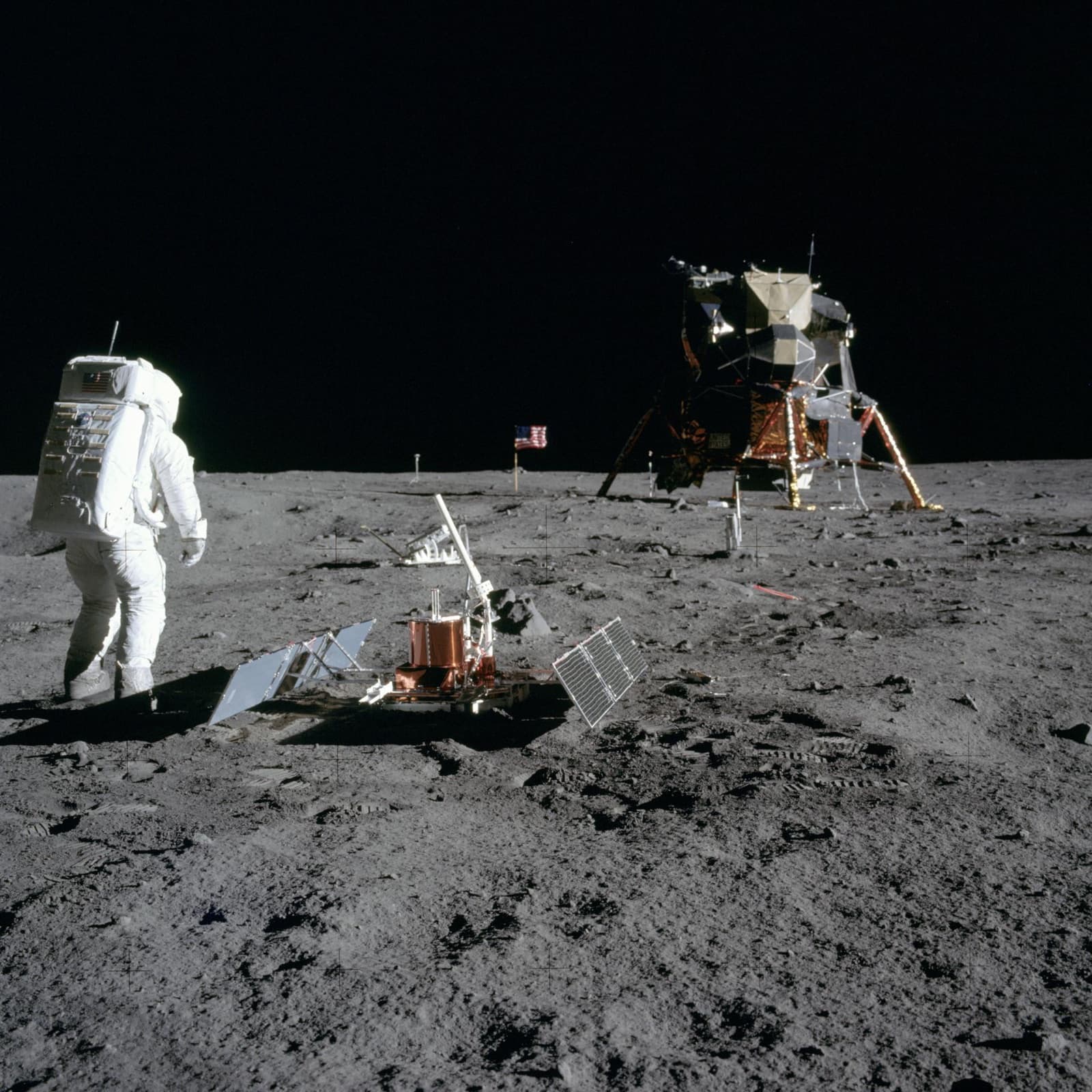
The Moon quakes, and people have known it since the week of the first landing. During the first moonwalk in July 1969 Buzz Aldrin set a small, solar-powered seismometer on the ground at Tranquility Base, and it was switched on while he and Neil Armstrong were still outside. Over the next eight years instruments at four more landing sites recorded thousands of events, and between them they sorted the Moon's shaking into four kinds. Deep moonquakes happen 800 to 1,000 km down and keep time with Earth's tides. Shallow moonquakes happen near the surface and are the ones strong enough to worry anyone planning to build there. Thermal moonquakes are small cracks and slips as the ground swings between the frigid lunar night and the hot day. And impacts, from meteoroids and, for a few years, from hardware NASA crashed into the Moon on purpose, shake the ground from outside. Almost all of this is tiny. The team's 1973 report put the moonquakes it had recorded at Richter magnitude 2 or less, at rates of 600 to 3,000 a year per station. The exceptions, the strongest of 28 shallow quakes at about magnitude 5, are why a subject that was once about the Moon's interior is now also about where to land.
The listening post was more modest than the results suggest. Apollo 11's seismometer ran on solar panels, slept through its first lunar night and stopped taking commands on 27 August 1969. The long record came from the experiment packages left by Apollo 12, Apollo 14, Apollo 15 and Apollo 16, which ran on radioisotope generators and did not need the Sun. They formed a rough triangle about 1,100 km on a side across the nearside, each with three long-period sensors and one short-period sensor, sensitive enough, the team wrote, to register ground motion of 0.05 nanometres. The Apollo 12 station started work on 19 November 1969, and on 30 September 1977 the whole network was shut down. Almost everything on this page about natural moonquakes rests on those eight years and a handful of nearside instruments designed in the 1960s, and scientists are still finding new things in the tapes.
The strangest discovery came on the Apollo 12 station's second day. On 20 November 1969, after Pete Conrad and Alan Bean had rejoined Richard Gordon in lunar orbit, controllers sent the empty ascent stage of their lunar module into the surface, 2,383 kg at 1.68 km/s, skimming in at 3.7 degrees, about 76 km from the new seismometer. On Earth a jolt like that would give a sharp arrival and a quick fade. The Moon gave a signal that grew for about 7 minutes and faded so slowly that the total ran to about 55 minutes, without the familiar sequence of seismic waves an earthquake produces. "It was very peculiar," Yosio Nakamura, a member of the team, recalled in 2019, "nothing like any signal produced here on Earth." At the announcement, according to the University of Texas Institute for Geophysics, Maurice Ewing of Lamont-Doherty Geological Observatory reached for an image: "It is as though one had struck a bell, say, in the belfry of a church, and found that the reverberation from it continued for thirty minutes." That sentence is the source of the popular line that the Moon 'rang like a bell'; the words are Ewing's, and the recorded signal ran well past his thirty minutes (about 55 minutes in the team's 1970 report, over an hour in the Texas institute's retelling).
In 1970 the team weighed scattering against a near-surface waveguide, and by 1973 it had settled on an explanation that has held up. The Moon's outer rock is almost perfectly dry, so seismic waves lose very little energy as they travel, and it is intensely fractured, so the waves scatter back and forth instead of passing cleanly through. On Earth, water in rock damps vibration quickly; on the Moon there is almost none to do it. To learn more, NASA turned spent hardware into seismic sources. From Apollo 13 onward the Saturn IVB third stage, emptied after sending the crew toward the Moon, was steered into the surface: the Apollo 13 stage, nearly 14 tonnes at 2.58 km/s, hit 135 km from the Apollo 12 station on 15 April 1970 (still 14 April in US time zones), and NASA compared the Apollo 14 stage's impact to 11 tons of TNT. More lunar module ascent stages followed the one from Apollo 12. By the end, the Apollo 17 report counts nine artificial impacts recorded by the network, each with a known time, place and energy, which is exactly what a seismologist needs to calibrate a planet. Apollo 14 and 16 also carried active seismic experiments, and Apollo 17 laid out eight explosive packages of 57 to 2,722 g, detonated from Earth after the crew had gone, which mapped about 1.2 km of lava fill under the Taurus-Littrow valley.
The deep moonquakes turned out to run like clockwork. Many signals matched each other almost exactly, as if the same patch of rock had failed again and again, and by 1971 the team had seen that they arrived in bursts once a month, near perigee, when the Moon is closest to Earth. The final summary of the experiment put them between about 800 and 1,000 km down. Earth's tide squeezes and relaxes the Moon's interior on each orbit, and these quakes are the interior answering. They are also where the Moon keeps one of its open questions. Almost all the deep sources that could be located are on the nearside. In 2005 Nakamura identified about 30 source regions that are probably on the farside, and concluded that either the deep interior on the far side is nearly aseismic, or something very deep in the Moon absorbs or bends the waves before they reach nearside stations (the Apollo team had suggested in 1973 that a deep central zone, possibly partly molten, stops or weakens shear waves from far-side sources). He leaned, cautiously, toward the second, on limited data. New instruments are meant to help settle it: explaining why Apollo heard so few far-side quakes is a stated goal of NASA's Farside Seismic Suite, and comparing the nearside and farside interiors is a goal of the seismometer on Chang'e 7, in the words of the Chinese Academy of Sciences academician Wu Fuyuan.
Thermal moonquakes are the Moon's background crackle, and part of that crackle comes from the hardware astronauts left behind. A lunar day lasts about a month, and the swing from night to day heats and cools the surface enough to crack rock and set loose regolith sliding. The Apollo team saw it early: its 1973 report described thousands of small signals on the short-period seismometers, tied closely to lunar sunrise and sunset, and listed the lunar module descent stages and other equipment left at each site among the likely sources. When Tamama, Civilini and colleagues sorted more than 12,000 thermal events in the Apollo 17 geophone record in 2025, they found that the repeating ones clustered around early sunrise and came mostly from the east, where the lunar module's descent stage had been left standing. Many of those, in other words, were probably the lander ticking as it warmed. Other events look like rock cracking or regolith sliding down crater slopes, and they linked 45 to several boulders near the site that may be cracking in the heat. Their paper warns future missions to expect the same repeating signals from their own hardware.
The shallow moonquakes are the ones that matter. The four long-running stations recorded 28 of them between 1969 and 1977, ranging from about 2 to around 5 on the Richter scale in NASA's summary, and NASA's Moon pages give the top of the range as 5.5 with shaking that can last more than 10 minutes. Watters and Schmerr call them the most energetic events the Apollo network recorded, although the team's 1973 report, with less of the record in hand, said meteoroid impacts had produced the largest signals up to then. There were probably more than the classic count: in 2024 Keisuke Onodera went back to the short-period records that had largely been set aside because of their noise, found 22,000 new events of all kinds, and concluded there were 2.6 times more tectonic events than previously thought, with the Apollo 15 site busier than the others. The weakness in all of it is geometry. Four stations on one side of the Moon locate a distant quake poorly, and for decades nobody could say with confidence where the shallow ones started.
The candidate that emerged is a shrinking Moon. The Moon has been losing heat since it formed, and as the interior cools it contracts, and a brittle crust answers by breaking along thrust faults, where one slab of crust is pushed up and over another. The result is a lobate scarp, a step-like cliff often tens of metres high. In 2010 Thomas Watters and colleagues used Lunar Reconnaissance Orbiter images to show these scarps are spread across the whole Moon and are among its youngest landforms, crisp enough to cut small craters. By 2019 NASA said the orbiter's camera had imaged more than 3,500 of them, and it puts the shrinkage at more than about 50 metres over the last several hundred million years. In 2019 Watters and five co-authors reran the 28 Apollo shallow quakes through an algorithm designed for sparse networks. Eight epicentres landed within 30 km of a scarp, close enough for strong shaking, and six of those eight occurred when the Moon was near apogee, when tidal stress adds to the compression on these faults. They wrote that this, together with fresh boulder fields and disturbed soil on the scarps, strongly suggests the Moon is tectonically active today. That is a strong case built on an inference: 20 of the 28 quakes do not fall within 30 km of a known scarp, the epicentres still carry wide uncertainty, and the argument rests on locations and timing rather than on a quake caught on a mapped fault by a nearby instrument. The sources of the stress are still being worked out. Watters's group models global contraction plus Earth's tides, and Nypaver and Thomson, mapping 1,116 recently active wrinkle ridge segments on the maria in 2022, found orientations that match predicted stresses from both contraction and the Moon's slow outward drift from Earth, plus reactivation of old structures tied to the South Pole-Aitken basin.
Whatever the exact mix, the faults are where people want to go. In January 2024 Watters and colleagues mapped a cluster of scarps in de Gerlache Rim 2, then one of NASA's candidate Artemis III landing regions near the south pole, and linked the largest to one of the strongest shallow moonquakes Apollo recorded, whose poorly located epicentre may fall there. Their model says a quake of about moment magnitude 5.3 could have built that scarp, with strong to moderate shaking out to at least 40 km, and that most steep slopes inside Shackleton crater could shed their regolith in light shaking if it is loose. In July 2025 Watters and Nicholas Schmerr turned the Apollo 17 valley into a record of past quakes. Boulders that rolled down the valley walls and a landslide across the floor, all sampled by Eugene Cernan and Harrison Schmitt and dated by cosmic-ray exposure, point to repeated shaking from the nearby Lee-Lincoln fault in quakes of at least magnitude 2.9 to 3.3. They estimate a magnitude 3 quake on that fault about once every 5.6 million years, so the chance of a hazardous one during any single day of a short visit is about 1 in 20 million, with the caveat that this is a lower limit. The warning is for things that stay: a 50 m tall lander like SpaceX's Starship would need about ten times less ground motion than a boulder to be at risk, so the advice is to keep landed assets and long-lived infrastructure away from young faults and away from slopes with perched boulders. In December 2025 Nypaver, Watters and colleagues published what they describe as the first global map of young small mare ridges, adding another inventory of possible shallow epicentres across the maria.
For all that, the Moon has had almost no seismometers since 1977. The attempts predate Apollo: Ranger 3, 4 and 5 in 1962 each carried a seismometer in a crash-cushioned capsule, and none got a working one onto the surface. The instrument that broke the silence, in the description of researchers who later reanalysed its data, was India's ILSA, built by ISRO's Laboratory for Electro-Optics Systems around silicon micro-machined accelerometers. The first unit was lost when Chandrayaan-2's lander crashed in 2019; the second landed on Chandrayaan-3 in August 2023 and recorded in the south polar region until 2 September. Its team reported more than 250 distinct signals, about 200 matched to the Pragyan rover's movements and instrument operations and about 50 unexplained, possibly from nearby micrometeorite hits, the soil heating, or the lander itself adjusting. An independent check by Keisuke Onodera and Taichi Kawamura in 2025 examined about 100 candidate natural events and found almost all tied to the rover, the instruments or the resonances of the lander and rover, with no positive evidence for a natural quake or impact. As of September 2026 it is fair to say ILSA proved a small seismometer can work on the Moon and heard a great deal of its own spacecraft, and that whether it caught the Moon itself is unresolved.
The next instruments are in hand or in development, and as of 23 September 2026 none has a firm ride. On 11 August 2026 NASA declared its Lunar Environment Monitoring Station complete: a self-contained seismometer suite from Goddard, with sensors from the University of Arizona and Silicon Audio, designed to work through the two-week lunar night without outside power or a heat source for between three months and two years. In August 2025 NASA described it as a payload for potential flight on Artemis III, but Artemis III is now planned as a test flight in low Earth orbit in 2027, with the first crewed landing moved to Artemis IV, and LEMS will stay in a Goddard clean room until it is assigned to a landing mission. The Farside Seismic Suite, whose very broadband sensor was built as a flight spare for NASA's InSight Mars lander, was due to go to Schrödinger basin on the far side, until Draper and NASA ended that delivery contract on 15 July 2026. Fleet Space's SPIDER seismometer is on Firefly's Blue Ghost Mission 2 to the far side, now set for no earlier than 2027. China's Chang'e 7 is to carry a seismometer to the south pole, and on 23 August 2026 China's crewed spaceflight office, in a notice reposted by CNSA, announced it could not launch in this year's window, without giving a new date. Fifty-seven years after Aldrin set his seismometer down, the Moon's quakes are better understood than ever, and for now, as far as the public record shows, nobody is listening to them.
What we know
The short answer
NASA describes four kinds of moonquake: deep quakes hundreds of miles down, caused by Earth's gravity stretching the Moon's interior; quakes from the Moon shrinking as it cools, at about 20 to 30 km depth, which it says can reach 5.5 on the Richter scale and last more than 10 minutes; quakes from meteoroid impacts; and extremely shallow thermal quakes as surface rock expands and contracts between the frigid night and the hot day.↗
The Apollo network
Stations at the Apollo 12, Apollo 14, Apollo 15 and Apollo 16 sites formed a rough triangle about 1,100 km on a side across the nearside (the Apollo 12 and 14 stations sat 181 km apart at one corner). Each carried four seismometers, three long-period and one short-period, and the team's 1973 report says they could detect ground motion as small as 0.05 nanometres at full sensitivity. By then each station was picking up 600 to 3,000 moonquakes a year, all of Richter magnitude 2 or less, and 70 to 150 meteoroid impacts a year, which the team said generated the largest signals.↗
Apollo 12's ascent stage impact
On 20 November 1969 the jettisoned ascent stage of Apollo 12's lunar module hit the Moon 75.9 km from the new seismometer, arriving only 3.7 degrees above the horizon. The signal built up for about 7 minutes and then faded gradually, for a total of about 55 minutes. The team wrote that the familiar pattern of body and surface waves seen in earthquake records was not observed, though there were some signs of body-wave arrivals early in the signal.↗
The bell, attributed precisely
The popular line that the Moon 'rang like a bell' is a paraphrase. The wording on record, reported by the University of Texas Institute for Geophysics, is Maurice Ewing's at the announcement of the Apollo 12 result: "It is as though one had struck a bell, say, in the belfry of a church, and found that the reverberation from it continued for thirty minutes." Ewing, of Columbia University's Lamont-Doherty Geological Observatory, had put one of his own students, Gary Latham, in charge of the seismic experiment. The same article says the signal in fact continued for over an hour; the team's 1970 report gave about 55 minutes.↗
Rocket stages as seismic sources
After Apollo 12, NASA kept steering spent hardware into the Moon as seismic sources: lunar module ascent stages once the crews had left them and, from Apollo 13, the Saturn IVB third stages. The team's 1971 report tabulates the first four, each with a known time, place and energy. The Apollo 13 stage, 13,925 kg at 2.58 km/s, struck at about 01:09:40 UT on 15 April 1970 (14 April in US time zones), 135 km from the Apollo 12 station; the Apollo 14 stage, 14,016 kg at 2.54 km/s, followed on 4 February 1971.↗
Why the Moon keeps shaking
The team's 1973 report put it down to the rock itself: with almost no water or other volatiles, seismic waves in the Moon's outer layer lose very little energy, while an intensely fractured, heterogeneous zone scatters them over and over. Most of the scattering happens in the outer several hundred metres, the Apollo 17 report says, but it may reach 10 to 20 km down.↗
Explosives on purpose
Apollo 14 and Apollo 16 carried active seismic experiments, and Apollo 17 extended them with the Lunar Seismic Profiling Experiment: eight explosive charges from 57 to 2,722 g, set out 100 to 2,700 m from a geophone array and detonated by command from Earth after the crew left. With the lunar module impact, they showed a valley floor of about 248 m of material at 250 m/s over a layer at 1,200 m/s down to about 1.2 km, then rock at about 4,000 m/s. The same report counts nine artificial impacts recorded by the network, ending with Apollo 17's own rocket stage and ascent stage.↗
Deep moonquakes and the tides
Many moonquake signals match each other almost exactly, as if the same source failed again and again. The team's 1971 report found nine sets of matching signals among the 208 recorded in the Apollo 12 station's first nine months, arriving at monthly intervals near perigee, the closest point in the Moon's orbit, with a smaller peak near apogee. It proposed that tidal stress triggers the release of strain inside the Moon.↗
How deep the deep quakes are
The final summary of the experiment (Nakamura, Latham and Dorman, 1982), written once the whole 1969 to 1977 record had been processed, placed the deep moonquakes rather sharply between about 800 and 1,000 km depth, concentrated near both boundaries. It also raised the estimated seismic velocities of the middle mantle, about 500 to 1,000 km down, above earlier values.↗
The far-side question
Yosio Nakamura found about 30 deep moonquake source regions likely to be on the farside, but few could be located. He concluded that either the deep interior within about 40 degrees of the point opposite Earth is nearly aseismic, or the very deep interior strongly attenuates or deflects seismic waves, and said some limited data favour the second. The question is still open.↗
Thermal moonquakes
Tamama, Civilini, Husker and Jackson (Journal of Geophysical Research: Planets, September 2025) sorted more than 12,000 thermal events in the Apollo 17 geophone record. Repeating events, common around early sunrise and arriving mostly from the east where the lunar module stood, are in many cases likely caused by thermal expansion of the lander or of volatiles trapped inside it; isolated events may be rock cracking or regolith sliding on crater slopes, and several boulders near the site may be the source of 45 events.↗
More quakes in the old tapes
Keisuke Onodera re-mined the little-used short-period Apollo records and reported 22,000 new seismic events, among them thermal quakes, impacts and shallow moonquakes, in the Journal of Geophysical Research: Planets in July 2024. He found 2.6 times more tectonic events than previously counted, with the Apollo 15 site more active than the Apollo 14 and 16 sites. The long-period catalogue already held more than 13,000 events.↗
Quakes placed next to young faults
Thomas Watters and five co-authors relocated the 28 shallow quakes with an algorithm built for sparse networks (Nature Geoscience 12:411-417, 13 May 2019). Eight epicentres fell within 30 km of a fault scarp, six of those eight happened when the Moon was within 15,000 km of apogee, and seven near-apogee events within 60 km of a scarp came near peak compressional stress. They concluded that this, with disturbed regolith and moved boulders on the scarps, strongly suggests the Moon is tectonically active.↗
The shrinking Moon
As the Moon's interior cools it contracts, and the brittle crust breaks along thrust faults where one section is pushed up and over another, leaving step-like cliffs called lobate scarps. NASA's 2019 release says the Lunar Reconnaissance Orbiter Camera has imaged more than 3,500 of them, puts the shrinkage at more than about 50 metres over the last several hundred million years, and says the 28 shallow moonquakes Apollo recorded ranged from about 2 to around 5 on the Richter scale.↗
The south pole
Watters and colleagues (Planetary Science Journal, 25 January 2024) found a cluster of lobate scarps in de Gerlache Rim 2, then an Artemis III candidate landing region, and linked the largest to one of the strongest shallow moonquakes Apollo recorded, whose poorly constrained epicentre may lie there. A quake of about Mw 5.3 could have formed it, with strong to moderate shaking out to at least about 40 km; most steep slopes in Shackleton crater are modelled as prone to regolith landslides.↗
The Apollo 17 valley as a quake record
Watters and Nicholas Schmerr (Science Advances, 30 July 2025) used four boulders and one landslide sampled by Apollo 17 to estimate past shaking from the Lee-Lincoln fault: repeated quakes of at least Mw 2.9 to 3.3. They estimate a magnitude 3.0 quake on that fault about every 5.6 million years, a chance of about 1 in 20 million of a hazardous quake on any given day, and warn that a 50 m tall lander would need ten times less ground motion than a boulder to be affected.↗
India's ILSA on Chandrayaan-3
ILSA, the Instrument for Lunar Seismic Activity, rode Chandrayaan-3's Vikram lander to the south polar region in August 2023 and ran until 2 September 2023, about 218 hours in all with 190 hours of usable data. Its team, publishing in Icarus in 2024, reported more than 250 distinct signals: about 200 matched to rover movements and instrument operations, and about 50 they could not match, possibly from nearby micrometeorite impacts, local heating of the soil or thermal adjustments inside the lander.↗
Did ILSA hear the Moon?
Keisuke Onodera and Taichi Kawamura (Earth and Space Science, September 2025), who describe ILSA's record as the first lunar seismic data since Apollo, examined about 100 natural moonquake candidates listed by the ILSA team and found almost all closely related to rover and instrument activity or to resonances of the lander and rover, with no positive evidence for a natural quake or impact. The ILSA team's unexplained signals and this reanalysis point different ways, and the question is open.↗
LEMS, status on 23 September 2026
On 11 August 2026 NASA declared its Lunar Environment Monitoring Station complete: a suitcase-size suite of two seismometers built at Goddard, with sensors from the University of Arizona and Silicon Audio, designed to work through the two-week lunar night without outside power or heating. It will stay in a Goddard clean room until it is assigned to an Artemis mission for deployment near the south pole.↗
The other instruments, status on 23 September 2026
The Farside Seismic Suite, bound for Schrödinger basin, lost its ride when Draper and NASA ended CLPS task order CP-12 on 15 July 2026. Fleet Space's SPIDER seismometer is on Firefly's Blue Ghost Mission 2 to the far side, set for no earlier than 2027. Chang'e 7, which carries a seismometer, was declared unable to launch in this year's window on 23 August 2026, with no new date given in that notice.↗
What happened, and when
- 26 Jan 1962Ranger 3 launches with a seismometer sealed in a capsule meant to rough-land at 130 to 160 km/h. It misses the Moon by about 36,800 km. Ranger 4 hits the far side dead in April and Ranger 5 misses by 725 km in October, so none of the three capsules reaches the surface.
- 21 Jul to 27 Aug 1969The Apollo 11 Passive Seismic Experiment Package, switched on while Armstrong and Aldrin are still outside, works through one lunar day and into a second before it stops accepting commands.
- 20 Nov 1969A day after the Apollo 12 station is switched on, the crew's discarded ascent stage hits the Moon about 76 km away. The signal builds for about 7 minutes and fades so gradually that it lasts about 55 minutes, nothing like an earthquake record.
- 15 Apr 1970The Apollo 13 Saturn IVB stage, nearly 14 tonnes, strikes 135 km from the Apollo 12 station at about 01:09 UT (14 April in US time zones), the first spent rocket stage used as a seismic source.
- 1971The team's Apollo 14 report describes sets of matching moonquake signals in the Apollo 12 station's record that arrive at monthly intervals near perigee, and proposes that tidal stress triggers them: the deep moonquakes.
- Dec 1972Apollo 17 sets out eight explosive charges for its seismic profiling experiment, and its rocket stage and ascent stage close a series of nine artificial impacts recorded by the network.
- 30 Sep 1977All Apollo surface stations, seismometers included, are shut down. The next lunar seismic data will come 46 years later.
- Aug 2010Watters and colleagues identify 14 young lobate thrust-fault scarps in Lunar Reconnaissance Orbiter Camera images, seven of them poleward of 60 degrees, and argue for late global contraction of the Moon.
- 13 May 2019Watters and colleagues place 8 of Apollo's 28 shallow moonquakes within 30 km of young fault scarps and argue the Moon is still tectonically active.
- Aug to Sep 2023ILSA on Chandrayaan-3's Vikram lander records more than 250 signals in the south polar region, most from the rover and instruments. Whether any are natural is still argued.
- 25 Jan 2024A study suggests one of Apollo's strongest shallow moonquakes may have come from a fault scarp in a south-polar candidate landing region, and models landslide-prone slopes in Shackleton crater.
- 30 Jul 2025Boulders and a landslide sampled by Apollo 17 are used to reconstruct repeated quakes on the Lee-Lincoln fault and to put numbers on the hazard to future outposts.
- 15 Jul 2026Draper and NASA end CLPS task order CP-12, the mission that was to carry the Farside Seismic Suite to Schrödinger basin.
- 11 Aug 2026NASA declares the Lunar Environment Monitoring Station complete, a seismometer suite for astronauts to set up near the south pole, and stores it until it is assigned to an Artemis mission.
- 23 Aug 2026The China Manned Space Engineering Office, in a notice CNSA reposts, says Chang'e 7, which carries a seismometer, does not meet launch conditions and cannot fly in this year's window.
In pictures
Tap a photo to enlarge.
Sources
- NASA Science: Moonquakes (page updated 12 Feb 2026)
- Apollo 12 Preliminary Science Report, NASA SP-235 (1970), section 3, Passive Seismic Experiment
- Apollo 14 Preliminary Science Report, NASA SP-272 (1971), section 6, Passive Seismic Experiment (manmade impact tables)
- Apollo 17 Preliminary Science Report, NASA SP-330 (1973), sections 10 and 11, Lunar Seismic Profiling and Passive Seismic Experiments
- Nakamura, Latham and Dorman, Apollo lunar seismic experiment: final summary (1982)
- Nakamura, Farside deep moonquakes and deep interior of the Moon, Journal of Geophysical Research 110, E01001 (2005)
- University of Texas Institute for Geophysics (19 Jul 2019): Yosio Nakamura and the birth of planetary seismology
- NSSDCA: Apollo 11 Lunar Module / EASEP
- NSSDCA: Apollo 12 Lunar Module / ALSEP
- NSSDCA: Ranger 3
- NSSDCA: Ranger 4
- NSSDCA: Ranger 5
- NASA image S71-17609 (4 Feb 1971): Maurice Ewing and David Lammlein during the Apollo 14 S-IVB impact, with caption naming Gary Latham as principal investigator
- Tamama, Civilini, Husker and Jackson, Classifying thermal moonquakes recorded in Apollo 17 lunar seismic data, JGR Planets 130, e2024JE008921 (Sep 2025)
- Onodera, New views of lunar seismicity brought by analysis of newly discovered moonquakes in Apollo short-period seismic data, JGR Planets 129, e2023JE008153 (Jul 2024)
- Watters, Robinson et al., Evidence of recent thrust faulting on the Moon revealed by the Lunar Reconnaissance Orbiter Camera, Science 329:936-940 (2010)
- Watters, Weber, Collins, Howley, Schmerr and Johnson, Shallow seismic activity and young thrust faults on the Moon, Nature Geoscience 12:411-417 (13 May 2019)
- NASA release 19-06 (13 May 2019): Shrinking Moon May Be Generating Moonquakes
- Watters, Schmerr, Weber, Johnson, Speyerer, Robinson and Banks, Tectonics and seismicity of the lunar south polar region, Planetary Science Journal 5 (25 Jan 2024)
- NASA (25 Jan 2024): Shrinking Moon Causing Moonquakes and Faults Near Lunar South Pole
- Watters and Schmerr, Paleoseismic activity in the Moon's Taurus-Littrow valley inferred from boulder falls and landslides, Science Advances (30 Jul 2025), doi 10.1126/sciadv.adu3201
- NASA (14 Aug 2025): NASA's Apollo Samples, LRO Help Scientists Forecast Moonquakes
- Nypaver, Watters, Banks, Clark and Frueh, A new global perspective on recent tectonism in the lunar maria, Planetary Science Journal 6 (Dec 2025)
- Nypaver and Thomson, New observations of recently active wrinkle ridges in the lunar mare, Geophysical Research Letters 49 (2022)
- John et al., Instrument for Lunar Seismic Activity studies on Chandrayaan-2 lander, Current Science 118(3):376-382 (2020)
- John et al., Identification and preliminary characterisation of signals recorded by ILSA at the Chandrayaan 3 landing site, Icarus 424 (2024)
- The Tribune / PTI (6 Sep 2024): Moon's seismic activity likely linked to past meteorite impacts or heat effects: ISRO
- Onodera and Kawamura, Analysis of Chandrayaan-3 lunar seismic data, Earth and Space Science 12, e2025EA004307 (Sep 2025)
- NASA (11 Aug 2026): NASA Completes Astronaut-Deployed Science Instrument for Lunar Surface (LEMS)
- NASA Science: Lunar Environment Monitoring Station (page updated 28 Apr 2026)
- NASA: Artemis III mission page (updated 12 Jun 2026)
- NASA JPL: Farside Seismic Suite
- NASA: CLPS delivery CP-12 (page updated 20 Feb 2026)
- ispace (15 Jul 2026): ispace-U.S. update on contract with Draper
- Firefly Aerospace: Blue Ghost Mission 2
- CNSA (23 Aug 2026): 嫦娥七号任务不满足发射条件 不能在今年预定窗口实施 (Chang'e 7 does not meet launch conditions and cannot fly in this year's window)
- ScienceNet.cn, from CCTV News (10 Jul 2025): 嫦娥七号2026年前后将发射,还会带地震仪上月球 (Wu Fuyuan on the Chang'e 7 seismometer)
Checked on 23 September 2026. Where the science is unsettled this page says so rather than picking a winner.