Moon Rocks and Samples
As of 22 September 2026, eleven missions have returned samples from the Moon: six Apollo landings (382 kg), three Soviet Luna robots (326 g in Russian accounts, about 300 g in NASA's) and China's Chang'e 5 and Chang'e 6 (about 1,731 g and 1,935.3 g). Lunar meteorites found on Earth outweigh them all: 2,036 kg across 832 named stones in Randy Korotev's list, updated 11 September 2026.
TL;DR· 19 min read
Eleven missions have brought the Moon to Earth: six Apollo landings returned 382 kg, three Soviet Luna robots a few hundred grams (326, 301 or 300 g depending on who counts), and China's Chang'e 5 and Chang'e 6 about 1,731 g and 1,935.3 g. Lunar meteorites outweigh all of it, at 2,036 kg across 832 named stones. The samples sit in nitrogen-filled cabinets in Houston and in stores in Beijing and Moscow and are lent to researchers by the gram and milligram; some goodwill gifts were stolen, and one sealed Apollo core waited until 2022 to be opened.
About 386 kilograms of the Moon has been brought to Earth on purpose: 382 kg by six Apollo crews between 1969 and 1972, and roughly 4 kg by five robots, three Soviet and two Chinese. Lunar meteorites that fell on their own outweigh all of it, with 2,036 kg across 832 named stones in the list kept by Randy Korotev of Washington University in St. Louis, updated on 11 September 2026. Those two sentences hide most of the interesting detail. The robotic masses depend on who is counting, the meteorite total depends on how you treat broken fragments of the same fall, and the samples themselves have had strange lives: swapped between Cold War rivals, handed to heads of state and later stolen, carried out of a NASA building in a safe by interns, and in one case sealed under vacuum on the Moon and left unopened in Houston until 2022. This page is about what there is, where it is kept, and how a scientist gets a piece.
- returned by six Apollo landings, 1969 to 1972, in about 2,200 samples
- 382 kgreturned by six Apollo landings, 1969 to 1972, in about 2,200 samples
- returned by five robots, roughly: Luna 16, 20 and 24, and China's Chang'e 5 and Chang'e 6
- 4 kgreturned by five robots, roughly: Luna 16, 20 and 24, and China's Chang'e 5 and Chang'e 6
- of lunar meteorites across 832 named stones, in Korotev's list of 11 September 2026
- 2,036 kgof lunar meteorites across 832 named stones, in Korotev's list of 11 September 2026
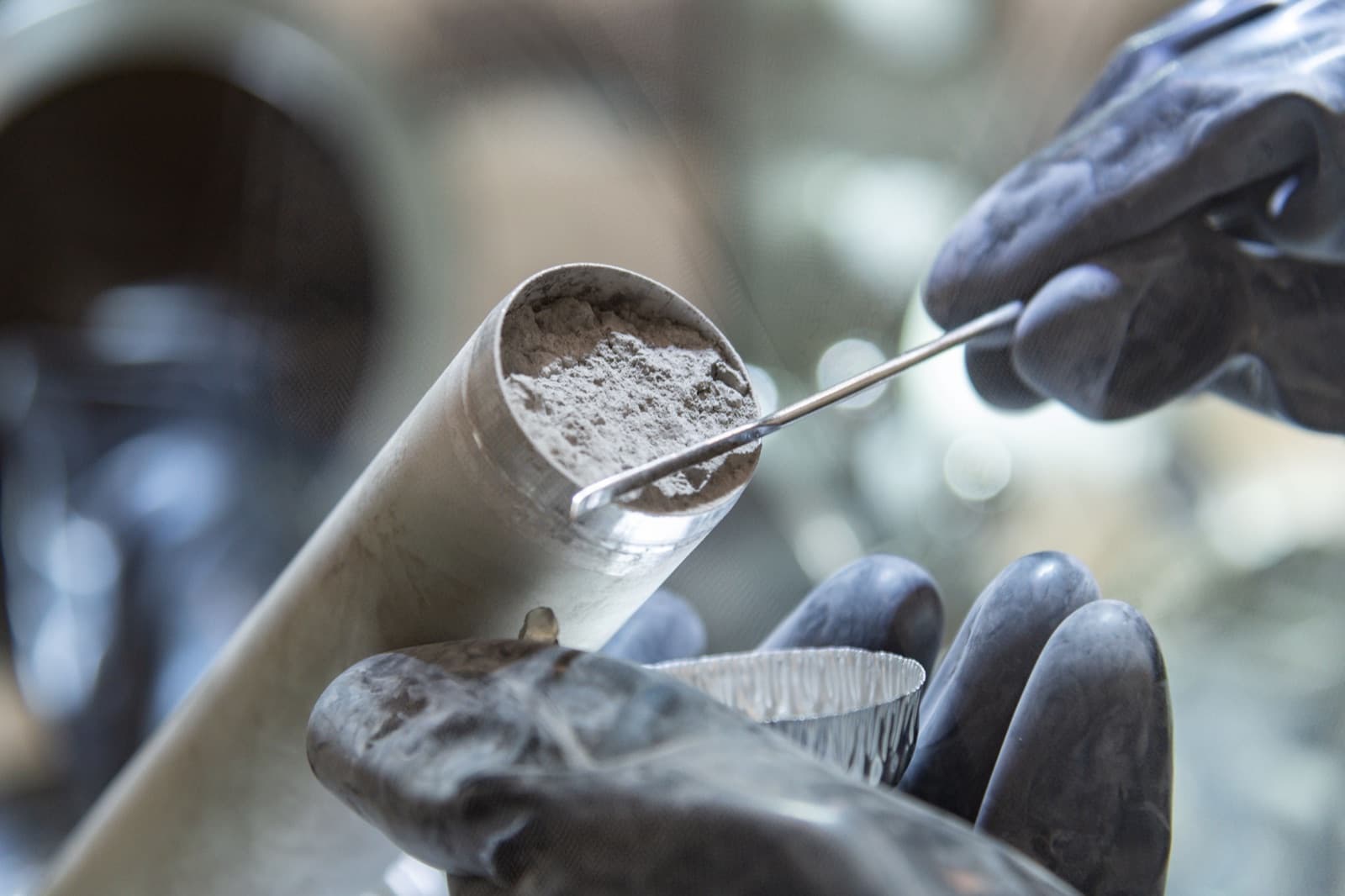
The whole inventory is smaller than you might expect. Six Apollo landings between July 1969 and December 1972 returned 382 kilograms of rock, core, pebbles, sand and dust, about 2,200 separate specimens from six sites. Three Soviet robots returned a few hundred grams between 1970 and 1976. China's Chang'e 5 and Chang'e 6 added just under 3.7 kilograms in 2020 and 2024. That is eleven missions and roughly 386 kilograms in total, and because samples are cut, lent, analysed and sometimes used up, the collection scientists actually work with is counted in numbered pieces: NASA's 382 kilograms has been divided into more than 110,000 catalogued samples.
The Apollo numbers grew mission by mission. NASA's Lunar Meteorite Compendium, quoting the Lunar Sourcebook, gives 21.5 kg for Apollo 11, 34.4 for Apollo 12, 42.3 for Apollo 14, 77.3 for Apollo 15, 95.7 for Apollo 16 and 110.5 for Apollo 17, 381.7 kg in all. NASA's curation pages round that to 382 kg, and an older NSSDCA summary says almost 400. None of these is wrong. They are the same haul counted to different precision, and it is worth knowing which one you are reading before comparing it with anything else. The weight is also not all rock. Only about 265 kg of the collection is pieces larger than a centimetre; the remaining 117 kg is fine material, almost all of it soil, according to Lunar Sourcebook figures quoted by the meteorite scientist Randy Korotev.
The Soviet Union did it with robots. Luna 16 landed in the Sea of Fertility, Mare Fecunditatis, on 20 September 1970, drilled 35 centimetres into the surface and sealed 101 grams of soil in its return capsule, which reached Earth on 24 September. The container went to the Vernadsky Institute of Geochemistry and Analytical Chemistry (GEOKHI) in Moscow, which a Gagarin Museum article described in 2023 as the country's largest store of extraterrestrial material, soil from all three successful Luna missions included. Luna 20 brought back highland soil from near Amegino crater in February 1972, and Luna 24 returned in August 1976 from Mare Crisium with a core from about two metres down. Its drill went 225 centimetres into the regolith at a slant, but the core that came home was 160 centimetres long, a small lesson in the gap between what a mission does and what it returns. Between these successes came two failures, Luna 18 and Luna 23: Luna 18 crashed in September 1971, and Luna 23 was damaged on landing in 1974 and could not collect its sample.
The Soviet totals are where announced and recorded masses part company. Russian accounts, such as the Gagarin Museum's, give 101, 55 and 170 grams and a total of 326. NASA's curation pages say the three missions returned 300 grams, a Chinese news report on the day Chang'e 5's samples were handed over said about 301 grams, and NASA's NSSDCA catalogue lists Luna 20 at 30 grams. Almost the whole disagreement is Luna 20. Russian sources carry 55 grams; the description of the core quoted in NASA's Lunar Sample Compendium says it weighed 50 grams; NSSDCA's 30 grams, added to 101 and 170, matches the 301 gram total. No published reconciliation turned up in the sources checked for this page, so the honest answer is a range with its origins attached. For Luna 24 the figures agree to within a gram: 170.1 in NSSDCA's catalogue, 170 in Russian sources and in the Compendium.
China's two announcements differ by one revealing word. Chang'e 5 landed in Inner Mongolia early on 17 December 2020, Beijing time, and when its container was handed over two days later the announcement said that by preliminary measurement (经初步测量) the mission had collected about 1,731 grams. The target had been two kilograms. Hu Hao, chief designer of the programme's third phase, later said the haul fell short for various reasons, and pointed out the happy accident that 17-3-1 matched the programme's 17 years, three steps and one success. When Chang'e 6 came home from the far side on 25 June 2024, CNSA's Chinese statement of 28 June dropped the word preliminary: by measurement (经测量), 1,935.3 grams. Xinhua's English report of the same announcement kept it. Neither figure had been revised in any CNSA statement found for this page as of September 2026, and in mid-2024 an article on CNSA's website still gave the Chang'e 5 haul as 1,731 grams. Chang'e 6's material came from the South Pole-Aitken basin; the same article counted ten earlier sample returns, all from the near side.
The largest lunar collection on Earth was not brought back by anyone. Lunar meteorites are pieces blasted off the Moon by impacts that later fell to Earth. The first rock recognised as one, Allan Hills A81005, was picked up in Antarctica on 18 January 1982, nine years after the last Apollo landing. Japanese teams had already collected lunar meteorites in the Yamato Mountains, among them Yamato 791197 on 20 November 1979, but their origin was only recognised in 1984. Korotev's list, updated on 11 September 2026, counts 832 approved names with a combined mass of 2,036 kilograms, 5.3 times the Apollo total. That headline needs a warning. Many names are fragments of one meteoroid found separately, and Korotev himself writes that once confirmed or strongly suspected pairs are counted together, the number of actual meteoroids falls to less than half the number of named stones. NASA's Lunar Meteorite Compendium, which groups such pairs, listed nearly 150 unique lunar meteorites as of January 2024 and gave the combined mass of all lunar meteorites as 417 kilograms, although Korotev's running total had already passed 1,000 kilograms in November 2022. The two tallies use different rules and dates, give very different masses, and neither is an official census.
A meteorite also arrives without an address. Its chemistry can hint at a region, as with the lunar meteorite found in the Yamato Mountains in 1986 that Japan's National Institute of Polar Research (NIPR) displays at its science museum in Tachikawa: a piece of highland crust about 4.4 billion years old that the institute thinks came from the far side, because it is poor in the iron and thorium that the near side is rich in. The institute holds about 17,400 Antarctic meteorites in all, and provides samples to researchers free of charge. Where lunar meteorites turn up says more about deserts than about the Moon. By Korotev's count about 85 per cent have been found in northern Africa, mostly by local people and collectors, while all the Antarctic finds together weigh only 5.7 kilograms. Unlike Apollo rock, lunar meteorites are bought and sold openly, at roughly 20 to 4,000 dollars a gram by Korotev's figures, and he warns that some online listings are ordinary Earth rock.
The Apollo collection lives in Building 31N at NASA's Johnson Space Center in Houston, built between 1977 and 1979 for the purpose. Pristine samples, those that have never left NASA custody, sit in stainless steel cabinets purged with high-purity nitrogen and are always separated from human hands by three layers of gloves. The vaults stand above expected hurricane storm-surge heights, and even the floor coverings, plumbing and paint were screened for elements that could contaminate the rocks. Material that goes out to a laboratory and comes back is reclassified as returned and kept apart. China's rules, issued in January 2021, name a main store, the National Astronomical Observatories of the Chinese Academy of Sciences in Beijing, and a backup store; when Chang'e 5's samples were handed over, an off-site backup was reported to be planned for Shaoshan in Hunan, Mao Zedong's birthplace. The rules divide every haul into four classes: permanent storage, backup permanent storage, research, and public-benefit use such as exhibitions. Chang'e 5's designers kept the sealed sample container between minus 25 and 55 C even through re-entry, and on the ground it was stored and opened under nitrogen, much as NASA handles its pristine Apollo samples.
Scientific samples are lent, and the paperwork is the price. At NASA a researcher needs favourable peer review, either a recommended proposal or published papers in the field, and a written request naming the samples, the quantities and the planned use. The Apollo sample curator decides whether outside review is needed; if it is, the request goes to the Astromaterials Allocation Review Board, which NASA's page says was formerly CAPTEM. The institution then signs a loan agreement with a security plan. Less than 10 grams can travel to a US laboratory by registered mail, foreign shipments go by diplomatic pouch to the nearest American embassy, and anything over 10 grams must be carried by hand. NASA's own pages put the traffic at several hundred samples a year (one says nearly 400, another about 500). China runs a parallel system and publishes the lists. Its first allocation, on 12 July 2021, sent 31 Chang'e 5 samples totalling 17,476.4 milligrams to 13 institutions. By June 2024 it had lent more than 80 grams in seven batches to over 100 Chinese teams, about 5 per cent of the Chang'e 5 haul. Chang'e 6 material has since joined the lists: an allocation announced on 5 February 2026 approved 22,836.6 milligrams from both missions for 14 institutions, and on 8 May 2026 CNSA opened another round of applications for both, which closed on 8 June.
Samples have also been diplomacy. In March 1973 NASA handed Soviet representatives three grams each of Apollo 16 and Apollo 17 material and received samples from Luna 16 and Luna 20 in return (the Lunar Sample Compendium's inventory shows Luna 16 material already received in the United States in July 1971); the Luna 20 portion allocated to NASA weighed 2.036 grams, according to the certificate quoted in the Compendium. Luna 24 material went to the United States, Britain, India and other countries. In 1978 Zbigniew Brzezinski, President Carter's national security adviser, brought China a one gram fragment cast in acrylic, and the Americans said nothing about where or when it had been collected. The Chinese Academy of Sciences passed it to the cosmochemist Ouyang Ziyuan, later the first chief scientist for lunar application science in China's lunar exploration programme. He cut it in two and kept one half. Analyses used up the other, produced 14 papers and let Chinese scientists deduce that it came from Apollo 17, then, with the help of published American data, which numbered sample it was. It is a high-titanium mare basalt from the Apollo 17 landing area on the southeastern edge of Mare Serenitatis, and the half gram that was kept is on show at the Beijing Planetarium. Forty-seven years later the flow reversed. In April 2025 China accepted applications to borrow Chang'e 5 samples from abroad, including two from American universities, and on 24 April 2026 it approved a second international round for France's IRAP, the University of Manchester and the space institute of Turkey's TÜBİTAK. The Chinese and English notices disagree on what the Turkish institute receives, four powders and one rock clast in Chinese and the reverse in English, a small reminder to read the original.
The most famous gifts were political. In 1970 and 1973 President Richard Nixon presented lunar samples to 135 countries and the 50 US states; the second set came from sample 70017, which NASA's history office calls the Goodwill Rock and describes as the last rock Eugene Cernan and Harrison Schmitt collected (the Lunar Sample Compendium says one of the last). These were gifts to governments, and NASA leaves them off its own list of lunar displays. Many have since gone missing. An AFP tally in 2019, built on research by the retired NASA special agent Joseph Gutheinz, his students and the space history site collectSPACE, found both of Afghanistan's and both of Libya's missing; Malta's Apollo 17 piece stolen from a museum in May 2004 and still missing at the time of the tally; Ireland's Apollo 11 display lost when a 1977 fire destroyed Dunsink Observatory, with the debris ending up in a landfill at Finglas; and Honduras's Apollo 17 fragment sold by an army colonel to a Florida businessman for 50,000 dollars. The businessman offered it to undercover agents for 5 million in a 1998 sting called Operation Lunar Eclipse, and the rock was seized and returned to Honduras.
NASA has been robbed from the inside too. In the spring of 2002 three NASA interns used their badges to enter Johnson Space Center at night and remove a 600 pound safe holding samples from every Apollo mission, along with a piece of a Martian meteorite. They offered the samples on the website of a mineral club in Antwerp; a Belgian collector alerted the FBI, and agents posing as his relatives arrested them at a restaurant in Orlando on 20 July 2002, the 33rd anniversary of the first landing. The samples were recovered, but the FBI said they had been contaminated to the point of being nearly useless for science, and that three decades of a scientist's handwritten notes kept in the safe were destroyed. The ringleader, Thad Roberts, was sentenced to more than eight years in prison. A NASA Inspector General audit in December 2011 counted 517 loaned astromaterial samples lost or stolen between 1970 and June 2010, including 218 from that single theft and a lunar sample disk lent to an observatory in Delaware in 1978 that still had not been found when the audit was published.
Some of the Moon was kept closed on purpose. In December 1972 Cernan and Schmitt hammered a double drive tube into a landslide deposit in the Taurus-Littrow valley. The lower half, 73001, was sealed under vacuum on the Moon and later stored inside a second vacuum tube in a nitrogen cabinet; the upper half, 73002, came home in an ordinary container. Both waited for the Apollo Next Generation Sample Analysis programme, ANGSA, which opened 73002 in 2019. For 73001, curators first CT-scanned the tube at the University of Texas at Austin, then in February 2022 captured the gas inside, and on 21 and 22 March 2022 pushed the core out and began dividing it into half-centimetre slices. "We are the first people who got to actually see this soil for the first time," said the deputy curator, Juliane Gross. NASA describes it as one of the last few samples it had kept unopened, and its curator of astromaterials, Francis McCubbin, gave the reason: the samples were curated for the long term so that scientists fifty years in the future could analyse them.
What ties these stories together is scarcity. Chinese allocations are published in milligrams, NASA sends out a few hundred samples a year from a collection curated for scientists half a century ahead, and an announced mass, once printed, tends to become the number everyone repeats. When you meet a figure for Moon samples, the useful questions are the ones this page has tried to answer: counted by whom, measured when, and rounded how.
What we know
The Apollo collection
382 kg of lunar material, returned as about 2,200 specimens from six landing sites between 1969 and 1972, and since processed into more than 110,000 individually catalogued samples.↗
Apollo, mission by mission
21.5 kg Apollo 11, 34.4 kg Apollo 12, 42.3 kg Apollo 14, 77.3 kg Apollo 15, 95.7 kg Apollo 16 and 110.5 kg Apollo 17: 381.7 kg in all (Vaniman et al., Lunar Sourcebook, 1991, as quoted in NASA's Lunar Meteorite Compendium, 2024). NASA's curation pages round the total to 382 kg.↗
Rock versus soil
Of the 382 kg, about 265 kg is rock larger than 1 cm. The other 117 kg is finer material, 96 per cent of it soil or regolith, per Lunar Sourcebook figures quoted by Randy Korotev.↗
Luna 16
Luna 16 lifted off from Mare Fecunditatis on 21 September 1970 carrying 101 grams from a 35 cm drill core, the figure NASA's NSSDCA and Russian sources agree on.↗
Luna 20, three numbers
Luna 20 is given as 55 g in Russian accounts, as a core "weighing 50 grams" in the description quoted by NASA's Lunar Sample Compendium, and as 30 g in NSSDCA's catalogue. The portion NASA received in exchange weighed 2.036 g, according to its certificate.↗
Luna 24's core
Luna 24's drill went 225 cm into the regolith at an angle, about 200 cm vertically, but the core that came home was 160 cm long and weighed 170 g (170.1 g in NSSDCA's catalogue). Its samples were exchanged with the US, Britain, India and other countries.↗
The Soviet total
326 g in Russian accounts (101 + 55 + 170 g, as the Gagarin Museum gives them); about 300 g on NASA's curation pages; about 301 g in a Chinese news report of 19 December 2020 (Guancha, relaying CCTV News). The spread comes almost entirely from Luna 20.↗
Where the Soviet samples are
The Luna 16 container went to the Vernadsky Institute of Geochemistry and Analytical Chemistry (GEOKHI RAN) in Moscow, which a Gagarin Museum article of September 2023 describes as Russia's largest store of extraterrestrial material, including the soil from Luna 16, 20 and 24.↗
Chang'e 5
At the handover in Beijing on 19 December 2020, Chang'e 5's haul was given as about 1,731 g "by preliminary measurement" (经初步测量). Beijing's National Astronomical Observatories were named as the main store, with an off-site disaster backup planned in Shaoshan, Hunan.↗
Chang'e 6
CNSA's Chinese statement of 28 June 2024 says that "by measurement" (经测量) Chang'e 6 collected 1,935.3 g, the first samples from the far side. Xinhua's English report of the same announcement says "based on preliminary measurement".↗
China's sample rules
The Lunar Sample Management Measures of January 2021 (nine chapters, 37 articles) split samples into permanent storage, backup permanent storage, research and public-benefit use. Research loans run up to a year, applications are reviewed each quarter, foreign users may apply, and papers must credit "Lunar sample provided by CNSA".↗
How much China had lent by 2024
By June 2024 CNSA had lent more than 80 g of Chang'e 5 material, in seven batches, to over 100 research teams in China: about 5 per cent of the haul, according to a Beijing Daily report republished on CNSA's website.↗
The February 2026 allocation
A CNSA notice of 5 February 2026, after a review meeting in January, approved 49 applications from 14 institutions for 22,836.6 mg of Chang'e 5 and Chang'e 6 samples.↗
International loans, 2026
On 24 April 2026 CNSA approved a second international round of Chang'e 5 loans: IRAP in France, the University of Manchester and TÜBİTAK's space institute in Turkey. The Chinese notice gives the Turkish institute four powder samples and one rock clast; the English notice says one powder and four clasts.↗
How a scientist borrows Apollo rock
Favourable peer review, a written request naming samples and quantities, review by the Astromaterials Allocation Review Board (formerly CAPTEM) when the curator requires it, and a loan agreement with a security plan. Less than 10 g can go to US labs by registered mail, foreign shipments go by diplomatic pouch, and more than 10 g must be hand-carried.↗
Building 31N
Built from 1977 to 1979 at Johnson Space Center, Houston. Pristine samples sit in stainless steel cabinets purged with high-purity nitrogen, always separated from human hands by three layers of gloves, in vaults raised above expected hurricane storm-surge levels.↗
Lunar meteorites, by name
832 approved names with a combined mass of 2,035.96 kg, or 533 per cent of the Apollo collection, in Randy Korotev's list last updated 11 September 2026.↗
Lunar meteorites, pairs grouped
Grouping stones that came from the same meteoroid, NASA's Lunar Meteorite Compendium listed nearly 150 unique lunar meteorites as of January 2024, 16 from the US Antarctic collection and 6 from the Japanese, and gave the combined mass of all lunar meteorites as 417.254 kg at that date.↗
The first to be recognised
Allan Hills A81005, found in Antarctica on 18 January 1982, was the first meteorite recognised as lunar. Yamato 791197, collected by a Japanese team on 20 November 1979, was found earlier but only recognised as lunar in 1984.↗
Lost and stolen
A NASA Inspector General audit of 8 December 2011 counted 517 loaned astromaterial samples lost or stolen between 1970 and June 2010, including 218 lunar and meteorite samples taken in one 2002 theft (all recovered).↗
What happened, and when
- 24 Jul 1969Apollo 11 returns to Earth from the Sea of Tranquility with the first samples brought back from another world.
- 20 to 24 Sep 1970Luna 16 lands in Mare Fecunditatis, drills 35 cm and sends 101 g home, the first lunar sample returned by a robot.
- 25 Feb 1972Luna 20's capsule lands with about 55 g of highland soil from near Amegino crater, by the Russian count.
- Dec 1972On Apollo 17, Cernan and Schmitt hammer a double drive tube into a landslide deposit in the Taurus-Littrow valley. The lower half, 73001, is sealed under vacuum on the Moon.
- Mar 1973NASA gives Soviet representatives 3 g each of Apollo 16 and Apollo 17 material for Luna 16 and Luna 20 samples, and Nixon orders fragments of rock 70017 for all 50 states and 135 foreign heads of state.
- 18 to 22 Aug 1976Luna 24 lands in Mare Crisium and returns 170.1 g, the last of the three Soviet sample returns.
- 1978US national security adviser Zbigniew Brzezinski brings China a 1 g Moon rock. Ouyang Ziyuan's team uses half of it in analyses; it is now known to be a high-titanium mare basalt collected by Apollo 17.
- 18 Jan 1982Allan Hills A81005 is found in Antarctica and becomes the first meteorite recognised as coming from the Moon.
- 1998Operation Lunar Eclipse: undercover agents recover Honduras's Apollo 17 goodwill rock after the Florida businessman who had bought it offers it to them for 5 million dollars.
- 20 Jul 2002FBI agents posing as relatives of a Belgian collector arrest former NASA interns at a restaurant in Orlando. The interns had stolen a 600 lb safe of lunar samples from Johnson Space Center.
- 19 Dec 2020Chang'e 5's container is handed over in Beijing: about 1,731 g by preliminary measurement, the first lunar samples returned since 1976.
- Feb to Mar 2022Curators extract the gas from core 73001, then push the core out on 21 and 22 March 2022, nearly fifty years after it was sealed on the Moon.
- 25 to 28 Jun 2024Chang'e 6's return capsule lands in Inner Mongolia on 25 June, and on 28 June CNSA announces 1,935.3 g, the first samples from the Moon's far side.
- 24 Apr 2026CNSA approves its second international round of Chang'e 5 loans, to institutions in France, the United Kingdom and Turkey.
- 11 Sep 2026Korotev's lunar meteorite list, updated on this date, stands at 832 approved names and 2,035.96 kg, 5.3 times the Apollo mass.
In pictures
Tap a photo to enlarge.
Sources
- NASA Astromaterials Curation: Lunar Sample Laboratory Facility (382 kg, 2,200 specimens, 110,000 samples, Building 31N)
- NASA Astromaterials Curation: Lunar Sample Laboratory Tour (Luna 16, 20 and 24 total given as 300 g)
- NASA Astromaterials Curation: Lunar Samples (nearly 400 samples distributed each year)
- NASA Astromaterials Curation: Sample Requests for Research (peer review, AARB formerly CAPTEM, loan agreements, shipping rules)
- NASA Astromaterials Curation: Lunar Sample Public Displays (goodwill samples of 1970 and 1973 excluded)
- K. Righter, The Lunar Meteorite Compendium, NASA JSC, 2024 (Apollo masses by mission; about 150 unique meteorite groups as of January 2024)
- R. L. Korotev, List of Lunar Meteorites, alphanumeric order, Washington University in St. Louis, last update 11 September 2026
- R. L. Korotev, Lunar meteorites (first recognition, pairing, where found, prices), Washington University in St. Louis
- R. L. Korotev, How do we know that it is a rock from the Moon? (Apollo rock versus fines; 1,000 kg of lunar meteorites by November 2022; 85 per cent found in northern Africa; 5.7 kg from Antarctica)
- NASA NSSDCA: Luna 16 (101 g)
- NASA NSSDCA: Luna 20 (30 g)
- NASA NSSDCA: Luna 24 (170.1 g)
- NASA NSSDCA: Luna 18 (crashed near Mare Fecunditatis, September 1971)
- NASA NSSDCA: Luna 23 (damaged on landing in Mare Crisium; no samples returned)
- C. Meyer, Lunar Sample Compendium: Luna 20 drill core (about 50 g; 2.036 g allocated to NASA)
- C. Meyer, Lunar Sample Compendium: Luna 24 drill core (225 cm drilled, 160 cm core, 170 g; exchanges)
- C. Meyer, Lunar Sample Compendium: Luna 16 drill core (samples provided to US workers)
- C. Meyer, Lunar Sample Compendium: 70017 (vesicular high-titanium basalt, one of the last rocks collected on Apollo 17, pieces distributed widely)
- Музей-заповедник Ю. А. Гагарина (12 Sep 2023): Лунный грунт на Земле (Luna 16, 20, 24: 101, 55, 170 g, total 326 g; GEOKHI), in Russian
- Научная Россия: До Луны и обратно (Luna 16 dates, 35 cm drill, 101 g), in Russian
- 观察者网, quoting CCTV News (19 Dec 2020): 嫦娥五号任务月球样品正式交接, 经初步测量约1731克; storage in Beijing, backup at Shaoshan; Soviet total about 301 g, in Chinese
- 国家航天局 (22 Apr 2021, from 科技日报): 月球土特产太珍贵 (about 1,731 g; sealed container and nitrogen handling), in Chinese
- 中国新闻网 (23 Jun 2021): 嫦娥五号取回的月壤为何是1731克 (Hu Hao on the 2 kg target), in Chinese
- 国家航天局 (28 Jun 2024): 嫦娥六号带回1935.3克月球样品 交接至地面应用系统, in Chinese
- CNSA English, from Xinhua (29 Jun 2024): China's Chang'e-6 collects 1,935.3 grams of samples from moon's far side
- 国家航天局, from 北京日报 (30 Jun 2024): 拆开第一份月背快递 (80 g lent in seven batches, about 5 per cent), in Chinese
- 国家航天局 (22 Jan 2021): 《月球样品管理办法》有关情况解读, in Chinese
- 国家航天局 (12 Jul 2021): 关于发放第一批月球科研样品的公告, in Chinese
- 国家航天局 (5 Feb 2026): 关于发放月球科研样品的公告, in Chinese
- 国家航天局 (24 Apr 2026): 关于嫦娥五号任务月球科研样品第二批国际借用申请的遴选结果, in Chinese
- CNSA English (24 Apr 2026): Selection Release of the 2nd Batch of International Loan on Chang'E-5 Mission Lunar Samples
- 国家航天局 (8 May 2026): 关于开放2026年度第一批月球科研样品借用申请的通知, in Chinese
- SpaceNews (26 Apr 2025): China to lend Chang'e-5 moon samples to U.S. universities
- NASA History: 50 Years Ago, Apollo 17 Post-Mission Activities (1973 exchange with the Soviet Union; Goodwill Rock 70017)
- 中国新闻网 (10 Dec 2020): 当年美国赠予中国的1克月岩去哪了, in Chinese
- 国家航天局 (17 Dec 2013): 欧阳自远:从半克月球岩石样品开始的研究, in Chinese
- AFP via Phys.org (16 Jun 2019): What happened to the Apollo goodwill moon rocks?
- FBI (18 Nov 2003, archived): The Case of the Stolen Moon Rocks
- NASA Office of Inspector General, IG-12-007 (8 Dec 2011): NASA's Management of Moon Rocks and Other Astromaterials Loaned for Research, Education, and Public Display (517 samples lost or stolen; Apollo material is US government property)
- NASA (23 Mar 2022): Fifty Years Later, Curators Unveil One of Last Sealed Apollo Samples
- 国立極地研究所 南極・北極科学館 スタッフブログ (18 Sep 2018): 月隕石をご紹介, in Japanese
- 国立極地研究所 (15 Jan 2025): 南極隕石コレクションがIUGS Geo-collectionに認定 (about 17,400 meteorites, lent free of charge), in Japanese
- NASA NSSDCA: The Apollo Program (mission dates)
Checked on 22 September 2026. Where the science is unsettled this page says so rather than picking a winner.