The Far Side of the Moon
The far side is lit by the Sun as often as the near side; it is the hemisphere that never faces Earth. As of 23 September 2026 it has been landed on twice, by China's Chang'e 4 in 2019 and Chang'e 6 in 2024, which brought back the first far-side samples, and why it looks so unlike the near side is still unsettled.
TL;DR· 21 min read
The far side of the Moon is the hemisphere that always faces away from Earth, and it gets as much sunlight as the near side. It was first photographed by Luna 3 in 1959, first seen by people on Apollo 8 in 1968, first landed on by China's Chang'e 4 in 2019 and first sampled by Chang'e 6 in 2024. Its thicker crust and near absence of lava plains are well measured, but why the two hemispheres differ is still an open question.
There is no dark side of the Moon. The far side, the hemisphere that always faces away from Earth, gets about as much sunlight as the side we see, and at new moon, when the face turned toward us is black, the far side is in full daylight. What it lacks is a line of sight to Earth. That is why nobody saw it until the Soviet Luna 3 photographed it in 1959, why no person saw it until Apollo 8 in 1968, and why landing there had to wait until China parked a relay satellite beyond the Moon and set Chang'e 4 down in 2019. It also looks strikingly unlike the near side, with a thicker crust and almost none of the dark lava plains, and scientists still disagree about why. Chang'e 6 brought back the first far-side rock in 2024, and radio astronomers want the same hemisphere for a different reason: behind the Moon, Earth's radio noise is blocked.
- of the far side is covered by dark mare basalt, against more than 30% of the near side (figures from He Huaiyu of the Chinese Academy of Sciences)
- ~3%of the far side is covered by dark mare basalt, against more than 30% of the near side (figures from He Huaiyu of the Chinese Academy of Sciences)
- soft landings on the far side as of 23 September 2026, both Chinese: Chang'e 4 in 2019 and Chang'e 6 in 2024
- 2soft landings on the far side as of 23 September 2026, both Chinese: Chang'e 4 in 2019 and Chang'e 6 in 2024
- of far-side soil and rock returned by Chang'e 6 in June 2024, the first samples from the far side
- 1,935.3 gof far-side soil and rock returned by Chang'e 6 in June 2024, the first samples from the far side
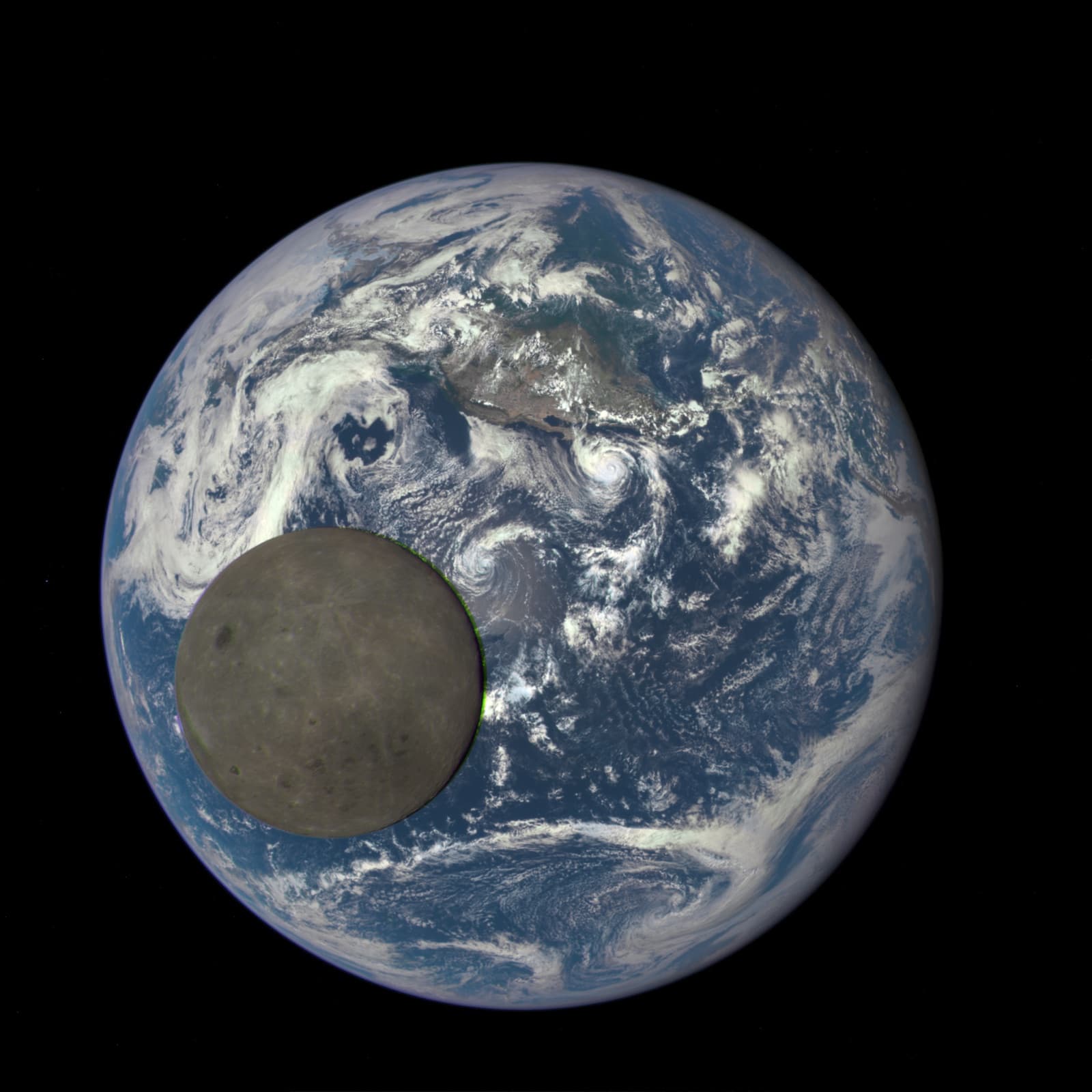
The name itself is wrong, and usefully so. The Moon turns once on its axis in precisely the time it takes to go once around Earth, so one face stays turned toward us and the other, the far side, stays turned away. NASA's Moon facts page is blunt about the rest: calling the far side the "dark side" is misleading. Day and night sweep around the whole Moon once a month, each lasting about two weeks at any given spot, so over a month the side we never see gets about as much sunlight as the side we do. At new moon, when the face toward us is in its night, the far side is in full daylight. Even the English report China's space agency carried on its website when it launched a far-side relay satellite in March 2024 stopped to explain that the phrase "dark side" refers to the mystery of largely unexplored terrain.
The boundary is also blurrier than the name suggests. Because the Moon's orbit is slightly elliptical and tilted, it appears to rock a little over the month, an effect called libration, and over time observers on the ground see somewhat more than half of its surface. The International Telecommunication Union, which needs a precise definition for radio regulation, puts the region that is always hidden at everything more than 23.2 degrees beyond the Moon's mean limb as seen from Earth's centre, a line drawn so that the region also stays out of sight of satellites up to 100,000 kilometres from Earth. The ITU calls that region, with the space just above it, the Shielded Zone of the Moon, and it returns at the end of this page.
For all of human history until 1959, nobody had seen that hemisphere at all. The Soviet station Luna 3 was launched on 4 October 1959, two years to the day after Sputnik, on a looping path that carried it past the Moon's south pole and round behind it. Its camera system, Yenisey, was built by the Leningrad Research Institute of Television to cope with weightlessness, large temperature swings and radiation striking its film. On 7 October a photocell detected the sunlit far side and the sequence began: 29 frames through two lenses over 40 minutes, from about 63,500 to 66,700 kilometres above the surface. The film was developed, fixed and dried on board, then scanned by a moving spot of light and radioed home as telemetry. The Russian State Archive of Scientific and Technical Documentation, which holds the prints, records that the signal was received by an antenna on Mount Koshka near Simeiz in Crimea, and that 70 per cent of the region being photographed was in sunlight at the time. Seventeen usable but noisy images reached Earth by 18 October, covering about 70 per cent of the far side, and they appeared on the front page of Pravda on 27 October 1959.
What the pictures showed was a surprise. The far side was mountainous and almost bare of the dark plains that make up the familiar face of the Moon, with only two obvious dark regions, named Mare Moscoviense, the Sea of Moscow, and Mare Desiderii, the Sea of Dreams, which later turned out to be a smaller mare, Mare Ingenii, plus other dark craters. Astronomers in Moscow, Pulkovo and Kharkiv worked the images into the first map and atlas of the far side in 1960, and because the Soviet Union saw it first, it named what it saw: craters for Konstantin Tsiolkovsky, the Russian rocketry pioneer, for Mendeleev and for Giordano Bruno, and the Sea of Moscow. The International Astronomical Union approved the names on 22 August 1961. Zond 3 photographed the remaining 30 per cent in July 1965 in much better pictures, and by August 1967 the five American Lunar Orbiter spacecraft had photographed 99 per cent of the whole Moon. An American probe had reached the far side even earlier, though it saw nothing: Ranger 4, crippled by a computer failure, struck it on 26 April 1962 without returning any data.
The first human eyes arrived on 24 December 1968. Apollo 8 lost radio contact about 68 hours 58 minutes into the flight as it slipped behind the Moon, and NASA's mission summary marks that as the moment three people first saw the far side. The crew remembered it slightly differently. Frank Borman said in the 1969 technical debrief that they never even saw the Moon until they had finished the braking burn that put them into orbit, and about three minutes after the burn ended Bill Anders looked down and said it looked like a big beach. The far side was in daylight: seen from Earth the Moon was a waxing crescent, so most of the far side was lit, and as the crew came round toward the eastern limb they crossed ground so close to the point directly under the Sun that Jim Lovell remarked on craters with no shadows in them. On the sixth orbit Anders gave the description that stuck: the back side looked like a sand pile his kids had been playing in for a long time, all beat up, no definition, just a lot of bumps and holes. Each pass behind the Moon cut them off from Earth for about 45 minutes, while a tape recorder captured their voices for replay once they came round again. That silence is the whole practical problem of the far side.
Luna 3's blurry frames already showed the far side's most striking feature, and better data have only sharpened it. The near side is low and dominated by maria, plains of dark solidified lava. The far side is higher, mountainous and saturated with craters. He Huaiyu of the Chinese Academy of Sciences' Institute of Geology and Geophysics, quoted by CNSA when Chang'e 6's samples were handed over, put numbers on it: basalt covers more than 30 per cent of the near side and only about 3 per cent of the far side. The crust is lopsided too. NASA gives roughly 40 kilometres on the near side and up to about 60 on the far side, which makes the Earth-facing crust about two thirds as thick. He's figures are 30 to 50 against 60 to 80 kilometres. Estimates differ because thickness is modelled from gravity and topography, and the answer depends on assumptions such as how porous the rock is. The gravity map from NASA's twin GRAIL spacecraft gave an average of 34 to 43 kilometres, well below the roughly 50 assumed before, and in its authors' model almost no crust at all under the far-side basin Moscoviense. So is the chemistry: heat-producing elements such as thorium are concentrated on the near side in a region called the Procellarum KREEP Terrane, named for potassium (K), rare earth elements and phosphorus, while the far-side highlands are bright, feldspar-rich and poor in them. In May 2025 a study of how GRAIL felt the Moon flex under Earth's tides added a thermal asymmetry: its authors infer a thermal anomaly of roughly 100 to 200 kelvin in the near-side mantle, linked to the volcanism that made the maria three to four billion years ago.
Why the Moon is two-faced is still argued over. A Brown University team led by M. J. Jones called it one of the fundamental mysteries of lunar evolution, unexplained since its discovery in the Apollo era. Internal explanations include uneven tidal heating, lopsided convection in the mantle and a magma ocean that crystallised unevenly. External ones blame something that happened to the Moon. Martin Jutzi and Erik Asphaug proposed in Nature in 2011 that a second, smaller moon about 1,200 kilometres across, formed from the same debris as the Moon, collided with it slowly enough to pile up on one hemisphere as the far-side highlands. Arpita Roy, Jason Wright and Steinn Sigurðsson argued in 2014 that heat radiating from the newly formed, hot Earth kept the near side warmer, so crust-forming material condensed preferentially on the cooler far side. Jones and colleagues showed in 2022 that heat from the impact that made the South Pole-Aitken basin, the largest and oldest basin on the Moon, could have driven mantle flow that swept thorium- and titanium-rich material toward the near side. Samples from Chang'e 6 have now entered the argument, and not all on the same side of it. A January 2026 paper in PNAS, working from potassium isotopes in the far-side basalts, argues that the South Pole-Aitken impact itself altered the mantle beneath the basin and that large impacts may have played a key role in creating the asymmetry. A July 2026 paper in National Science Review, comparing far-side rock types with Apollo samples, finds no clear compositional difference between the two sides' mantles, a far-side crust that is thicker and richer in magnesium, and proposes that the split began with sideways (lateral) thermal convection in a long-lived magma ocean on a Moon already locked facing Earth. None of these ideas has displaced the others.
Landing on the far side took almost sixty years after it was first photographed, and the reason is geometry. A lander there can never see Earth, so it cannot talk to mission control directly. China's answer was to launch the radio link first. The relay satellite Queqiao, named for the bridge of magpies in a Chinese folk tale that reunites two lovers across the Milky Way, lifted off on 21 May 2018 (Beijing time) and settled into a halo orbit around the Earth-Moon L2 point, about 65,000 kilometres beyond the Moon, where it could see both the far side and Earth. People's Daily called it the first satellite in the world to operate in that orbit. Chang'e 4, built as the backup to Chang'e 3, followed that December. At 10:26 Beijing time on 3 January 2019 it came down on the floor of Von Kármán crater inside the South Pole-Aitken basin, the first soft landing on the far side. China's lunar programme chief designer Wu Weiren compared the terrain to landing among the mountains of Yunnan, Guizhou and Sichuan, and because every signal went through Queqiao with a delay, for the ground the descent was in effect an autonomous blind landing: the lander paused to hover at 100 metres, checked for obstacles and slopes, chose its own spot and set itself down. The Yutu-2 rover rolled onto the surface at 22:22 that night. Among its first results, the Chinese Academy of Sciences lists rocks rich in olivine and low-calcium pyroxene that may help reveal the Moon's deep interior.
The second landing needed a better bridge. Queqiao-2 was launched from Wenchang on 20 March 2024 and on 2 April entered a new kind of relay orbit, a 24-hour, highly elliptical frozen lunar orbit, stable enough to need almost no fuel to hold. At its farthest it is about 16,000 kilometres from the lunar surface, against up to 90,000 kilometres for the first Queqiao, and it can take data from up to ten channels at once instead of two, with relay link rates nearly ten times higher. Its farthest point sits over the south pole with later missions such as Chang'e 7 in mind. On 6 April it made contact with Chang'e 4, still working on the far side, to show it could take over when the first relay retired. Chang'e 6 landed in the South Pole-Aitken basin at 06:23 Beijing time on 2 June 2024. Its builders at the China Academy of Space Technology noted that the whole descent was invisible from Earth, and that Queqiao-2's orbit was phased to give more than 20 hours of relay coverage on each of the two days the lander spent drilling and scooping. The lander loaded its samples into an ascent vehicle and launched them into lunar orbit, and the return capsule came down in Siziwang Banner, Inner Mongolia, on 25 June. On 28 June the China National Space Administration announced the mass: 1,935.3 grams, humanity's first sample from the far side. All ten earlier lunar sample returns, Soviet, American and Chinese, had come from the near side.
Two years of work on those grams have produced the first sample-based numbers for the far side's interior. Lead-lead dating by a Chinese Academy of Sciences team found two episodes of volcanism: a basalt fragment 4.2 billion years old from a source rich in KREEP, and a main episode 2.807 billion years ago from a source poor in it, so eruptions on the far side went on for more than 1.4 billion years. The younger age also matched the crater-counting estimate for the site, a welcome sign that the dating clock calibrated on near-side samples works on the far side too. The basalts' mantle source held only 1 to 1.5 micrograms of water per gram, potentially drier than the near side's, which its authors say hints that water inside the Moon may be split between the hemispheres like so much else. Other teams found the mantle beneath the basin ultra-depleted and recovered a magnetic record from 2.8 billion years ago showing the Moon's magnetic field had strengthened again by then after an earlier decline. All of it comes from one landing site in one unusual basin, so the samples open a single window onto the far side's interior.
The far side's other great value has nothing to do with rocks. Radio astronomers want it because it is the quietest place within reach. At long wavelengths Earth is loud: it gives off strong natural radio emission at kilometre wavelengths, human transmissions leak into space, and its ionosphere absorbs signals at wavelengths of tens of metres and longer, so that part of the sky is very hard to observe from the ground. That long-wavelength band is where astronomers hope to catch the faint signal of hydrogen from the cosmic dark ages, before the first stars formed. Behind the Moon, Earth's noise is blocked, and during the two-week lunar night so is the Sun's. The shielding has been measured. In preliminary results from 2018, the small Chinese satellite Longjiang-2's low-frequency receiver, passing behind the Moon, saw Earth's radio interference drop away on all three channels. The Chang'e 4 lander carried a low-frequency spectrometer covering 100 kilohertz to 40 megahertz, and Queqiao carried a Dutch and Chinese radio instrument, the Netherlands-China Low-Frequency Explorer. One dedicated experiment now waiting to fly is LuSEE-Night, a NASA and US Department of Energy radio telescope developed with the University of California, Berkeley, designed to listen from 0.1 to 50 megahertz through the lunar night. It is to ride Firefly Aerospace's Blue Ghost Mission 2 to a site near Nassau crater, and the lander is designed to power off before nightfall so it does not spoil the silence. As of 23 September 2026, Firefly lists the launch as no earlier than 2027, later than the no-earlier-than-late-2026 date reported in April, and a LuSEE-Night paper revised in July 2026 expects the telescope to reach the far side in 2027.
The quiet is protected, on paper. The ITU's Radio Regulations single out the Shielded Zone of the Moon as an area of great potential for radio astronomy to be kept as free as possible from transmissions, and ITU-R Recommendation RA.479, last revised in 2003, calls the far side the remaining accessible place where the universe can be observed without interference across the whole radio spectrum. It cites an International Astronomical Union resolution of 1994 recommending that once radio astronomy begins there, transmissions in the zone be limited to the 2 to 3 gigahertz band. The catch is that every relay that makes the far side usable is itself a transmitter within sight of it, and the same recommendation concedes that links to stations on the far side may be necessary. A 2019 report from an international forum in Beijing, first-authored by Chen Xuelei, who is also first author of a 2023 paper describing China's lunar-orbit radio array DSL (Hongmeng in Chinese), concluded that the coming decade offers a unique opportunity for radio-quiet measurements from the far side, before further development of lunar assets compromises it. As of July 2026 DSL had not flown: the Chinese Academy of Sciences listed it in November 2025 among the missions it plans for 2026 to 2030, and a July 2026 paper still describes it as proposed.
Sixty-seven years after Luna 3's noisy frames, the far side has been photographed in detail, landed on twice and sampled once, and it still keeps its main secret: why the Moon's two faces are so different.
What we know
Why one face points at Earth
The Moon takes exactly as long to spin once on its axis as it takes to orbit Earth once, so its far side stays hidden from us. NASA calls this synchronous tidal locking and says that in the Moon's case it started at birth.↗
Sunlight on the far side
NASA: calling the far side the "dark side" is misleading. During a new moon the far side has full sunlight while the side facing us is having its night.↗
How much of the Moon Earth can see
Because the Moon's orbit is slightly elliptical and inclined, observers on Earth see somewhat more than half of its surface over time. The ITU defines the part that is always hidden as everything more than 23.2 degrees beyond the mean limb as seen from Earth's centre, a region also out of sight of satellites up to 100,000 km from Earth.↗
Dark lava plains
Basalt covers more than 30% of the near side and only about 3% of the far side, according to He Huaiyu of the CAS Institute of Geology and Geophysics, quoted in a Beijing Daily report on the Chang'e 6 sample handover that CNSA republished on 30 June 2024 (原文: 月球正面的玄武岩分布面积大于30%,背面分布面积仅约3%).↗
Crust thickness
NASA gives about 40 km on the near side and up to about 60 km on the far side, so the Earth-facing crust is roughly two thirds as thick, and says scientists are still working out why. He Huaiyu (CAS) gives 30 to 50 km against 60 to 80 km (月球正面月壳厚度大约30至50千米,而背面厚度大约60至80千米). Both are model estimates and differ with their assumptions.↗
The crust as seen by GRAIL
Gravity data from NASA's twin GRAIL spacecraft give an average crustal thickness of 34 to 43 km, up to 16 km thinner than the roughly 50 km assumed before. In the model the crust under the far-side basin Moscoviense is less than 1 km thick (Wieczorek et al., Science 339:671-675, 2013).↗
Why the two sides differ: status
Unsettled. Jutzi and Asphaug (Nature, 2011) summarise the dichotomy: the near side is low and flat, dominated by volcanic maria, the far side mountainous and deeply cratered, with potassium, rare earth elements and phosphorus concentrated in the near-side Procellarum KREEP Terrane. Proposed causes include internal ones (uneven tidal heating, asymmetric convection, a magma ocean that crystallised unevenly) and external ones (the South Pole-Aitken impact, asymmetric cratering).↗
A second moon, or a hot young Earth
Jutzi and Asphaug (2011) modelled a companion moon about 1,200 km across striking the Moon at 2 to 3 km/s and piling up as the far-side highlands. Roy, Wright and Sigurðsson (Astrophysical Journal Letters 788:L42, 2014) proposed instead that heat radiated by the newly formed Earth kept the near side warmer, so crust-forming material settled on the cooler far side.↗
The basin-impact explanation
Jones et al. (Science Advances, 2022) call the asymmetry one of the fundamental mysteries of lunar evolution and show that heat from the South Pole-Aitken impact could drive mantle flow that gathers thorium- and titanium-rich material under the near side. A January 2026 PNAS paper (Tian et al.) reads heavy potassium isotopes in Chang'e 6 basalts as evidence that the same impact altered the mantle beneath the basin, and concludes that large impacts may have played a key role in creating the asymmetry.↗
The newest proposal (July 2026)
Comparing Chang'e 6 rock types with Apollo samples, Gu et al. (National Science Review, published 13 July 2026) find no clear compositional dichotomy in the mantle, a far-side crust that is thicker and richer in magnesium, and propose that the asymmetry began with sideways (lateral) thermal convection in a long-lived magma ocean on an already tidally locked Moon.↗
A warmer near-side mantle
Tidal measurements from GRAIL, published in Nature in May 2025 (Park et al.), gave a tidal Love number k3 about 72% higher than expected for a symmetric Moon. The authors explain it with a thermal anomaly of roughly 100 to 200 K in the near-side mantle, linked to the volcanism that formed the maria 3 to 4 billion years ago.↗
Luna 3's photography
On 7 October 1959 a photocell on Luna 3 detected the sunlit far side and the camera started: first frame at 03:30 UT from 63,500 km, last frame 40 minutes later from 66,700 km. It took 29 photographs covering about 70% of the far side; 17 resolvable but noisy images reached Earth by 18 October.↗
Luna 3 in the Russian archive
The Russian State Archive of Scientific and Technical Documentation records that the Yenisey camera was built by the Leningrad Research Institute of Television, that the images were received by an antenna on Mount Koshka near Simeiz in Crimea, that 70% of the area photographed was sunlit at the time («70% которой в это время была освещена Солнцем»), that Pravda printed the pictures on 27 October 1959, that the first far-side map and atlas followed in 1960, and that the IAU approved the Soviet feature names on 22 August 1961.↗
Apollo 8: the first human eyes
The Apollo 8 crew lost radio contact with Earth about 68 hours 58 minutes into the flight on 24 December 1968 as they passed behind the Moon. Frank Borman said in the 1969 technical debrief that they never even saw the Moon until the lunar orbit insertion burn was complete; at 069:15:24, about three minutes after the burn ended, Bill Anders said it looked like a big beach down there.↗
Chang'e 4: the first landing
Chang'e 4 landed at 10:26 Beijing time on 3 January 2019 in Von Kármán crater, inside the South Pole-Aitken basin. With every command routed through the Queqiao relay, People's Daily described the descent as, for the ground, effectively an autonomous blind landing (自主、自助的“盲降”); the lander hovered at 100 m to choose its spot.↗
Relays: Queqiao and Queqiao-2
The first relay, Queqiao, worked from up to 90,000 km from the lunar surface. Queqiao-2 entered a 24-hour elliptical frozen lunar orbit on 2 April 2024, about 16,000 km from the surface at its farthest, taking up to 10 data channels at once instead of 2, with relay link rates nearly ten times higher.↗
Chang'e 6: the first far-side samples
Chang'e 6 landed in the South Pole-Aitken basin at 06:23 Beijing time on 2 June 2024, its return capsule came down in Siziwang Banner, Inner Mongolia, on 25 June, and CNSA announced 1,935.3 g of samples on 28 June, calling them humanity's first far-side sample (人类首份月背样品).↗
What the samples showed
Pb-Pb dating found far-side volcanism at 4,203 and 2,807 million years ago, so it lasted more than 1.4 billion years, and the 2.8-billion-year age matched crater counting at the site (Zhang et al., Nature 643:356, 2025). The basalts' mantle source held 1 to 1.5 micrograms of water per gram, potentially drier than the near side's (He et al., Nature 643:366, 2025).↗
The radio-quiet zone
ITU-R Recommendation RA.479-5 (2003) calls the far side "the remaining accessible place where radio observations of the Universe are possible without interference over the whole radio spectrum" and notes that the Radio Regulations (Article 22) treat the Shielded Zone of the Moon as an area to keep as free as possible from transmissions. An IAU resolution of 1994 recommends limiting transmissions there to the 2 to 3 GHz band once radio astronomy begins.↗
LuSEE-Night (as of 23 September 2026)
The NASA and US Department of Energy radio telescope LuSEE-Night, built to measure 0.1 to 50 MHz through the lunar night, is to fly on Firefly's Blue Ghost Mission 2 to a far-side site near Nassau crater. Firefly's mission page, checked 23 September 2026, lists launch no earlier than 2027; in April 2026 it was no earlier than late 2026.↗
What happened, and when
- 4 to 18 Oct 1959Luna 3 is launched exactly two years after Sputnik, photographs the sunlit far side for 40 minutes on 7 October and radios back 17 usable images.
- 27 Oct 1959Pravda prints the first pictures of the far side on its front page.
- 26 Apr 1962The US probe Ranger 4, disabled by a computer failure, strikes the far side without returning any data.
- 20 Jul 1965Zond 3 photographs the remaining 30% of the far side in 25 good-quality pictures.
- Aug 1967Lunar Orbiter 5 finishes photography, bringing coverage by the five Lunar Orbiter spacecraft to 99% of the Moon, near and far side.
- 24 Dec 1968Apollo 8 enters lunar orbit behind the Moon and its crew become the first people to see the far side.
- Jun 1973NASA's RAE-B (Explorer 49) enters lunar orbit to make radio measurements from 25 kHz to 13.1 MHz.
- Dec 2012GRAIL gravity results put the Moon's average crust at 34 to 43 km thick and show it nearly absent beneath the far-side basin Moscoviense (published in Science, February 2013).
- 21 May 2018The relay satellite Queqiao launches for a halo orbit around the Earth-Moon L2 point, about 65,000 km beyond the Moon.
- 3 Jan 2019Chang'e 4 makes the first soft landing on the far side, in Von Kármán crater; the Yutu-2 rover drives onto the surface that night.
- 20 Mar to 12 Apr 2024Queqiao-2 launches, enters its 24-hour frozen lunar orbit on 2 April and passes link tests with Chang'e 4 on the far side and with Chang'e 6, then still on the ground.
- 2 to 28 Jun 2024Chang'e 6 lands in the South Pole-Aitken basin, returns to Inner Mongolia on 25 June, and 1,935.3 g of far-side samples are handed to scientists on 28 June.
- Nov 2024 to Jul 2025Chang'e 6 papers in Nature date far-side volcanism to 4.2 and 2.8 billion years ago, estimate a mantle source holding only 1 to 1.5 micrograms of water per gram, and find the mantle beneath the basin ultra-depleted.
- Jan to Jul 2026Chang'e 6 papers in PNAS and National Science Review argue for different origins of the near side and far side asymmetry; the question stays open.
- NET 2027 (planned)Firefly's Blue Ghost Mission 2 is to land near Nassau crater with the LuSEE-Night radio telescope, per Firefly as of 23 September 2026. Not yet launched.
In pictures
Tap a photo to enlarge.
Sources
- NASA Science: Moon facts (far side, new moon, crust)
- NASA Science: Tidal locking
- NASA Science: Moon composition (crust asymmetry)
- NASA SVS: Moon Phase and Libration, 2025
- NSSDCA: Luna 3 spacecraft details
- RGANTD (Russian State Archive of Scientific and Technical Documentation): 65 лет первым снимкам обратной стороны Луны (in Russian)
- State Museum of the History of Cosmonautics, Kaluga: 65 лет назад «Луна-3» впервые сфотографировала обратную поверхность Луны (in Russian, 7 Oct 2024)
- Scientific Russia: На обратной стороне Луны (in Russian)
- NSSDCA: Ranger 4
- NSSDCA: Zond 3
- NSSDCA: Lunar Orbiter 5 and the Lunar Orbiter programme
- NASA: Apollo 8 mission details
- Apollo 8 Flight Journal (Woods, O'Brien, Smeaton): lunar encounter
- Apollo 8 Flight Journal: day 4, lunar orbit 2 (45-minute loss of signal behind the Moon)
- Apollo 8 Flight Journal: day 4, lunar orbit 6 (Anders's sand pile description)
- Wieczorek et al., The crust of the Moon as seen by GRAIL, Science 339:671-675 (2013)
- Jutzi and Asphaug, Forming the lunar farside highlands by accretion of a companion moon, Nature 476:69-72 (2011)
- Roy, Wright and Sigurðsson, Earthshine on a Young Moon: Explaining the Lunar Farside Highlands, ApJ Letters 788:L42 (2014)
- Jones et al., A South Pole-Aitken impact origin of the lunar compositional asymmetry, Science Advances 8:eabm8475 (2022)
- Park et al., Thermal asymmetry in the Moon's mantle inferred from monthly tidal response, Nature 641:1188-1192 (2025)
- Tian et al., Isotopic evidence for volatile loss driven by South Pole-Aitken basin-forming impact, PNAS 123:e2515408123 (2026)
- Gu et al., Lunar farside-nearside asymmetry formation during magma ocean solidification, National Science Review 13:nwag424 (2026)
- Zhang et al., Lunar farside volcanism 2.8 billion years ago from Chang'e-6 basalts, Nature 643:356-360 (2025)
- He et al., Water abundance in the lunar farside mantle, Nature 643:366-370 (2025)
- Zhou et al., Ultra-depleted mantle source of basalts from the South Pole-Aitken basin, Nature 643:371-375 (2025)
- Cai et al., A reinforced lunar dynamo recorded by Chang'e-6 farside basalt, Nature 643:361-365 (2025)
- People's Daily Overseas Edition (5 Jan 2019): 月背“软着陆” “嫦娥”硬功夫 (in Chinese)
- Chinese Academy of Sciences: 嫦娥四号实现人类探测器首次月背软着陆 (in Chinese)
- CNSA: 鹊桥二号中继星任务取得圆满成功 (in Chinese, 12 Apr 2024)
- CNSA: 嫦六月背取“宝”记 鹊桥二号本领强,月背通信有保障 (in Chinese, 2024)
- CNSA (Xinhua): China launches new relay satellite for Earth-Moon communications (20 Mar 2024)
- CNSA: 着陆月背!五院“硬核技术”护嫦娥六号轻盈落月 (in Chinese, June 2024)
- CNSA: 嫦娥六号带回1935.3克月球样品 交接至地面应用系统 (in Chinese, 28 Jun 2024)
- CNSA (republishing Beijing Daily, 30 Jun 2024): 拆开第一份“月背快递”!嫦娥六号采回1935.3克样品 (in Chinese, with He Huaiyu's figures)
- ITU-R Recommendation RA.479-5, Protection of frequencies for radioastronomical measurements in the shielded zone of the Moon (2003)
- Chen et al., Discovering the Sky at the Longest Wavelengths with Small Satellite Constellations, ISSI-BJ forum report (2019)
- 陈学雷等, 宇宙黑暗时代探路者−鸿蒙计划, 空间科学学报 43(1):43-59 (2023, in Chinese)
- Xinhua (from People's Daily, 6 Dec 2025): “鸿蒙”初开 “夸父”追日 星河问源 (in Chinese; CAS plans Hongmeng for 2026 to 2030)
- Synthesis imaging with a lunar orbit array: III. AMIGO (arXiv 2607.11006, July 2026; DSL described as proposed)
- NSSDCA: Radio Astronomy Explorer B (Explorer 49)
- Saliwanchik et al., LuSEE-Night power requirements and power generation strategy (2024)
- Joint Estimation of Properties of the Lunar Subsurface and Galactic Foregrounds with LuSEE-Night (arXiv 2604.21170, revised July 2026)
- Firefly Aerospace: Blue Ghost Mission 2 (checked 23 Sep 2026)
- SatNews (9 Apr 2026): Firefly Aerospace prepares for Blue Ghost Mission 2
- NASA JPL (16 Dec 2025): NASA JPL shakes things up testing future commercial lunar spacecraft
- NASA: From a Million Miles Away, NASA Camera Shows Moon Crossing Face of Earth (2015)
- The Planetary Society: Chang'e-4 mission page (image caption)
- The Planetary Society: Chang'e-6 mission page (image captions)
Checked on 23 September 2026. Where the science is unsettled this page says so rather than picking a winner.