Why We See One Face of the Moon
The Moon spins once in the same 27.32 days it takes to orbit Earth, so one face always points our way. As of 22 September 2026 NASA gives its drift away from Earth as about 4 cm a year, and the laser-ranging rate from Williams and Boggs (2016), which Farhat and colleagues used in their 2022 tidal-history model, is 3.83 cm a year.
TL;DR· 18 min read
We always see the same face of the Moon because it spins exactly once per orbit, every 27.32 days, a lock created by tides that braked its early, faster spin. Libration, a monthly rocking caused by its oval orbit and tilted axis, lets us see about 59 percent of the surface over time. Earth is still paying for the arrangement: tides slow our spin and push the Moon away by about 3.8 cm a year, measured by bouncing lasers off reflectors on the Moon.
The Moon does spin: it turns once on its axis every 27.32 days, and it also takes 27.32 days to go once around Earth, so the same hemisphere stays turned toward us. That match is no coincidence. Tides raised in the young Moon by Earth's gravity acted as a brake on its spin until the spin and the orbit came into step, a state called tidal locking that NASA says every large moon in the solar system has reached. The lock is not perfect to the eye: because the Moon's orbit is slightly oval and its axis slightly tilted, it seems to rock and nod over the month, and over time we see about 59 percent of its surface. The same tides are still at work on Earth. They slow our planet's spin and push the Moon outward by about 3.8 centimetres a year, a number measured with lasers fired at reflectors left on the surface by Apollo 11, Apollo 14, Apollo 15 and the two Soviet Lunokhod rovers.
- for one spin of the Moon and for one orbit of Earth, which is why one face stays toward us
- 27.32 daysfor one spin of the Moon and for one orbit of Earth, which is why one face stays toward us
- of the Moon's surface visible from Earth over time, thanks to libration
- 59 %of the Moon's surface visible from Earth over time, thanks to libration
- how fast the Moon is moving away from Earth, measured by laser ranging
- 3.8 cm a yearhow fast the Moon is moving away from Earth, measured by laser ranging
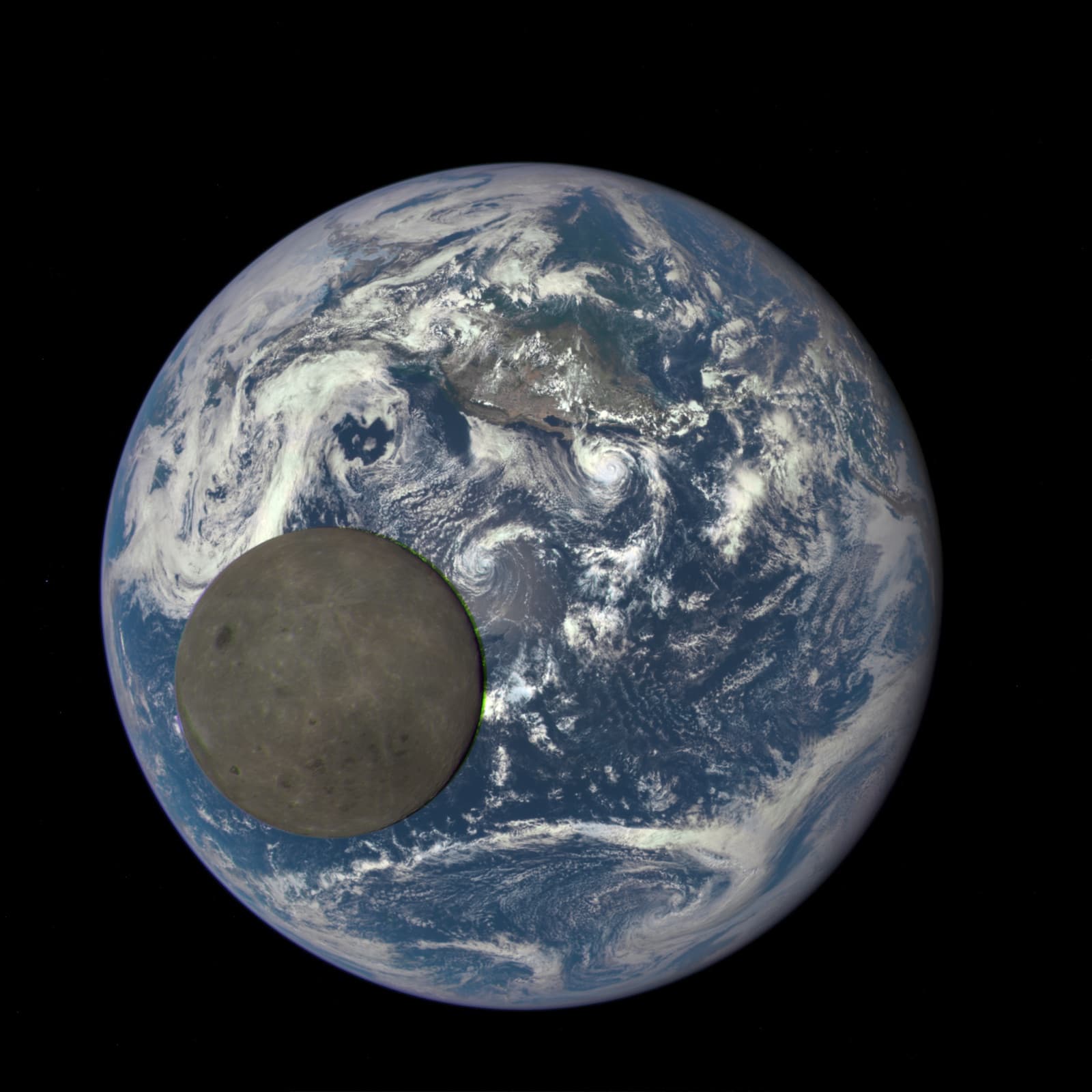
Put a chair in the middle of a room and walk a full circle around it while always facing it. When you get back to where you began, you will have faced every wall of the room once: you turned around exactly once while going around exactly once. That is what the Moon does. NASA's fact sheet gives its rotation period as 655.72 hours and its orbital period as 27.32 days, which is the same length of time, and because the two match, the side facing Earth stays facing Earth. Astronomers call this synchronous rotation. The interesting question is why the match is so exact, and the answer is tides.
Gravity weakens with distance, so Earth pulls harder on the near side of the Moon than on its centre, and harder on the centre than on the far side. The difference stretches the Moon along the line to Earth. NASA's explanation of how that turned into a lock runs like this. When the Moon was young, hotter and closer, it spun faster than it orbited, and Earth stretched it into a slight football shape. Its rotation kept carrying the bulge out of line with Earth, and because rock takes time to rise and fall, the bulge always lagged. Earth's pull on the misaligned bulge acted as a brake, and the constant bending released the spin's energy as heat. The spin slowed until the bulge stopped moving across the surface, which is the moment rotation and orbit came into step. After that there was nothing left to brake. The Moon is not special in this: NASA says every large moon in the solar system is locked to its planet, and that big moons reach this state early, within hundreds of thousands of orbits.
The lock also holds itself in place. The Moon's mass is distributed so that its long axis points toward Earth, and laser ranging has pinned down the resulting differences in its moments of inertia to about 0.05 percent, according to Tom Murphy's review of the technique. If something nudged that axis out of line, Earth's pull on the elongated body would swing it back, the way a pendulum returns to the bottom of its arc. The Moon does rock slightly as Earth, the Sun and the planets tug on it, but only by about 120 arcseconds, which at the surface is a motion of around a kilometre. Earth still raises a tide in the solid Moon today, a small one: a fully fluid Moon would stretch by about 19 metres from peak to trough, while the real, stiff Moon stretches by less than a metre.
So why can we see more than half of it? The Hong Kong Observatory, in an explainer published in May 2026, gives the usual figure: over time, 59 percent of the Moon's surface is visible from Earth, because of libration. Most of libration is a matter of viewing angle. The Moon's spin is almost perfectly steady, but its orbit is an ellipse with an eccentricity of 0.055, so it moves faster when it is close to Earth and slower when it is far away. Through the fast stretch around its closest point the orbit gets ahead of the spin, so as the Moon heads back out we see a little more of its eastern side; through the slow stretch around its farthest point the spin catches up and pulls ahead, so on the way back in we see more of its western side, as the Hong Kong Observatory explains. NASA calls this libration in longitude. Libration in latitude comes from tilt: the Moon's equator is inclined 6.68 degrees to the plane of its orbit, so for part of each month its north pole leans slightly toward us and for part its south pole does. A third, smaller effect, diurnal libration, comes from Earth's size and rotation, which shift our own viewpoint over the course of a night. According to Murphy, libration in longitude and latitude together swing the Earth-facing point by up to about 8 degrees east or west and 7 degrees north or south, a combined tilt that can exceed 10 degrees. The Moon also seems to roll back and forth like a metronome over the month. NASA attributes that mostly to the tilt of Earth, and it changes which way is up on the disc without revealing any more of it.
NASA's Scientific Visualization Studio renders all of this for every hour of the year. Its 2026 edition lists, for each hour, the sub-Earth point: the place on the Moon where Earth is directly overhead, which is also the centre of the disc we see. Over a month that point wanders around the middle of the near side, and that wandering is libration. The azmth Luna globe is built on the same idea. Its Near side view keeps the camera over the real sub-Earth point computed from the globe's clock, and at 10,000 times real speed a full lunar day passes in about four minutes, long enough to watch the Moon turn and nod.
Locking has consequences you can point to. The hemisphere that never turns toward us stayed unseen until Luna 3 swung behind the Moon and photographed it on 7 October 1959. As the Russian science outlet Nauchnaya Rossiya recounts, the 40-minute session covered almost half of the Moon's surface, two thirds of it on the side invisible from Earth, and the public saw the pictures on the front page of Pravda on 27 October. They showed a different world: NASA notes that the dark lava plains, the maria, that mark the near side are nearly absent on the far side, which is crowded with craters instead. The far side is often called the dark side, a label NASA calls misleading. It gets sunlight on the same 29.5-day cycle as the near side, and in July 2015 a NASA camera on NOAA's DSCOVR satellite photographed it almost fully lit as it crossed in front of Earth. What the far side lacks is a view of Earth, and that matters for anything that lands there. Most of it has no direct radio path home, so when Chang'e 4 made the first soft landing on the far side on 3 January 2019, the lander and the Yutu-2 rover worked through the Queqiao relay satellite, which the Chinese Academy of Sciences credits with supporting both.
Stand on the near side and the lock looks different again. The Sun rises and sets once every 29.5 days, but Earth barely moves. It hangs close to the same point in the sky, wandering by several degrees as the sub-Earth point shifts over the month, and from most of the far side it never rises at all.
The tides run both ways, and on Earth they are still working. The Moon raises bulges in Earth's oceans and rock, and because Earth spins once a day while the Moon takes 27.3 days to go around, those bulges are carried ahead of the Moon. James Williams, Slava Turyshev and Dale Boggs of JPL describe what follows: the leading bulges pull the Moon forward along its orbit, and the Moon's pull on them brakes Earth's spin. Energy and angular momentum move from Earth's rotation into the Moon's orbit, so the Moon's distance grows, its month lengthens and Earth's day lengthens. George Darwin predicted this in the late nineteenth century, long before anyone could measure it. Most of the braking happens in the oceans, which is why the shape of the ocean basins turns out to matter so much.
The measuring is done with light. On 21 July 1969 (UTC) Apollo 11 set up the first laser retroreflector on the Moon, a tray of 100 fused-silica corner cubes, each 3.8 centimetres across. A corner cube sends light back toward wherever it came from, so a telescope that fires a short laser pulse at the tray and times the echo gets the distance. Apollo 14 left a second 100-cube array on 5 February 1971 and Apollo 15 a larger one with 300 cubes. The Soviet rovers Lunokhod 1 and Lunokhod 2, landed on 17 November 1970 and 15 January 1973, each carried an identical French-built array of 14 larger cubes. RIA Novosti's reference history of Lunokhod 1 notes that ranging to its French reflector fixed the Earth-Moon distance to within three metres at the time. The first accurate ranges came on 1 August 1969 from the 3.1-metre telescope at Lick Observatory, and McDonald Observatory in Texas began the long campaign a month after the landing.
It is hard. Murphy puts the chance that a photon launched from Earth hits the Apollo 11 array at one in 25 million, because even a well-focused beam has spread to about 1.9 km by the time it reaches the Moon, and a 1-metre telescope catches about one in 250 million of the photons coming back. Precision has still improved from a few decimetres in the early years to a few millimetres. Libration makes the work harder: it tilts the arrays, so some cubes sit closer than others and each returning pulse is smeared out in time. It also makes one reflector especially valuable. Lunokhod 1's array went unranged for almost four decades until Lunar Reconnaissance Orbiter images located the rover in March 2010. On 22 April 2010 the APOLLO station at Apache Point in New Mexico got a strong return, about 2,000 photons in its first 10,000-shot run. Sitting about 50 degrees from the centre of the near side, twice as far out as the Apollo reflectors, it is a more sensitive probe of the Moon's orientation than any of the other four. The newest array, NGLR-1, landed on Blue Ghost 1 on 2 March 2025 and was designed to cut that smearing. The University of Maryland team that built it reports returns that month from Grasse in France, Wettzell in Germany and Apache Point, with Wettzell reaching a precision of about a millimetre.
Decades of those echoes produce the famous number. JPL's DE430 lunar ephemeris, fitted to 43 years of laser ranges, has the Moon's average distance growing by 38.08 ± 0.19 millimetres a year, Williams and colleagues report. Later modellers such as Mohammad Farhat and colleagues take 3.830 ± 0.008 cm a year from a 2016 analysis by Williams and Boggs and treat it as a fixed constraint. The breakdown shows where the push comes from. In DE430, Earth's twice-daily tides supply 33.5 mm a year, its once-daily tides 5.1 mm, and a small remainder from other tides and from tides raised in the Moon takes away 0.5 mm. The laser value agrees to within 1 percent with the Moon's tidal acceleration calculated independently from satellite measurements of Earth's tides, and the same data rule out a claim that the recession is an illusion created by a slowing speed of light: any such apparent drift comes to minus 1.0 ± 1.3 mm a year, consistent with zero.
On Earth the same exchange shows up as a slowly lengthening day, and history can check it. Stephenson, Morrison and Hohenkerk analysed ancient and medieval eclipse records from 720 BC to AD 1600, including Babylonian and Chinese observations, together with timings of the Moon passing in front of stars from 1600 to 2015. They found the average day lengthening by 1.78 ± 0.03 milliseconds per century. Tidal friction alone predicts 2.3 ± 0.1. The gap is informative. Williams and colleagues, following earlier work by Yoder and co-workers, attribute it to Earth still rebounding from the weight of its ice-age glaciers: the planet is becoming slightly less flattened and, like a skater pulling in their arms, spinning up a little, which offsets part of the tidal braking. Stephenson's team also points to coupling between Earth's core and mantle, and to fluctuations over decades to centuries on top of the trend, which is why the tidal slowdown only shows clearly over very long records.
Run the clock backward and today's rate turns out to be unusually fast. Farhat and colleagues note that simple tidal models starting from the present recession and integrated backward bring the Moon into a close encounter with Earth less than 1.6 billion years ago, yet the Moon's estimated age is about 4.4 billion years. The rocks agree that recession was slower for most of Earth's history. Tidal layers in the 620-million-year-old Reynella Siltstone imply an average of 2.17 ± 0.31 cm a year since then, and a 2018 analysis by Stephen Meyers and Alberto Malinverno of 1.4-billion-year-old sediments from the Xiamaling Formation in north China gave a day of 18.68 ± 0.25 hours and a Moon about 340,900 km away. The leading explanation, and the one Farhat's model builds on, is resonance. An ocean basin answers the tide the way water in a bath sloshes when it is pushed at the right rhythm, and as continents drift and the length of the day changes, the oceans move toward and away from resonance. Farhat's 2022 model places today's oceans near a resonance peak, which makes present dissipation high, and it reproduces both the measured rate and the Moon's age with several passes through resonance, each bringing rapid changes in the Earth-Moon distance and the length of the day.
One part of that history is still argued over. In 2023 Ross Mitchell and Uwe Kirscher compiled day-length estimates from ancient rocks and concluded that the day stalled at about 19 hours for roughly a billion years in the middle of the Proterozoic eon. They suggest that a tide in the atmosphere, driven by solar heating, pushed Earth's spin forward just hard enough to cancel the Moon's braking. In a 2024 review, Jacques Laskar and colleagues argue that the case leans on two stromatolite estimates at 1.88 and 2.0 billion years that carry large uncertainties, that the most robust cyclostratigraphic estimates do not support a stall, and that the atmospheric resonance was probably never strong enough to hold the day still. The two groups weigh the same sparse rock record differently, and as of the 2024 review the two positions had not been reconciled, so this page presents both.
None of this is finished. The Moon keeps moving out and Earth keeps slowing. NASA's tidal locking page sketches where the process leads: about 50 billion years from now, if Earth and Moon could somehow avoid the eventual death of the Sun, Earth would also become tidally locked to the Moon, and only one hemisphere of Earth would ever see it. The condition in that sentence carries the weight. The Sun's own evolution comes first, so read it as a description of where the physics points. For now the arrangement is lopsided. The Moon finished locking long ago, while Earth, about 81 times more massive, is still being braked: tidal friction alone would lengthen the day by about 2.3 milliseconds per century, and the measured net lengthening is about 1.8.
What we know
Spin and orbit
NASA's Moon fact sheet gives the sidereal rotation period as 655.720 hours and the orbital (revolution) period as 27.3217 days, the same length of time. The Moon does rotate; it rotates exactly once per orbit.↗
Lunar day and night
NASA: the Moon has a day side and a night side that change as it rotates, and the cycle of phases, new Moon to new Moon, repeats every 29.5 days. So one full day and night lasts about 29.5 days anywhere on the Moon; at new Moon the far side is in full sunlight.↗
How the lock formed
NASA's account: Earth's gravity distorted the young Moon, then closer and less solid, into a football shape (it still does, slightly). As the Moon spun, the bulge lagged because rock takes time to rise and fall; the constant bending released energy as heat, and the spin slowed until it matched the orbit.↗
Not unusual
NASA says all the solar system's large moons are tidally locked to their planets, and that big moons synchronise early in their existence, within hundreds of thousands of orbits.↗
How much we see
About 59 percent of the Moon's surface is visible from Earth over time because of libration (Hong Kong Observatory explainer, May 2026).↗
Libration in longitude
The orbit is elliptical, so the Moon moves faster near Earth and slower far away while its spin stays nearly steady. The Hong Kong Observatory explains that it shows a little more of its eastern side while moving away from Earth and more of its western side while moving back toward it.↗
Libration in latitude
The Moon's equator is tilted 6.68 degrees to the plane of its orbit, so its north and south polar regions take turns leaning toward Earth.↗
Size of the swing
Optical libration moves the Earth-facing point across a range of about ±8.1 degrees in longitude and ±6.9 degrees in latitude; Murphy gives a median total libration of 6.5 degrees, sometimes more than 10. The Moon's real physical rocking is far smaller, about 120 arcseconds, or roughly a kilometre at the surface.↗
Measured recession
Analysis of 43 years of lunar laser ranging (18,548 ranges, March 1970 to December 2012) gives a semi-major axis growth of 38.08 ± 0.19 mm a year for JPL's DE430 lunar ephemeris.↗
Updated value
Farhat and colleagues (2022), citing Williams and Boggs (2016), take the laser-ranging rate as 3.830 ± 0.008 cm a year and use it as a fixed constraint in their tidal-history model.↗
What drives it
In DE430 the twice-daily tides on Earth supply 33.5 mm a year of recession, the once-daily tides 5.1 mm, and zonal tides plus tides raised in the Moon subtract 0.5 mm. Most of the dissipation happens in the oceans.↗
Longer days, measured
Eclipse records from 720 BC to AD 1600 and lunar occultations from 1600 to 2015 show the mean solar day lengthening by +1.78 ± 0.03 ms per century, against +2.3 ± 0.1 ms per century expected from tidal friction alone.↗
The classic reflectors
Five arrays: Apollo 11 and Apollo 14 with 100 fused-silica corner cubes each, Apollo 15 with 300, and Lunokhod 1 and Lunokhod 2 with identical French-built arrays of 14 larger cubes.↗
Long odds
Even a well-focused beam spreads to about 1.9 km at the Moon, so a photon leaving Earth has roughly a one-in-25-million chance of hitting the Apollo 11 array, and a 1-metre telescope catches about one in 250 million of the photons coming back.↗
Lost and found
Lunokhod 1's reflector went unranged for almost 40 years until Lunar Reconnaissance Orbiter images located the rover in March 2010. On 22 April 2010 the APOLLO station at Apache Point returned about 2,000 photons in its first 10,000-shot run.↗
Newest reflector
NGLR-1 landed on Blue Ghost 1 on 2 March 2025. Grasse, Wettzell and Apache Point recorded returns on 3, 4 and 20 March, and Wettzell reached a precision of 0.79 and 1.14 mm.↗
The day 1.4 billion years ago
Cyclic layers in the 1.4-billion-year-old Xiamaling Formation of north China give a day of 18.68 ± 0.25 hours and an Earth-Moon distance of 340,900 ± 2,600 km.↗
Earth's own lock
NASA: about 50 billion years from now, if Earth and Moon could somehow avoid the eventual death of the Sun, Earth would also become tidally locked to the Moon.↗
What happened, and when
- About 4.4 billion years agoThe Moon forms; Farhat and colleagues adopt a 2020 geochemical estimate of its age, 4.425 ± 0.025 billion years. NASA says large moons lock early, so the Moon's one-face arrangement dates from early in its history.
- About 2 to 1 billion years agoDisputed: Mitchell and Kirscher (2023) propose the day stalled at about 19 hours for a billion years; Laskar and colleagues (2024) argue the robust data do not support a stall.
- About 1.4 billion years agoSediments of the Xiamaling Formation record a day of about 18.7 hours and a Moon about 340,900 km away.
- About 620 million years agoTidal layers in the Reynella Siltstone of the Elatina Formation imply the Moon has since receded at an average 2.17 ± 0.31 cm a year, slower than today.
- 720 BCThe oldest eclipse records in the compilation Stephenson, Morrison and Hohenkerk later use to measure Earth's slowing spin.
- 7 Oct 1959Luna 3 photographs the far side for the first time; Pravda prints the pictures on its front page on 27 October.
- 21 Jul 1969Apollo 11 places the first laser retroreflector array on the Moon.
- 1 Aug 1969First accurate laser ranges to the Moon, from the 3.1 m telescope at Lick Observatory; McDonald Observatory begins a long-term programme a month after the landing.
- 17 Nov 1970Lunokhod 1 lands in Mare Imbrium carrying a French-built reflector; laser ranging to it measures the Earth-Moon distance to within three metres.
- 5 Feb 1971Apollo 14 astronauts deploy the second Apollo laser ranging retroreflector.
- 15 Jan 1973Lunokhod 2 lands in Le Monnier crater carrying a French-supplied laser corner reflector.
- 22 Apr 2010After almost 40 years, the lost Lunokhod 1 reflector returns a strong laser echo to Apache Point.
- 3 Jan 2019Chang'e 4 makes the first soft landing on the far side, in Von Karman crater, working through the Queqiao relay satellite because Earth never rises over its landing site.
- 2 to 20 Mar 2025NGLR-1 lands on Blue Ghost 1 and returns laser echoes to Grasse, Wettzell and Apache Point.
- May to Jul 2026NASA's tidal locking page, updated 23 July 2026, gives the Moon's recession as about 4 cm a year; the Hong Kong Observatory's May 2026 libration explainer gives the 59 percent figure.
In pictures
Tap a photo to enlarge.
Sources
- NASA Science: Tidal Locking (page updated 23 Jul 2026)
- NASA NSSDCA: Moon Fact Sheet (rotation and orbit periods, obliquity 6.68 deg, eccentricity 0.0549, recession 3.8 cm/yr)
- NASA Science: Moon Phases, including Our Wobbly Moon on libration (page updated 3 Aug 2026)
- NASA Science: Earth's Moon, Facts (synchronous rotation; the far side as 'dark side' is misleading)
- NASA Scientific Visualization Studio 5587: Moon Phase and Libration, 2026 (Ernie Wright, Noah Petro; released 11 Dec 2025, updated 18 Feb 2026)
- Hong Kong Observatory: What is Lunar Libration? (Hui Hon-ka, May 2026; 59 percent, libration in longitude and latitude, diurnal libration)
- Murphy, Lunar laser ranging: the millimeter challenge, Reports on Progress in Physics 76, 076901 (2013), arXiv:1309.6294
- Williams, Turyshev and Boggs, The past and present Earth-Moon system: the speed of light stays steady as tides evolve, Planetary Science 3:2 (2014)
- Farhat et al., The resonant tidal evolution of the Earth-Moon distance, Astronomy and Astrophysics 665, L1 (2022), arXiv:2207.00438 (cites Williams and Boggs 2016 for the 3.830 cm/yr rate)
- Stephenson, Morrison and Hohenkerk, Measurement of the Earth's rotation: 720 BC to AD 2015, Proceedings of the Royal Society A 472:20160404 (2016)
- Meyers and Malinverno, Proterozoic Milankovitch cycles and the history of the solar system, PNAS 115:6363 (2018)
- Mitchell and Kirscher, Mid-Proterozoic day length stalled by tidal resonance, Nature Geoscience (Jul 2023)
- Laskar et al., Did atmospheric thermal tides cause a daylength locking in the Precambrian? A review on recent results, Sedimentologika (2024), doi:10.57035/journals/sdk.2024.e21.1271, arXiv:2309.11479
- Dickey et al., Lunar laser ranging: a continuing legacy of the Apollo program, Science 265:482 (1994), PubMed abstract
- RIA Novosti (17 Nov 2020): Первый лунный самоходный аппарат "Луноход-1" (reference history, in Russian)
- Nauchnaya Rossiya (7 Oct 2021): На обратной стороне Луны (Luna 3, in Russian)
- Chinese Academy of Sciences: 嫦娥四号实现人类探测器首次月背软着陆 (Chang'e 4 far-side landing, in Chinese)
- NASA NSSDCA Master Catalog: Luna 21 / Lunokhod 2 (Wayback snapshot 4 Jul 2025)
- University of Maryland: NGLR, Next Generation Lunar Retroreflector (NGLR-1 on Blue Ghost 1)
- University of Maryland: NGLR-1 status, 12 March 2025
- NASA Image and Video Library: AS14-67-9386, Apollo 14 laser ranging retroreflector (5 Feb 1971)
- NASA Science: First Photo of the Lunar Far Side (Luna 3 and LRO)
- NASA (5 Aug 2015): From a Million Miles Away, NASA Camera Shows Moon Crossing Face of Earth
- LROC Featured Image: Lunokhod 1 Revisited (Jeff Plescia, 14 Mar 2012)
- Apollo Lunar Surface Journal: Apollo 11 image library (AS11-40-5952)
Checked on 22 September 2026. Where the science is unsettled this page says so rather than picking a winner.