Water on the Moon
Yes, in small and patchy amounts: traces across the whole surface, water in ancient magmas and ice in shadowed polar craters. As of 23 September 2026 no lander has sampled polar ice, and published estimates for the poles run from tens of millions to a few billion tonnes.
TL;DR· 23 min read
Yes. The Moon holds water in three places: tens to hundreds of parts per million in sunlit soil and glass, water dissolved in its ancient magmas, and ice cold-trapped in permanently shadowed polar craters. Polar ice has been measured in place only once, when LCROSS hit Cabeus crater in 2009 and found about 5.6 per cent by mass at the impact point. Published estimates for the poles run from tens of millions to billions of tonnes, and no lander has yet touched the ice, which is why China, India, Japan and the United States are all heading south.
Yes, the Moon has water, but almost none of it looks like water. It is spread through the soil at a few to a few hundred parts per million, sealed inside volcanic and impact glass, and frozen into the floors of polar craters that never see the Sun, and the polar ice, the kind most missions hope to use, has been measured in place just once, when LCROSS crashed a spent rocket stage into Cabeus crater in 2009. For decades after Apollo the Moon was treated as dry; the reversal took disputed radar echoes, neutron counts, re-examined Apollo glass, infrared spectra and that one deliberate impact, and Chinese sample returns have since filled in much of the chemistry. The honest position in September 2026 is that water is everywhere on the Moon in tiny amounts, concentrated in a few very cold places in amounts on which published estimates differ more than tenfold, and that this uncertainty is exactly why so many missions are aimed at the south pole.
- water ice in the Cabeus crater soil struck by LCROSS in 2009, plus or minus 2.9 points: the only in-place measurement of polar ice
- 5.6 % by masswater ice in the Cabeus crater soil struck by LCROSS in 2009, plus or minus 2.9 points: the only in-place measurement of polar ice
- molecular water in sunlit ground around Clavius crater (SOFIA, 2020), roughly a 12-ounce bottle per cubic metre of soil
- 100 to 412 ppmmolecular water in sunlit ground around Clavius crater (SOFIA, 2020), roughly a 12-ounce bottle per cubic metre of soil
- published polar ice estimates, from the eight richest south polar cold traps (2022) to both poles (Lunar Prospector era); none yet checked on the ground
- 34 million to 6 billion tonnespublished polar ice estimates, from the eight richest south polar cold traps (2022) to both poles (Lunar Prospector era); none yet checked on the ground
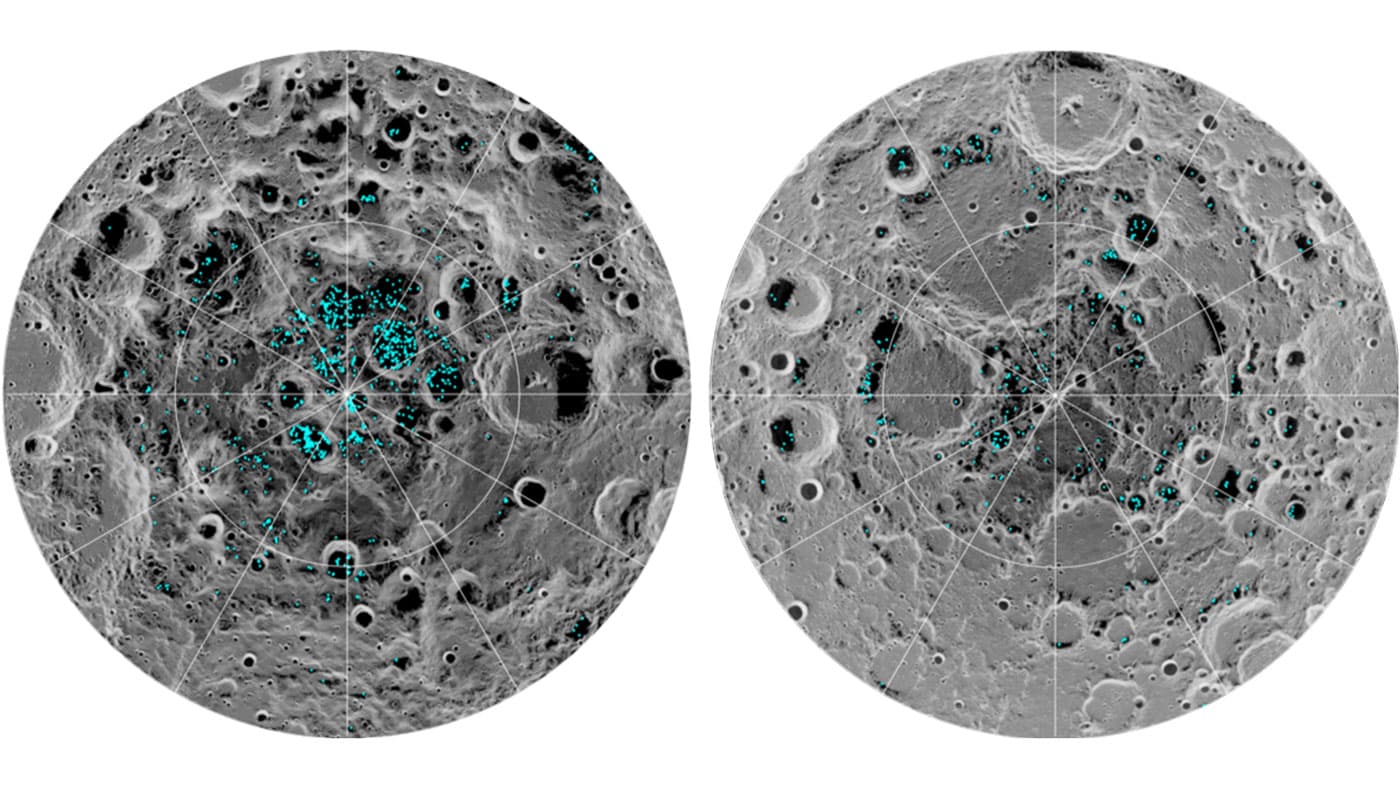
Most arguments about lunar water are really arguments about vocabulary. Scientists count three things under one name. Hydroxyl is one oxygen atom bonded to one hydrogen, bound into minerals and glass. Molecular water is H2O itself, which can be locked in glass or frozen. Water ice is the solid, which survives only where it is cold enough. The amounts are small. When the airborne SOFIA telescope found molecular water in sunlit ground around Clavius crater in 2020, NASA put the concentration at 100 to 412 parts per million, roughly a 12-ounce bottle spread through a cubic metre of soil, and pointed out that the Sahara holds about a hundred times more. Carle Pieters, who led the Moon Mineralogy Mapper team, said in 2009 that water on the Moon means molecules of water and hydroxyl interacting with rock and dust in the top millimetres of the surface, and that nobody was talking about lakes, oceans or even puddles. So the water lives in three places: at trace levels in the sunlit surface everywhere, inside the Moon in magmas that erupted billions of years ago, and frozen in the permanently shadowed floors of polar craters, the reservoir most mission planners hope to mine. The first two have been measured in samples brought to Earth. The third has been measured at its source once, in 2009, by crashing a rocket stage into it.
For a generation the textbook Moon was dry, and for reasons that looked sound. The Chinese Academy of Sciences' Institute of Physics sums up the era in one line: studies of the Apollo samples found no water-bearing minerals, and a waterless Moon became a basic assumption of lunar science. The traces that did turn up were explained away. Rust in the Apollo 16 breccia 66095, the so-called Rusty Rock, was put down to water carried in by the meteorite that formed it, and hydrogen isotopes close to Earth's were read as contamination. On 7 March 1971 the ion detector left by Apollo 14 recorded a burst of ions that its experimenters reported in 1973 as water vapour ions; eighteen years later two of them concluded that the likeliest source was the lander's own exhaust. The Soviet side came closer. In February 1978 M. V. Akhmanova, B. V. Dement'ev and M. N. Markov of the Vernadsky Institute reported in Geokhimiya that infrared spectra of the Luna 24 drill core from Mare Crisium showed about 0.1 per cent water by mass, rising with depth. They gave the paper a title that ended in a question mark, Water in the regolith of Mare Crisium (Luna-24)?, and were careful: the sample showed little tendency to soak up water from the air, but they would not swear contamination had been avoided. In Arlin Crotts's 2011 history of the subject, no other author had ever cited it. Even the Apollo 17 orange soil, a volcanic glass, was described by NASA in January 1973 as holding no substantial water. Almost forty years later, grains of that same soil helped overturn the verdict.
The polar idea is older than the dry Moon. The Moon's spin axis is barely tilted, so near the poles the Sun always skims the horizon and the floors of deep craters never see it; a 1961 paper by Watson and colleagues argued that water could collect as ice in these cold traps. The polar case began in earnest with Clementine, a small US spacecraft that in 1994 bounced radio waves off the south pole to a receiving dish on Earth. In Science on 29 November 1996 its team reported an echo enhancement confined to permanently shadowed ground, with water ice as the probable explanation; NASA's archive records an estimated deposit of 60,000 to 120,000 cubic metres, a small lake. The claim was soon challenged. In 2006 Campbell and colleagues imaged the south pole with Arecibo radar at 20-metre resolution and found the same signature on sunlit terrain where ice cannot last, following rocky crater walls and ejecta with no link to shadow; if the polar hydrogen was ice, their data were consistent only with grains scattered through the soil. Lunar Prospector counted neutrons instead. Hydrogen slows the neutrons that leak from the surface, and in 1998 the spacecraft found dips in intermediate-energy neutrons of 4.6 per cent over the north pole and 3.0 per cent over the south, consistent with ice buried under up to 40 centimetres of dry soil. NASA announced on 5 March 1998 that water ice might be present at both poles, and NASA's archive puts the ice at about 6 trillion kilograms, an estimate it warns could be off considerably. On 31 July 1999 the spent spacecraft was steered into a shadowed crater near the south pole in the hope of throwing up a plume. Telescopes on Earth saw nothing.
The turn, when it came, started inside the Moon. In July 2008 Alberto Saal, Erik Hauri and colleagues used a newly sensitive ion probe on Apollo volcanic glass beads and modelled how much water the glass had lost as it erupted: a best estimate of 745 parts per million before eruption, and no less than 260. In 2011 they found a way to stop modelling. A Brown University undergraduate, Thomas Weinreich, searched thousands of grains of the Apollo 17 orange soil and found ten with melt inclusions, droplets of magma sealed inside olivine crystals before they could degas. Those droplets held 615 to 1,410 parts per million of water, similar to the primitive basalts of Earth's mid-ocean ridges, and implied that parts of the lunar interior are as wet as Earth's upper mantle. The interior is uneven, though. Basalts returned by China's Chang'e 5 point to a mantle source with at most 1 to 5 micrograms of water per gram for lavas two billion years old, and far side basalts from Chang'e 6 to 1 to 1.5, possibly drier than the near side; the authors suggest the Moon's interior water may be split between hemispheres, as so much of its surface is. How much water the Moon started with remains open, and it matters, because the answer constrains models of the giant impact thought to have made it.
Then, in the autumn of 2009, the surface lit up. On 24 September three papers in Science, from the NASA-built Moon Mineralogy Mapper on India's Chandrayaan-1, from Cassini's 1999 flyby and from the Deep Impact spacecraft, reported an infrared absorption near 3 micrometres across the sunlit Moon, strongest at cool high latitudes: hydroxyl or water, and the data could not say which. A fortnight later, on 9 October, NASA's LCROSS drove a spent Centaur upper stage into the permanently shadowed floor of Cabeus crater near the south pole and flew a shepherding spacecraft through the debris. Colaprete's team counted 155 plus or minus 12 kilograms of water vapour and ice in the instruments' view, and estimated that the soil at the impact site held 5.6 plus or minus 2.9 per cent water ice by mass, along with light hydrocarbons, sulfur compounds and carbon dioxide. The Diviner radiometer on the Lunar Reconnaissance Orbiter put subsurface temperatures at the site near 38 kelvin, and its team read the mix of volatiles as strong evidence of delivery by primitive bodies from the outer solar system. LRO's Russian-built neutron detector, LEND, had chosen the target: it placed Cabeus at 0.5 to 4 per cent ice depending on how much dry soil lies on top, and found that hydrogen-rich patches do not line up neatly with the shadows. In March 2010 NASA's Mini-SAR radar on Chandrayaan-1 reported more than 40 small north polar craters whose interiors scattered radar the way ice does, and NASA estimated at least 600 million tonnes, if the ice was relatively pure and at least a couple of metres thick.
The 3-micrometre band cannot tell hydroxyl from water, and that gap stayed open for eleven years until an aeroplane closed it for one place. On 26 October 2020 Casey Honniball and colleagues reported that SOFIA, a Boeing 747SP carrying a 2.7-metre telescope above most of Earth's water vapour, had caught the 6-micrometre signature that only molecular water produces, at high southern latitudes around Clavius, at 100 to 400 micrograms per gram. To survive the sunshine, they argued, it must be sheltered inside glass or between grains. The same day Hayne and colleagues showed that cold traps exist at every scale from a kilometre down to a centimetre, which brings the permanent cold-trap area for water to about 40,000 square kilometres, 60 per cent of it in the south. Other questions are still argued. Li and Milliken mapped hydroxyl rising with latitude to about 500 to 750 parts per million and changing by some 200 over a lunar day; Bandfield's group, correcting the same instrument's data for heat in a different way, found the signal at every latitude and time of day, with no significant daily migration. LADEE caught 29 releases of water into the Moon's thin exosphere as it crossed meteoroid streams, which Benna's team read as a hydrated layer lying under several centimetres of dry soil, and as a Moon slowly losing water it received long ago or was born with.
China's sample returns have turned the surface question into laboratory chemistry. Chang'e 5 landed in northern Oceanus Procellarum in December 2020 and, before lifting off, measured the ground with its own spectrometer: up to 120 parts per million of water in the soil, mostly implanted by the solar wind, and, if the same model applies to rock, about 180 in a nearby rock. In the returned soil an ion-probe study found grain rims carrying 1,116 to 2,516 parts per million of hydrogen with an isotope signature that points almost wholly to the solar wind, and predicted about 560 parts per million of water in polar soils. In March 2023 He Huicun and Hu Sen of the Institute of Geology and Geophysics reported impact glass beads with up to about 2,000 parts per million of water at their rims, falling toward their cores: solar wind water diffusing inward and, on their model, recharged in under 15 years. Scaled to the whole Moon, the beads could hold up to 270 trillion kilograms, which, as the Academy's release points out, is still far below the roughly billion trillion kilograms in Earth's oceans. In July 2024 Jin Shifeng, Chen Xiaolong and colleagues at the Institute of Physics described a crystal in Chang'e 5 soil, (NH4)MgCl3·6H2O, about 41 per cent water by mass, which the institute called the first discovery of molecular water in lunar soil; the authors excluded contamination and rocket exhaust on chlorine isotope and formation grounds, and the finding rests on one sample. A separate 2024 study showed that melting the soil at temperatures above 1,200 kelvin (about 930 degrees Celsius) yields 51 to 76 milligrams of water per gram by reacting implanted hydrogen with iron oxides. That is water manufactured from the soil. The Academy's release on that study puts the water already in the soil's minerals at 0.0001 to 0.02 per cent.
That leaves the poles, where the stakes are. Some craters sit inside larger shadowed craters and are sheltered even from light reflected off sunlit peaks; their floors reach about 25 kelvin. In 2018 Shuai Li and colleagues found the near-infrared fingerprints of water ice itself in Moon Mineralogy Mapper data, using faint light bounced off crater walls: several thousand 280-metre pixels within 20 degrees of both poles, some possibly around 30 per cent ice mixed with soil, yet only about 3.5 per cent of cold traps showed exposed ice at all. On 18 March 2026 a team led from the University of Hawaii published a new survey from NASA's ShadowCam on Korea's Danuri, a camera 200 times more sensitive than LRO's narrow-angle camera. They found no evidence of widespread surface ice above a detection limit of 20 to 30 per cent by weight and could not rule out widespread ice at lower concentrations; a few spots 20 to 50 metres across could hold more than 10 per cent ice, though other explanations remain possible. In May 2026 Rishitosh Sinha and colleagues, using the dual-frequency radar on Chandrayaan-2, reported signatures of subsurface ice beneath four of nine doubly shadowed craters inside Faustini, Haworth and Shoemaker. Ice may not need permanent shadow either. Chandrayaan-3's thermal probe measured 355 kelvin on a sunward slope of 6 degrees at its high-latitude landing site, hotter than expected, and the modelling built on it suggests that poleward-facing slopes steeper than 14 degrees at high latitudes could harbour water ice, in places that are technically less challenging to reach.
So how much is there? What has been measured is modest: parts per million in the sunlit surface and in returned samples, up to about 2,000 in the rims of individual glass beads, and one polar crater, Cabeus, at about 5.6 per cent at a single impact point. Everything larger is an estimate, and the estimates count different things. The Lunar Prospector era figure was about 6 billion tonnes for both poles. Mini-SAR's was at least 600 million tonnes for the north alone. A 2022 synthesis by Brown and colleagues put roughly 34 million tonnes in the eight south polar cold traps most likely to be rich in volatiles, and a 2007 model gave Shackleton crater 1.6 to 4.5 million tonnes, depending on assumptions. At the other end, Cannon and colleagues modelled billions of years of ice delivery interrupted by impacts that bury it, and found that cold traps older than about 4 billion years could hide buried, ice-rich deposits on the scale of a billion tonnes, while conceding that ice buried that deep is hard to confirm. On 14 September 2026 Martin Elvis and Jonathan McDowell took one billion tonnes as a generous baseline and calculated that it would supply a city of a million people, recycling water as well as the International Space Station does, for only about a century. The origin is just as unsettled. The Diviner team read the mix of volatiles in the LCROSS plume as pointing to comets and other primitive bodies, the isotopes in Chang'e 5 grains point to the solar wind, and the Apollo melt inclusions show that lunar magmas carried water their eruptions could release; Erik Hauri, an author of the 2011 study, suggested some polar ice could have come from that source. How much each contributed is unknown.
That uncertainty is the reason for the traffic. Water means drinking water and breathable oxygen, and split into hydrogen and oxygen it becomes rocket propellant, so ice dug up locally would spare a base from hauling all of it from Earth. The people building the landers want ground truth. Tang Yuhua, deputy chief designer of Chang'e 7, told China National Radio in February 2025, in a report carried by Xinhua, that remote sensing had only suggested ice might be there, and that the mission would go to the surface to verify whether it exists; its hopper is to carry a water-molecule analyser and is designed to fly from sunlight into shadowed craters to fix where the ice is, how much there is and how it is spread. On 23 August 2026 China's crewed space office said Chang'e 7 could not fly in this year's scheduled window, and gave no new date. NASA cancelled its ice-prospecting rover VIPER in July 2024, then in September 2025 gave Blue Origin an option to land it on a second Blue Moon Mark 1 by late 2027, to be decided after the first Mark 1 has flown. After a New Glenn rocket exploded on its pad in May 2026, Blue Origin said in August that it expected that first launch in early 2027. IM-2 Athena reached the south polar region on 6 March 2025 with a NASA ice drill but came down on its side, and the drill could demonstrate only its range of motion. The Japanese and Indian LUPEX rover is designed to drill for polar water and measure its quantity and quality. And NASA, which on 27 February 2026 made Artemis IV its first crewed landing, targeted for early 2028, said then that it aims to send astronauts to the lunar south pole in 2028 and expects to begin building a Moon base on Artemis V, planned for late 2028. Who may own the ice is unsettled too. The Outer Space Treaty bars national appropriation of the Moon; the Artemis Accords, signed by 73 countries as of 21 September 2026, affirm that extracting resources does not in itself amount to appropriation; and a United Nations working group is still drafting principles for space resource activities, with meetings scheduled into 2027.
What we know
The short answer (as of 23 September 2026)
Water is present across the Moon as hydroxyl and molecular water at parts-per-million levels, inside volcanic glass and minerals, and as ice in polar cold traps. A ShadowCam survey of the shadowed craters, published in March 2026, found no evidence of widespread surface ice above a detection limit of 20 to 30 per cent by weight, a few small spots that could be consistent with more than 10 per cent, and could not rule out widespread ice at lower concentrations. Its authors note that radar, neutron and visible-light observations had not definitively detected ice deposits. In May 2026 a Chandrayaan-2 radar study reported what its authors call strong evidence for subsurface ice beneath four small, doubly shadowed craters.↗
The Apollo-era verdict
The Institute of Physics of the Chinese Academy of Sciences summarises the pre-2008 consensus: 对1969年-1972年采集的阿波罗样品的研究表明,月壤中未发现任何含水矿物。此后,月球不含水成为月球科学的基本假设 (studies of the Apollo samples collected from 1969 to 1972 found no water-bearing minerals in the lunar soil; after that, a waterless Moon became a basic assumption of lunar science). NASA puts it the same way: when the Apollo astronauts returned in 1969, the Moon was thought to be completely dry.↗
The Soviet report nobody followed up
In February 1978 M. V. Akhmanova, B. V. Dement'ev and M. N. Markov of the Vernadsky Institute reported in Geokhimiya (No. 2, pp. 285-288) about 0.1 per cent water by mass in the Luna 24 core from Mare Crisium, seen by infrared absorption near 3 micrometres and increasing with depth. The Russian title ended in a question mark: Вода в реголите моря Кризисов (Луна-24)? (Water in the regolith of Mare Crisium (Luna-24)?). The authors said the sample showed little tendency to absorb atmospheric water but did not rule contamination out entirely, and by Arlin Crotts's 2011 account no other author had cited the paper.↗
Clementine's radar claim, and the rebuttal
Nozette and colleagues (Science 274:1495-1498, 29 November 1996) reported a same-sense radar polarisation enhancement localised to the permanently shadowed south polar region and absent from sunlit terrain, with water ice as a probable explanation. Campbell and colleagues (Nature 443:835-837, 2006) then imaged the south pole with Arecibo radar at 20-metre resolution and found the same polarisation at all latitudes observed, strongly correlated with the rocky walls and ejecta of young craters and uncorrelated with sunlight. They found no evidence for concentrated ice in Shackleton crater or elsewhere at the south pole.↗
Lunar Prospector's hydrogen (1998)
Epithermal neutron flux dipped 4.6 per cent at the north pole and 3.0 per cent at the south, consistent with water ice covered by up to 40 centimetres of dry regolith in shadowed craters (Feldman and colleagues, Science 281:1496-1500). The neutron data detect hydrogen, whose chemical form they cannot identify. NASA's archive gives the resulting ice estimate as 6 trillion kilograms and warns that model uncertainties mean it could be off considerably.↗
Water inside the Moon
Melt inclusions sealed in olivine from the Apollo 17 orange soil hold 615 to 1,410 ppm water, similar to primitive mid-ocean ridge basalts on Earth (Hauri and colleagues, Science 333:213-215, 2011). Chang'e 5 basalts point to a mantle source with at most 1 to 5 micrograms per gram (Hu and colleagues, Nature 600:49-53, 2021), and Chang'e 6 far side basalts to 1 to 1.5, which their authors read as a possible near side and far side dichotomy (He and colleagues, Nature 643:366-370, 2025).↗
Moon Mineralogy Mapper (2009)
NASA's M3 on Chandrayaan-1 detected absorption near 2.8 to 3.0 micrometres across the sunlit surface, strongest at cool high latitudes and at some fresh feldspathic craters, attributed to hydroxyl and/or water (Pieters and colleagues, Science 326:568-572, 24 September 2009). The band cannot separate hydroxyl from molecular water.↗
LCROSS in Cabeus (2009)
A spent Centaur stage hit the shadowed floor of Cabeus on 9 October 2009. The shepherding spacecraft saw 155 plus or minus 12 kg of water vapour and ice in its instruments' field of view, and the team estimated 5.6 plus or minus 2.9 per cent water ice by mass in the soil at the impact site, plus light hydrocarbons, sulfur-bearing species and carbon dioxide (Colaprete and colleagues, Science 330:463-468).↗
The neutron view of Cabeus
LRO's Russian-built LEND detector, whose data picked the LCROSS target, placed Cabeus at 0.5 to 4.0 per cent water ice by weight depending on how much dry regolith overlies it, and found that the hydrogen-rich regions are not spatially coincident with permanently shadowed regions (Mitrofanov and colleagues, Science 330:483-486, 2010).↗
Mini-SAR's north pole estimate (2010)
NASA's radar on Chandrayaan-1 found more than 40 small north polar craters, 2 to 15 km across, with elevated circular polarisation ratios inside their rims but not outside, which the team's paper called consistent with water ice deposits (Spudis and colleagues, Geophysical Research Letters 37, March 2010). Fresh craters show high ratios inside and outside their rims because of surface roughness. NASA's release estimated at least 600 million metric tons, adding that the ice must be relatively pure and at least a couple of metres thick to give the signature.↗
Molecular water in sunlight (2020)
SOFIA saw the 6-micrometre band that only molecular water produces at high southern latitudes around Clavius crater, at about 100 to 400 micrograms per gram, probably stored in glass or between grains (Honniball and colleagues, Nature Astronomy 5:121-127, published online 26 October 2020). The authors attribute its distribution to local geology and say it is probably not a global phenomenon. NASA's release gives 100 to 412 ppm and notes the Sahara holds about a hundred times more.↗
Chang'e 5 on the surface (2022)
The Chang'e 5 lander's spectrometer measured up to 120 ppm water (hydroxyl plus H2O) in the regolith of northern Oceanus Procellarum, mostly from solar wind implantation, and about 180 ppm in a nearby rock if the soil model applies to rock, possibly pointing to an interior source (Lin and colleagues, Science Advances 8:eabl9174, 7 January 2022).↗
Glass beads as a reservoir (2023)
The CAS Institute of Geology and Geophysics release on He Huicun and Hu Sen's Nature Geoscience paper: 月球撞击玻璃珠的水含量可达约2000 ppm (water in lunar impact glass beads reaches about 2,000 ppm), with rims wetter than cores, and 估算月壤的储水量最高可达2.7×10^14 kg,比地球四大洋的水储量(~1×10^21 kg)低 (lunar soil may store up to 2.7 × 10^14 kg of water, less than Earth's oceans at about 1 × 10^21 kg). The paper models recharge by solar wind in under 15 years at 360 K.↗
A hydrated crystal in Chang'e 5 soil (2024)
Jin Shifeng, Chen Xiaolong and colleagues at the CAS Institute of Physics described (NH4)MgCl3·6H2O, about 41 per cent water by mass, in Chang'e 5 soil (Nature Astronomy, July 2024). The institute called it 首次在月壤中发现了分子水 (the first discovery of molecular water in lunar soil). The authors ruled out terrestrial contamination and rocket exhaust from chlorine isotopes and formation conditions.↗
Water made from soil is a different number
Chen and colleagues, a CAS-led team, found that melting Chang'e 5 soil at temperatures above 1,200 K (about 930 degrees Celsius) yields 51 to 76 mg of water per gram, by reacting solar wind hydrogen with iron oxides, and that ilmenite holds the most hydrogen (The Innovation 5:100690, published online 22 August 2024). The Academy's release puts the water already held in soil minerals at only 0.0001 to 0.02 per cent (这些矿物中的含水量仅在0.0001%至0.02%之间).↗
How much cold trap there is
Counting shadows from 1 km down to 1 cm, Hayne and colleagues estimate about 40,000 square kilometres of permanent cold traps for water, about 60 per cent in the south and most poleward of 80 degrees, with 10 to 20 per cent of the area in micro cold traps (Nature Astronomy 5:169-175, published online 26 October 2020).↗
Exposed ice is patchy
Li and colleagues found near-infrared ice absorptions in several thousand M3 pixels (about 280 m) within 20 degrees of both poles, some possibly around 30 per cent ice mixed with dry regolith, but only about 3.5 per cent of cold traps show exposed ice (PNAS 115:8907-8912, 2018).↗
Radar ice in doubly shadowed craters (2026)
Sinha and colleagues used Chandrayaan-2's dual-frequency radar on nine doubly shadowed craters inside Faustini, Haworth and Shoemaker, where temperatures reach around 25 K. Four show circular polarisation ratios above 1 with low degrees of polarisation, which the authors call strong evidence for subsurface ice (npj Space Exploration, published 6 May 2026).↗
What a billion tonnes would buy (2026)
Elvis and McDowell take about one billion tonnes of polar water as a generous baseline and find it could support a population of one million at ISS-level (98 per cent) recycling for only about a century. Their paper cites Brown and colleagues (Icarus, 2022) at about 34 million tons for the eight richest south polar cold traps and notes that the mass estimates are quite uncertain (Frontiers in Space Technologies, 14 September 2026).↗
What Chang'e 7 is for
Tang Yuhua, deputy chief designer of Chang'e 7, told China National Radio, in a report carried by Xinhua on 3 February 2025: 之前的遥感探测说可能有水冰,现在嫦娥七号就相当于直接到月面去认证水冰到底有没有 (earlier remote sensing said there may be water ice; Chang'e 7 is in effect going straight to the lunar surface to verify whether the ice is there at all). Its hopper is to carry a water-molecule analyser and is meant to fly from the sunlit south polar region into the floors of permanently shadowed craters to determine the ice's location, quantity and distribution. As of 23 September 2026 it has not launched: the 23 August 2026 notice from China's crewed space office said it could not fly in this year's scheduled window.↗
What happened, and when
- 1961Watson and colleagues argue in the Journal of Geophysical Research that ice could collect in lunar cold traps, the permanently shadowed crater floors near the poles.
- 7 Mar 1971The ion detector left by Apollo 14 records a burst of ions that its experimenters reported in 1973 as water vapour ions. Two of its experimenters later judged the lander's own exhaust the likeliest source.
- Feb 1978Vernadsky Institute scientists report about 0.1 per cent water in the Luna 24 core, under a title that ends in a question mark. The paper goes almost uncited.
- 29 Nov 1996Clementine's bistatic radar result is published: an echo enhancement over the shadowed south pole, read as possible ice. Arecibo radar later finds the same signal on sunlit rough ground.
- 5 Mar 1998NASA announces that Lunar Prospector's neutron data indicate water ice might be present at both poles. Its deliberate crash into a shadowed crater on 31 July 1999 produces no visible plume.
- Jul 2008Saal and colleagues model Apollo volcanic glasses as having held about 745 ppm water before eruption (at least 260 ppm), evidence that the Moon's interior may not be entirely dry.
- 24 Sep 2009Three papers in Science, from M3 on Chandrayaan-1, Cassini and Deep Impact, report hydroxyl or water across the sunlit surface.
- 9 Oct 2009LCROSS strikes Cabeus crater. NASA announces water in the plume on 13 November; the full analysis gives 5.6 per cent water ice by mass at the site.
- 2 Mar 2010NASA reports Mini-SAR radar signatures of ice in more than 40 north polar craters, at least 600 million metric tons if the ice is pure and metres thick.
- 26 Oct 2020NASA announces SOFIA's detection of molecular water in sunlit soil at Clavius crater, alongside a paper finding cold traps down to centimetre scale.
- 7 Jan 2022The Chang'e 5 team publishes water measured on the surface by the lander's own spectrometer: up to 120 ppm in the regolith.
- Mar 2023Chinese Academy of Sciences researchers report Chang'e 5 impact glass beads holding up to about 2,000 ppm solar wind water.
- 18 Mar 2026ShadowCam on Danuri finds no widespread surface ice above 20 to 30 per cent by weight in polar shadowed craters, and a few small candidate spots.
- 6 May 2026Chandrayaan-2 radar results point to subsurface ice beneath four doubly shadowed craters near the south pole.
- 23 Aug 2026China's crewed space office says Chang'e 7, built to verify south polar ice on the ground, does not meet launch conditions and cannot fly in this year's window. No new date given (as of 23 September 2026).
In pictures
Tap a photo to enlarge.
Sources
- Li, Robinson, Denevi et al., Searching for surficial water ice in lunar permanently shaded regions (PSRs) with ShadowCam, Science Advances 12:eaec8211 (18 Mar 2026)
- Sinha, Bharti, Acharyya, Mishra, Srivastava and Bhardwaj, Subsurface ice in doubly shadowed craters as revealed by Chandrayaan-2 dual frequency synthetic aperture radar, npj Space Exploration (6 May 2026)
- Elvis and McDowell, No cities on the Moon: a billion tons of water is not enough for sustainability, Frontiers in Space Technologies (14 Sep 2026)
- NASA Space Science Data Coordinated Archive: Ice on the Moon, a summary of Clementine and Lunar Prospector results
- Crotts, Water on the Moon, I. Historical Overview, Astronomical Review 6(8):4-20 (2011), arXiv 1205.5597
- Marov, Exploration of the Moon by Automatic Spacecraft, Kosmicheskie Issledovaniya (2023): Russian reference list citing Akhmanova, Dement'ev and Markov, Geokhimiya 1978 No. 2, 285-288
- Nozette et al., The Clementine bistatic radar experiment, Science 274:1495-1498 (1996)
- Campbell et al., No evidence for thick deposits of ice at the lunar south pole, Nature 443:835-837 (2006)
- Feldman et al., Fluxes of fast and epithermal neutrons from Lunar Prospector: evidence for water ice at the lunar poles, Science 281:1496-1500 (1998)
- NSSDCA Lunar Prospector mission page (impact of 31 July 1999, no plume observed)
- Saal et al., Volatile content of lunar volcanic glasses and the presence of water in the Moon's interior, Nature 454:192-195 (2008)
- Hauri et al., High pre-eruptive water contents preserved in lunar melt inclusions, Science 333:213-215 (2011)
- Brown University (2011): Scientists detect Earth-equivalent amount of water in the moon
- NASA image S73-15171 (4 Jan 1973): photomicrograph of Apollo 17 orange soil, with the contemporary caption
- Pieters et al., Character and spatial distribution of OH/H2O on the surface of the Moon seen by M3 on Chandrayaan-1, Science 326:568-572 (2009)
- NASA JPL (24 Sep 2009): NASA instruments reveal water molecules on lunar surface
- Clark, Detection of adsorbed water and hydroxyl on the Moon, Science 326:562-564 (2009), Cassini VIMS data
- Sunshine et al., Temporal and spatial variability of lunar hydration as observed by the Deep Impact spacecraft, Science 326:565-568 (2009)
- Colaprete et al., Detection of water in the LCROSS ejecta plume, Science 330:463-468 (2010)
- NASA: What was LCROSS? (mission page with the 13 November 2009 announcement)
- Paige et al., Diviner Lunar Radiometer observations of cold traps in the Moon's south polar region, Science 330:479-482 (2010)
- Mitrofanov et al., Hydrogen mapping of the lunar south pole using the LRO neutron detector experiment LEND, Science 330:483-486 (2010)
- NASA (2 Mar 2010): NASA radar finds ice deposits at Moon's north pole (Mini-SAR)
- Spudis, Bussey, Baloga, Butler et al., Initial results for the north pole of the Moon from Mini-SAR, Chandrayaan-1 mission, Geophysical Research Letters 37(6) (March 2010)
- Honniball et al., Molecular water detected on the sunlit Moon by SOFIA, Nature Astronomy 5:121-127 (published online 26 Oct 2020)
- NASA (26 Oct 2020): NASA's SOFIA discovers water on sunlit surface of Moon
- Hayne, Aharonson and Schorghofer, Micro cold traps on the Moon, Nature Astronomy 5:169-175 (published online 26 Oct 2020)
- Li and Milliken, Water on the surface of the Moon as seen by the Moon Mineralogy Mapper, Science Advances 3:e1701471 (2017)
- Bandfield et al., Widespread distribution of OH/H2O on the lunar surface inferred from spectral data, Nature Geoscience 11:173-177 (2018)
- Benna et al., Lunar soil hydration constrained by exospheric water liberated by meteoroid impacts, Nature Geoscience 12:333-338 (2019)
- Li et al., Direct evidence of surface exposed water ice in the lunar polar regions, PNAS 115:8907-8912 (2018)
- Lin et al., In situ detection of water on the Moon by the Chang'E-5 lander, Science Advances 8:eabl9174 (2022)
- Xu et al., High abundance of solar wind-derived water in lunar soils from the middle latitude, PNAS 119:e2214395119 (2022)
- He et al., A solar wind-derived water reservoir on the Moon hosted by impact glass beads, Nature Geoscience 16:294-300 (2023)
- 中国科学院 (29 Mar 2023): 嫦娥五号月壤中的撞击玻璃珠揭示月球可能的储水方式 (CAS: Chang'e 5 impact glass beads reveal how the Moon may store water)
- 中国科学院物理研究所 (19 Jul 2024): 月壤中发现富含水分子的矿物 (CAS Institute of Physics: a mineral rich in water molecules found in lunar soil)
- Jin et al., Evidence of a hydrated mineral enriched in water and ammonium molecules in the Chang'e-5 lunar sample, Nature Astronomy (16 Jul 2024)
- 中国科学院 (22 Aug 2024): 科学家通过嫦娥五号月壤研究提出大量生产水的方法 (CAS: a method to produce large amounts of water from Chang'e 5 soil)
- Chen et al., Massive water production from lunar ilmenite through reaction with endogenous hydrogen, The Innovation 5(5):100690 (published online 22 Aug 2024)
- Hu et al., A dry lunar mantle reservoir for young mare basalts of Chang'e-5, Nature 600:49-53 (2021)
- He et al., Water abundance in the lunar farside mantle, Nature 643:366-370 (2025)
- Durga Prasad et al., Higher surface temperatures near south polar region of the Moon measured by ChaSTE experiment on-board Chandrayaan-3, Communications Earth & Environment (6 Mar 2025)
- Cannon, Deutsch, Head and Britt, Stratigraphy of ice and ejecta deposits at the lunar poles, Geophysical Research Letters 47 (2020)
- 新华网客户端 (3 Feb 2025), report by 中央广播电视总台中国之声 (China National Radio): 目标月球南极!嫦娥七号任务有哪些特殊之处 (what is special about the Chang'e 7 mission), with deputy chief designer Tang Yuhua
- 中国载人航天工程办公室 (23 Aug 2026): Chang'e 7 postponement notice
- NASA (17 Jul 2024): NASA ends VIPER project, continues Moon exploration
- NASA (19 Sep 2025): NASA selects Blue Origin to deliver VIPER rover to Moon's south pole
- Spaceflight Now (6 Aug 2026): Blue Origin identifies engine issue behind New Glenn explosion (first Blue Moon Mark 1 expected Q1 2027)
- NASA (Mar 2025): NASA receives some data before Intuitive Machines ends lunar mission (IM-2, PRIME-1)
- JAXA: Lunar Polar Exploration (LUPEX) project underway, working with India to investigate if there is water on the Moon
- NASA (27 Feb 2026): NASA strengthens Artemis, adds mission, refines overall architecture
- NASA (21 Sep 2026): NASA welcomes Albania as newest Artemis Accords signatory (73rd)
- The Artemis Accords (13 Oct 2020), Section 10: Space Resources
- UNOOSA: Treaty on Principles Governing the Activities of States in the Exploration and Use of Outer Space (1967), Article II
- UNOOSA: Working Group on Legal Aspects of Space Resource Activities (meeting schedule into 2027)
- ShadowCam team (ASU): first ShadowCam image, the shadowed interior of Shackleton crater
Checked on 23 September 2026. Where the science is unsettled this page says so rather than picking a winner.