Where the Moon Came From
Unsettled. As of 23 September 2026 most researchers work with some version of a giant impact between the young Earth and a body called Theia about 4.5 billion years ago, but how one collision could produce the system's spin, the iron-poor Moon and the near-perfect match between lunar and terrestrial isotopes together is still argued over.
TL;DR· 20 min read
Most researchers think the Moon formed after a planet-sized body, Theia, hit the young Earth about 4.5 billion years ago, but it remains a hypothesis. Its classic version predicts a Moon made mostly of Theia, yet lunar rocks match Earth's mantle in oxygen, titanium and other isotopes to within a few parts per million. Rival versions (a fast-spinning Earth, a vapour synestia, many small impacts, a magma ocean, a Moon formed in hours) each fix part of that problem, and none has won.
Nobody knows for certain, but the leading explanation is a collision: about 4.5 billion years ago a planet-sized body, now called Theia, struck the young Earth, and the Moon gathered out of the debris. That idea has been the working consensus since a 1984 conference in Kona, Hawaii, yet its classic version predicts a Moon built mostly from Theia, while the Moon's rocks turn out to be almost indistinguishable from Earth's mantle in oxygen, titanium and other isotopes, down to parts per million. Decades of simulations have produced a family of rescue plans: a faster-spinning Earth, a bigger impactor, a vast spinning cloud of rock vapour called a synestia, a string of smaller impacts, a magma ocean on the young Earth, a Moon thrown into orbit intact within hours. Each fixes part of the problem. None has won, and a small school of Russian geochemists doubts there was a giant impact at all. This page sets out the evidence, what the Apollo, Luna and Chang'e samples have added, and why the question is still open.
- difference in the oxygen isotope signature (Δ'17O) between Earth's mantle and 14 pristine Apollo rocks, Fischer et al. 2024
- 0.2 ± 1.6 ppmdifference in the oxygen isotope signature (Δ'17O) between Earth's mantle and 14 pristine Apollo rocks, Fischer et al. 2024
- range of published ages for the Moon, depending on whether whole rocks or zircon grains are dated
- 4.35 to 4.51 billion yearsrange of published ages for the Moon, depending on whether whole rocks or zircon grains are dated
- the Moon's mass as a share of Earth's; in John Wood's 1986 table of satellite-to-planet ratios only Pluto's was larger
- 1.2 %the Moon's mass as a share of Earth's; in John Wood's 1986 table of satellite-to-planet ratios only Pluto's was larger
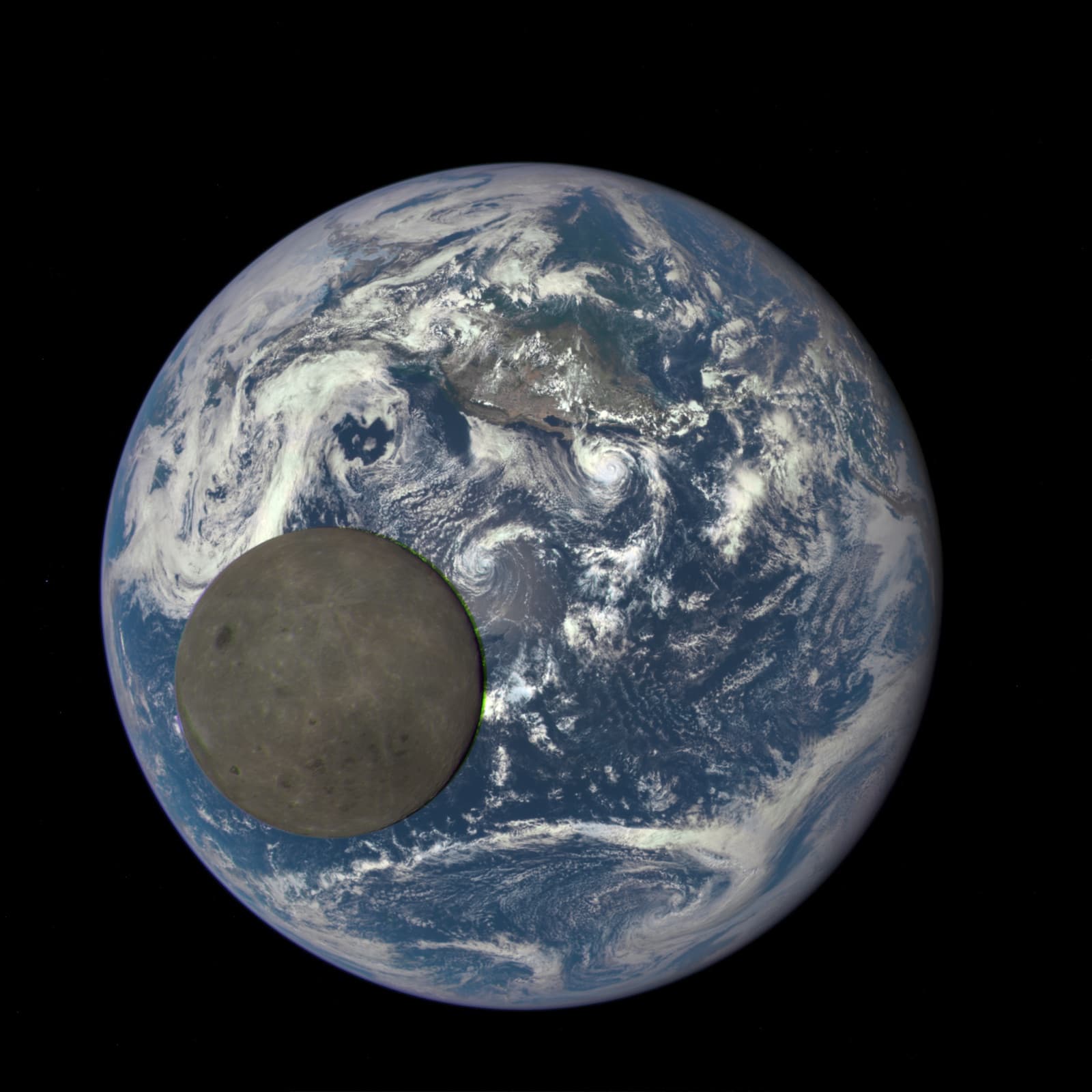
Any theory of where the Moon came from has to explain an odd object. It carries about 1.2 percent of Earth's mass, a far larger share than any planet's satellites in John Wood's 1986 table, with the probable exception of Pluto's Charon. Earth is roughly a third iron by mass; the Moon, by the figures in a NASA Goddard review, is about 8 to 10 percent iron, with a small core some 325 kilometres in radius from GRAIL gravity work. The Moon is short of volatile elements such as potassium, sodium and zinc. Its oldest crust says it was once wrapped in a magma ocean hundreds of kilometres deep. The Earth-Moon pair also holds more angular momentum than the other planets would lead you to expect. Any account of the Moon's birth has to deliver all of that at once, plus the property that turned out to be hardest of all: in isotopes, the Moon's rocks are almost indistinguishable from Earth's mantle.
For most of the twentieth century there were three main candidate stories. George Darwin's 1879 treatise had the Moon flung off a rapidly rotating Earth. Others imagined a Moon formed elsewhere and captured as it passed. A third, co-accretion, had Earth and Moon grow side by side out of the same swarm of debris; Russian accounts credit its development to the Soviet scientists Otto Schmidt, Evgenia Ruskol and Viktor Safronov, and Wood later described it as the model most lunar scientists had accepted, at least at a subconscious level. There was a widespread expectation that Apollo would settle the matter. It did not. Writing after the samples had been studied, Wood said the Moon had preserved "a priceless record of the earliest igneous activity" in a small planet, "but not of how the body formed"; the one clear verdict on origin was that Harold Urey's cold, primitive Moon had been wrong.
The idea that replaced them arrived from two directions in the mid-1970s. In April 1975 William Hartmann and Donald Davis argued in Icarus that the planetesimals building Earth included much larger objects than Safronov allowed, so a late hit by something around a tenth of Earth's mass was to be expected, and that such a collision could throw out more than enough debris for a Moon, most of it iron-poor mantle. The next year A. G. W. Cameron and W. R. Ward worked from the angular momentum instead. The early Earth's spin, they wrote, was presumably imparted by a collision with a major secondary body; if it struck a glancing blow at about 11 kilometres per second, its mass was comparable to that of Mars. At that speed most silicate would vaporise, gas pressure would push debris into orbit, and the resulting Moon should be short of metallic iron and volatile elements. Neither paper proved anything. When lunar scientists met at Kona, Hawaii, on 14 to 16 October 1984, confidence swung toward the collision model, and Wood's summary is candid about why: co-accretion had been shown unable to account for the angular momentum, and the impact was the most plausible idea left standing. It began its career as the survivor.
By 2001 the collision had a standard form. Robin Canup and Erik Asphaug reported in Nature a class of impacts that yields an iron-poor Moon along with the present masses and angular momentum of the Earth-Moon system, using a smaller and therefore more likely impactor than earlier work had needed, late in Earth's growth. The same year a Science paper on lunar oxygen used the name that stuck for the impactor: Theia, after the Titan who in Greek myth was the mother of Selene, goddess of the Moon. The catch was already visible. In the standard simulations, most of the orbiting debris is impactor material. Wood had flagged the worry in 1986: if the impactor formed far from Earth's orbit, he wrote, we should worry about the close match in oxygen isotopes between Earth and Moon. Junjun Zhang and colleagues put a number on the tension in 2012, citing models in which more than 40 percent of the Moon-forming disk came from Theia.
Why that matters comes down to fingerprints. Bodies that formed in different parts of the young solar system carry different mixtures of isotopes, which is why meteorites from different parent bodies can be told apart, and why Mars, as the 2026 SwRI team notes, is compositionally distinct from Earth and Moon. The Moon keeps failing to look different. In 2001 Wiechert and colleagues measured 31 Apollo samples from five landing sites and found them all within ±0.016 per mil of a single line identical, within uncertainties, to Earth's. In 2016 Young's group put the Earth-Moon difference at -1 ± 5 parts per million. In December 2024 a Göttingen team measured 14 Apollo rocks on a newly built instrument and reported 0.2 ± 1.6 ppm, an isotopic match at the sub-ppm level. Titanium, a highly refractory element, tells the same story: the Moon's 50Ti/47Ti ratio matches Earth's within about 4 ppm, 1/150 of the spread seen in meteorites. In March 2023 geochemists at the Vernadsky Institute of the Russian Academy of Sciences listed nine elements, from oxygen and iron to tungsten and chromium, whose isotopes are close in Earth and Moon. For a Moon built mostly from another planet, that is a remarkable coincidence.
Even that result is argued over at the edges. The same Göttingen laboratory, in a 2014 Science paper by Herwartz and colleagues, had reported a 12 ± 3 ppm difference and presented it as Theia's signature finally found in lunar rock. Its 2024 data do not reproduce that, and the authors write that the exact cause of the discrepancy could not be resolved. In 2020 Erick Cano, Zachary Sharp and Charles Shearer reported that Earth and Moon in fact have distinct oxygen compositions, that lunar values vary with rock type, and that samples from the deep lunar mantle, heavier than Earth, may best represent Theia. So the field does not yet agree whether the difference is zero or merely tiny.
There are three logical ways out, as the NASA Goddard review sets them out: the Moon is mostly Earth mantle after all; Earth and impactor material mixed until their fingerprints matched; or Theia was made of the same stuff as Earth. Each has champions. In 2012 two papers in Science pushed the collision harder. Ćuk and Stewart showed that a typical late impact onto a fast-spinning proto-Earth could make a disk derived mainly from Earth's mantle, and Canup showed that much larger impactors, comparable in mass to the proto-Earth they struck, could give the disk the composition of the planet's mantle. Both leave the system spinning too fast and need the excess drained later through an orbital resonance with the Sun. In 2018 Simon Lock, Sarah Stewart and colleagues went further: a high-energy impact can leave a structure too hot and fast-spinning to be a planet in the usual sense, a doughnut of rock vapour they named a synestia, inside which the Moon condenses while bathed in vapour of Earth's composition. Potassium offered this family some support. Wang and Jacobsen found lunar rocks about 0.4 per mil heavier in potassium isotopes than Earth and chondrites, a pattern they read as condensation from vapour at more than 10 bar, inconsistent with the low-energy disk equilibration model and supportive of a high-energy impact.
Other groups changed the impact itself. Raluca Rufu, Oded Aharonson and Hagai Perets proposed in 2017 that no single blow was needed: a succession of smaller collisions could each leave a debris disk and a moonlet, and if the moonlets drifted outward and merged efficiently they could build the Moon. Natsuki Hosono of JAMSTEC and colleagues struck a proto-Earth still covered by a magma ocean. Because molten rock heats far more under shock than solid rock, their simulations drew much of the Moon-forming debris from the magma ocean even in a glancing collision; the Japanese release from JAMSTEC, Kobe University and RIKEN described this as a possible resolution of the contradiction between the Apollo isotope measurements and conventional giant-impact simulations. In 2022 Jacob Kegerreis and colleagues at NASA Ames and Durham University found that at high enough resolution a giant impact can place a Moon-like satellite directly into orbit, in NASA's words "in a matter of hours", its outer layers around 60 percent proto-Earth material. And on 1 September 2026 Adeene Denton of the Southwest Research Institute and colleagues added something earlier models had left out, the strength of rock. With otherwise identical parameters, a hot but solid Theia produced an intact Moon while a colder, stronger Theia made a classic debris disk, which ties the style of the Moon's birth to the timing of the impact.
Where Theia came from is its own open question. In November 2025 Timo Hopp, Nicolas Dauphas and colleagues measured iron isotopes in six Apollo samples, 15 terrestrial rocks and a range of meteorites and, combining them with other elements in a mass balance, concluded that all of Theia came from the inner solar system, possibly closer to the Sun than Earth. That would ease the isotope problem, since neighbours share fingerprints. Their institute's release keeps a caveat worth repeating: the Moon may be mostly Theia, mostly early Earth mantle, or an inseparable mix of both. Around the same time Duarte Branco, Pedro Machado and Sean Raymond published dynamical simulations in Icarus that, in a scenario built to match cosmochemical estimates that Earth took in some carbonaceous material, gave roughly even odds that Theia was a carbonaceous object, either an embryo from the outer solar system or an inner one that had absorbed such an embryo, and Cano's 2020 oxygen work had pointed to a Theia formed farther from the Sun than Earth. There is even a proposal that pieces of Theia are still here: Yuan and colleagues argued in Nature in 2023 that two continent-sized, seismically slow regions at the base of Earth's mantle may be buried relics of Theia's mantle.
Not everyone accepts a giant impact at all. Erik Galimov, director of the Vernadsky Institute of Geochemistry and Analytical Chemistry (GEOKHI) of the Russian Academy of Sciences, told the Presidium of the Russian Academy of Sciences in December 2003 that his group held a different hypothesis, with no catastrophic impact, in which Earth and Moon formed from primary material as a double system. In his model the pair condensed from a single rarefied cloud of gas and dust, and evaporation stripped iron from the hot early embryos; he argued from rubidium and strontium that the Moon's material spent its first 50 million years dispersed. GEOKHI colleagues have kept the question alive. A 2023 institute review, summarised in Kommersant with comments from Mikhail Marov and Sergei Ipatov, weighs co-accretion, multiple impacts, the megaimpact and Galimov's condensation model, and lists weaknesses in each, Galimov's included: other researchers' work has not supported a condensation lasting tens of millions of years, and his model does not say where 95 percent of its iron-poor inner material went. Ipatov's own 2018 variant, which the review judged the best supported today, has the Earth and Moon embryos form together from a condensation spun up when two clouds collided. These ideas sit outside the collision family that NASA says almost all current theories belong to, but they press on the same fact: the isotope match is what every model has to meet.
The samples are where the argument is tested. The Apollo crews brought back 382 kilograms, and NASA's summary builds the core of the modern picture on them and on later orbital mapping: lunar basalts strikingly similar to Earth's, oxygen that matches, white anorthosite crust that floated on a magma ocean, and a Moon poor in volatile elements. The Soviet robots Luna 16, Luna 20 and Luna 24 added about 0.3 kilograms (101, 30 and 170.1 grams by NSSDCA's figures) from three eastern sites no crew visited, including highland samples from the Apollonius region and drill samples from Mare Crisium. Their part in the origin debate has been quieter: the 2001 and 2024 oxygen datasets and the 2025 iron study described here were all measured on Apollo material. China's samples have started to test whether the Apollo picture holds for the whole Moon. Chang'e-5 basalts, dated to 2,030 ± 4 million years, extended known lunar volcanism by some 800 to 900 million years, which bears more on how the Moon cooled than on how it formed. Chang'e-6 returned to Earth on 25 June 2024 with 1,935.3 grams from the South Pole-Aitken basin on the far side. Li Yiheng, Wang Zaicong and colleagues found that its basalts carry the same heavy sulfur signature as the near side, about 2 per mil heavier than Earth's mantle, and attribute it to global volatile loss in the Moon-forming impact. Then in January 2026 Tian Hengci and colleagues reported that Chang'e-6 basalts are heavier in potassium isotopes than Apollo and Chang'e-5 basalts, most likely because of evaporation during the South Pole-Aitken impact itself: a reminder that later giant impacts left isotopic marks too.
Even the date is disputed. NASA's summary, drawing on Apollo ages, puts the Moon's formation around 60 million years after the solar system began. Published ages range from 4.35 to 4.51 billion years depending on whether whole rocks or individual zircon grains are dated. In December 2024 Francis Nimmo, Thorsten Kleine and Alessandro Morbidelli argued in Nature that the many 4.35 billion year ages record a later tidal remelting as the Moon's orbit evolved, which would allow the Moon itself to have formed within a few tens of millions of years of the solar system's start. The Denton result makes timing matter more, since in those simulations the temperature of the colliding bodies, and so the date of the impact, decides whether the Moon forms intact or from a disk.
So the honest answer, as of 23 September 2026, comes in two parts. A giant collision is the family of explanations nearly all current work sits within, and NASA reads the magma ocean and the lost volatiles as signs of an intensely energetic start. Which collision, how large, how fast, how hot, one blow or many, a disk or an intact Moon, and whether the Moon is mostly Theia or mostly Earth: all of that is open, and papers from 2025 and 2026 pull in different directions. The Göttingen oxygen team drew one practical lesson worth keeping: returned samples are worth more for this work than meteorites, which may have interacted with terrestrial water. John Wood's sentence from 1986 still holds for everything beyond the broad outline: how the Earth's Moon was formed is still not known.
What we know
The short answer
Unsettled. NASA's Moon formation page, last updated 23 July 2026, says several theories vie for dominance but that almost all share one point: about 4.5 billion years ago something, perhaps a single object the size of Mars and perhaps a series of objects, crashed into the young Earth and flung out enough molten and vaporised debris to make the Moon.↗
What any model has to explain
A NASA Goddard review lists the targets: a Moon about 1 percent of Earth's mass that holds most of the system's angular momentum; a bulk iron content of about 8 to 10 percent against Earth's roughly 33 percent, with a small iron core of about 325 km radius from GRAIL gravity work; depletion in volatile elements such as potassium, sodium and zinc; an early magma ocean; and stable isotope ratios nearly identical to Earth's mantle.↗
Hartmann and Davis, 1975
William K. Hartmann and Donald R. Davis, 'Satellite-sized planetesimals and lunar origin', Icarus 24:504-515 (April 1975). As John Wood summarised it in 1986, they argued that the planetesimals building Earth included objects far larger than Viktor Safronov's models allowed, so a late hit by something of about 0.1 Earth mass was to be expected, and that such a collision might eject more than enough debris to make a Moon, most of it iron-depleted mantle.↗
Cameron and Ward, 1976
A. G. W. Cameron and W. R. Ward (Harvard College Observatory and Smithsonian Astrophysical Observatory) started from the system's abnormally large angular momentum. A collision at close to 11 km/s with an impact parameter of one Earth radius implied an impactor 'comparable to that of Mars'; most silicate would vaporise, gas pressure would push debris into orbit, and the Moon should be 'deficient in metallic iron and volatile elements'. Published as a Lunar Science VII abstract, pages 120 to 122.↗
Kona, October 1984
At the Origin of the Moon conference in Kona, Hawaii (14 to 16 October 1984), the first on lunar origin since Apollo, confidence shifted to the collision model. John Wood's summing up credits the shift to several investigators showing that co-accretion could not account for the angular momentum, and notes that no strong evidence had been presented that the Moon formed by collision. He opened the same paragraph: 'How the Earth's Moon was formed is still not known.'↗
The canonical impact
Robin Canup and Erik Asphaug (Nature 412:708-712, August 2001) reported a class of impacts that yields an iron-poor Moon plus the present masses and angular momentum of the Earth-Moon system, using a smaller, and so more likely, impactor than earlier work required, and placing the Moon's birth near the very end of Earth's growth.↗
Oxygen, 2001
Wiechert and colleagues measured 31 lunar samples from Apollo 11, 12, 15, 16 and 17 and found all of them within ±0.016 per mil of a single mass-dependent fractionation line, identical within uncertainties to Earth's. They noted this fits a giant impact only if the proto-Earth and the impactor, which they called Theia, formed from an identical mix of components.↗
Oxygen, 2024
A Göttingen team (Fischer, Peters, Herwartz, Hartogh, Di Rocco and Pack, PNAS, 16 December 2024) measured 14 lunar samples on a newly built laser fluorination line. Pristine lunar rocks average Δ'17O of -51.4 ± 1.4 ppm against -51.6 ± 1.0 ppm for Earth's mantle: a difference of 0.2 ± 1.6 ppm, which the authors call an isotopic match at the sub-ppm level.↗
The oxygen disagreement
Not every laboratory agrees the difference is zero. Herwartz and colleagues reported 12 ± 3 ppm in Science in 2014, and the 2024 Göttingen paper says the exact cause of that discrepancy could not be resolved. Cano, Sharp and Shearer (Nature Geoscience, March 2020) found distinct compositions that vary with lunar rock type, and proposed that deep-mantle samples, heavier than Earth, best represent Theia.↗
Titanium
Zhang, Dauphas, Davis, Leya and Fedkin (Nature Geoscience, March 2012) found the Moon's 50Ti/47Ti ratio identical to Earth's within about 4 ppm, only 1/150 of the range seen in meteorites, against models that put more than 40 percent of the Moon-forming disk as Theia material. They suggested the lunar material came predominantly from the proto-Earth's mantle.↗
Potassium
Wang and Jacobsen (Nature, September 2016) found lunar rocks about 0.4 per mil heavier in potassium isotopes than Earth and chondrites, best explained by incomplete condensation from vapour at pressures above 10 bar. They judged this inconsistent with the low-energy disk equilibration model and supportive of a high-energy, high-angular-momentum impact.↗
A fast-spinning Earth
Ćuk and Stewart (Science, October 2012) showed that a typical late impact onto a fast-spinning proto-Earth could make a Moon-forming disk derived mainly from Earth's mantle, with the excess angular momentum later drained through an orbital resonance between the Sun and Moon. Canup, in the same issue, reached an Earth-like disk with much larger impactors, comparable in mass to the proto-Earth they hit, and needed the same resonance.↗
Synestia
Lock, Stewart, Petaev, Leinhardt, Mace, Jacobsen and Ćuk (JGR Planets, April 2018) described high-energy impacts that leave a body too hot and fast-spinning to hold a normal shape, a structure they named a synestia. Moonlets condense inside it, surrounded by tens of bars of vapour of bulk silicate Earth composition, which sets the Moon's isotopes and volatile pattern.↗
Many impacts
Rufu, Aharonson and Perets (Nature Geoscience, 2017) simulated a succession of smaller collisions, each leaving a debris disk and a moonlet that drifts outward. Assuming the moonlets merge efficiently, they concluded a multiple-impact origin can reproduce the Earth-Moon system.↗
A magma ocean on the young Earth
Hosono, Karato, Makino and Saitoh (Nature Geoscience, April 2019) hit a proto-Earth covered by a magma ocean. Because molten rock is shock-heated far more than solid rock, much of the Moon-forming debris came from the magma ocean even in an oblique impact. The Japanese release from JAMSTEC, Kobe University and RIKEN: 「月が原始地球のマグマオーシャンと呼ばれるマグマの海から作られた可能性があることを突き止めました」 (they found the Moon may have formed from the proto-Earth's magma ocean).↗
A Moon in hours
Kegerreis and colleagues (Durham University and NASA Ames, The Astrophysical Journal Letters 937:L40, October 2022) found that above a high resolution threshold a giant impact can place a Moon-mass, Moon-like satellite directly into orbit, with outer layers of around 60 percent proto-Earth material, offering a single-stage origin.↗
Rock strength, 2026
Denton, Asphaug, Baijal and Melikyan (The Astrophysical Journal Letters, 1 September 2026) added realistic material strength to giant-impact simulations. With otherwise identical canonical parameters, a hot but solid Theia produced an intact Moon, while a colder, stronger Theia, the later-formation case, produced a classic debris disk. SwRI's release notes the Earth-Moon compositional match remains an open question. The caption SwRI issued with its simulation image pairs the two outcomes with temperature the other way round (hotter bodies with the disk); this page follows the paper's abstract.↗
Where Theia formed
Hopp, Dauphas, Boyet, Jacobson and Kleine (Science, 20 November 2025) measured iron isotopes in lunar samples, terrestrial rocks and meteorites (six Apollo samples and 15 terrestrial rocks, per the Max Planck release) and concluded that all of Theia came from the inner solar system, perhaps closer to the Sun than Earth. The Max Planck release cautions that the Moon may be mostly Theia, mostly early Earth mantle, or an inseparable mix.↗
The Russian dissent
Erik Galimov, director of the Vernadsky Institute (GEOKHI), told the Presidium of the Russian Academy of Sciences on 23 December 2003 that his group held a hypothesis without a catastrophic impact, in which Earth and Moon formed from primary material as a double system. Original: «Мы придерживаемся другой гипотезы, не привлекающей механизм катастрофического удара, согласно которой Земля и Луна образовались из первичного материала как двойная система.»↗
Far-side sulfur
Li Yiheng, Wang Zaicong and colleagues (Nature Communications, 1 July 2025) reported 17 analyses of Chang'e-6 basalt: δ34S of 0.83 ± 0.16 per mil, within the near-side range and about 2 per mil heavier than Earth's mantle. They attribute it to global volatile loss during the Moon-forming impact. The China University of Geosciences summary: 「最可能代表地月大碰撞导致的全月挥发性元素的丢失」 (most likely represents whole-Moon loss of volatile elements caused by the giant impact).↗
What happened, and when
- 1879George Darwin publishes his treatise on fission of the Moon from the Earth, which Wood calls the only widely cited reference on lunar origin from that era.
- 20 to 21 Jan 1964A conference on the dynamics of the Earth-Moon system at NASA's Goddard Institute for Space Studies in New York debates fission and capture; Wood knew of no earlier conference on the Moon's origin.
- Jul 1969 to Dec 1972The Apollo crews, from Apollo 11 to Apollo 17, bring back 382 kg of lunar samples, which reveal a once-molten Moon with Earth-like oxygen.
- Sep 1970 to Aug 1976Luna 16, Luna 20 and Luna 24 return 101 g, 30 g and 170.1 g (NSSDCA figures) from Mare Fecunditatis, the Apollonius highlands and Mare Crisium.
- Apr 1975Hartmann and Davis publish 'Satellite-sized planetesimals and lunar origin' in Icarus.
- 1976Cameron and Ward propose a glancing impact by a body comparable in mass to Mars, with vaporised mantle forming the lunar disk.
- 14 to 16 Oct 1984The Kona conference on the Origin of the Moon; the collision model becomes the working consensus.
- Aug 2001Canup and Asphaug publish the canonical Mars-sized impact in Nature.
- Oct to Nov 2012Ćuk and Stewart, then Canup, publish high-angular-momentum impacts designed to make an Earth-like Moon.
- 25 Jun 2024The return capsule of Chang'e-6 lands in Inner Mongolia with 1,935.3 g of far-side samples from the South Pole-Aitken basin.
- Dec 2024The Göttingen group reports the Earth-Moon oxygen difference as 0.2 ± 1.6 ppm; in the same week Nimmo, Kleine and Morbidelli argue in Nature that the Moon is older than its common 4.35 billion year rock ages.
- 9 Jul 2025The Chinese Academy of Sciences presents Chang'e-6 results, including a formation age of 4.25 billion years for the South Pole-Aitken basin.
- 20 Nov 2025Hopp and colleagues use iron isotopes to argue that Theia formed in the inner solar system.
- 12 Jan 2026Tian and colleagues report heavier potassium isotopes in Chang'e-6 basalts and attribute them most likely to evaporation in the South Pole-Aitken impact.
- 1 Sep 2026Denton and colleagues show that rock strength and temperature decide whether a giant impact makes an intact Moon or a debris disk.
In pictures
Tap a photo to enlarge.
Sources
- NASA Science, Moon Formation (page updated 23 July 2026)
- Ahrens (NASA Goddard), Origin of the Moon, Impactor Theory, Encyclopedia of Lunar Science entry, author copy on NTRS 20210000977
- Wood, Moon over Mauna Loa: a review of hypotheses of formation of Earth's Moon, in Origin of the Moon (LPI, 1986), pp. 17-55
- Cameron and Ward, The origin of the Moon, Lunar Science VII, pp. 120-122 (1976)
- Hartmann and Davis, Satellite-sized planetesimals and lunar origin, Icarus 24:504-515 (1975), doi 10.1016/0019-1035(75)90070-6
- Canup and Asphaug, Origin of the Moon in a giant impact near the end of the Earth's formation, Nature 412:708-712 (2001)
- Wiechert et al., Oxygen isotopes and the Moon-forming giant impact, Science 294:345-348 (2001)
- Young et al., Oxygen isotopic evidence for vigorous mixing during the Moon-forming giant impact, Science 351:493-496 (2016), arXiv 1603.04536
- Herwartz et al., Identification of the giant impactor Theia in lunar rocks, Science 344:1146-1150 (2014)
- Cano, Sharp and Shearer, Distinct oxygen isotope compositions of the Earth and Moon, Nature Geoscience 13:270-274 (2020)
- Fischer et al., Oxygen isotope identity of the Earth and Moon, PNAS 121:e2321070121 (16 Dec 2024)
- Zhang et al., The proto-Earth as a significant source of lunar material, Nature Geoscience 5:251-255 (2012)
- Wang and Jacobsen, Potassium isotopic evidence for a high-energy giant impact origin of the Moon, Nature 538:487-490 (2016)
- Ćuk and Stewart, Making the Moon from a fast-spinning Earth, Science 338:1047-1052 (2012)
- Canup, Forming a Moon with an Earth-like composition via a giant impact, Science 338:1052-1055 (2012), author copy
- Lock et al., The origin of the Moon within a terrestrial synestia, JGR Planets 123:910-951 (2018), arXiv 1802.10223
- Rufu, Aharonson and Perets, A multiple-impact origin for the Moon, Nature Geoscience 10:89-94 (2017), arXiv 1903.02525
- Hosono, Karato, Makino and Saitoh, Terrestrial magma ocean origin of the Moon, Nature Geoscience 12:418-423 (2019)
- RIKEN, JAMSTEC and Kobe University press release (Japanese), 10 May 2019: 月は地球のマグマオーシャンからできた
- Kegerreis et al., Immediate origin of the Moon as a post-impact satellite, ApJL 937:L40 (2022)
- NASA Ames, Collision may have formed the Moon in mere hours, simulations reveal (Oct 2022)
- Denton, Asphaug, Baijal and Melikyan, Collisional capture of an intact Moon depends on strength, ApJL 1008 (1 Sep 2026)
- SwRI press release, SwRI-led modeling identifies new scenarios for Moon formation (1 Sep 2026)
- Hopp et al., The Moon-forming impactor Theia originated from the inner Solar System, Science 390:819-823 (20 Nov 2025)
- Max Planck Institute for Solar System Research, Theia and Earth were neighbors (Nov 2025)
- Branco, Machado and Raymond, Dynamical origin of Theia, the last giant impactor on Earth, Icarus 441:116724 (2025), arXiv 2507.01826
- Yuan et al., Moon-forming impactor as a source of Earth's basal mantle anomalies, Nature 623:95-99 (2023)
- Nimmo, Kleine and Morbidelli, Tidally driven remelting around 4.35 billion years ago indicates the Moon is old, Nature 636:598-602 (2024)
- Galimov, Состояние и перспективы исследования Луны и планет, Vestnik RAN 74(12):1059-1081 (2004), address of 23 Dec 2003 (Russian)
- Kommersant, Откуда взялась Луна: отвечают геохимики, GEOKHI RAS review (30 Mar 2023, Russian)
- CNSA, 嫦娥六号带回1935.3克月球样品 交接至地面应用系统 (28 Jun 2024, Chinese)
- CNSA, 中国科学院发布嫦娥六号月球样品系列研究成果 (10 Jul 2025, Chinese)
- Li et al., Sulfur isotopes from the lunar farside reveal global volatile loss following the giant impact, Nature Communications 16:5780 (1 Jul 2025)
- China University of Geosciences, 嫦娥六号样品硫同位素指示地月大碰撞曾导致全月尺度挥发份丢失 (Chinese)
- Tian et al., Isotopic evidence for volatile loss driven by South Pole-Aitken basin-forming impact, PNAS (12 Jan 2026)
- Li et al., Two-billion-year-old volcanism on the Moon from Chang'e-5 basalts, Nature 600:54-58 (2021)
- NASA NSSDCA, Luna 16
- NASA NSSDCA, Luna 20
- NASA NSSDCA, Luna 24
Checked on 23 September 2026. Where the science is unsettled this page says so rather than picking a winner.