Phobos and Deimos
Phobos is 22 km wide, orbits in 7h39m and rises in the west. Deimos is 12.5 km. Where either came from is still an open question.
TL;DR· 22 min read
Mars has two tiny, very dark moons, and nobody knows where either came from. Phobos is about 22 km across and goes round Mars in 7 h 39 m, faster than the planet turns, so it rises in the west and sets in the east; Deimos is about 12.5 km across and takes 30 h 18 m. After 149 years of looking, captured asteroids and debris from a giant impact are both still live answers. No spacecraft has ever landed on either moon, and JAXA's MMX, targeted to launch on 20 October 2026, is the best chance anyone has had of settling it.
Mars has two moons, and both of them are tiny. Phobos, the inner one, is a lumpy object about 22 kilometres across, roughly the length of Manhattan, orbiting so low and so fast that it laps Mars three times in a Martian day and rises in the west instead of the east. Deimos, the outer one, is about 12.5 kilometres across and creeps across the Martian sky over two and a half days. Neither would look like a moon to you. Phobos at its highest is about a third the width of a full Moon seen from Earth, and Deimos is a bright dot. The interesting part is that after 149 years of looking at them, nobody can say what they are: captured asteroids, debris from a giant impact on Mars, or something in between.
- 7 h 39 mPhobos's orbit, shorter than the 24 h 37 m it takes Mars to turn, so Phobos rises in the west
- 0spacecraft that have ever landed on Phobos or Deimos. Everything we know is remote sensing
- 3.8 cm/yrrate Phobos's orbit is shrinking on the 2025 ephemeris fit. NASA's public page still says 1.8
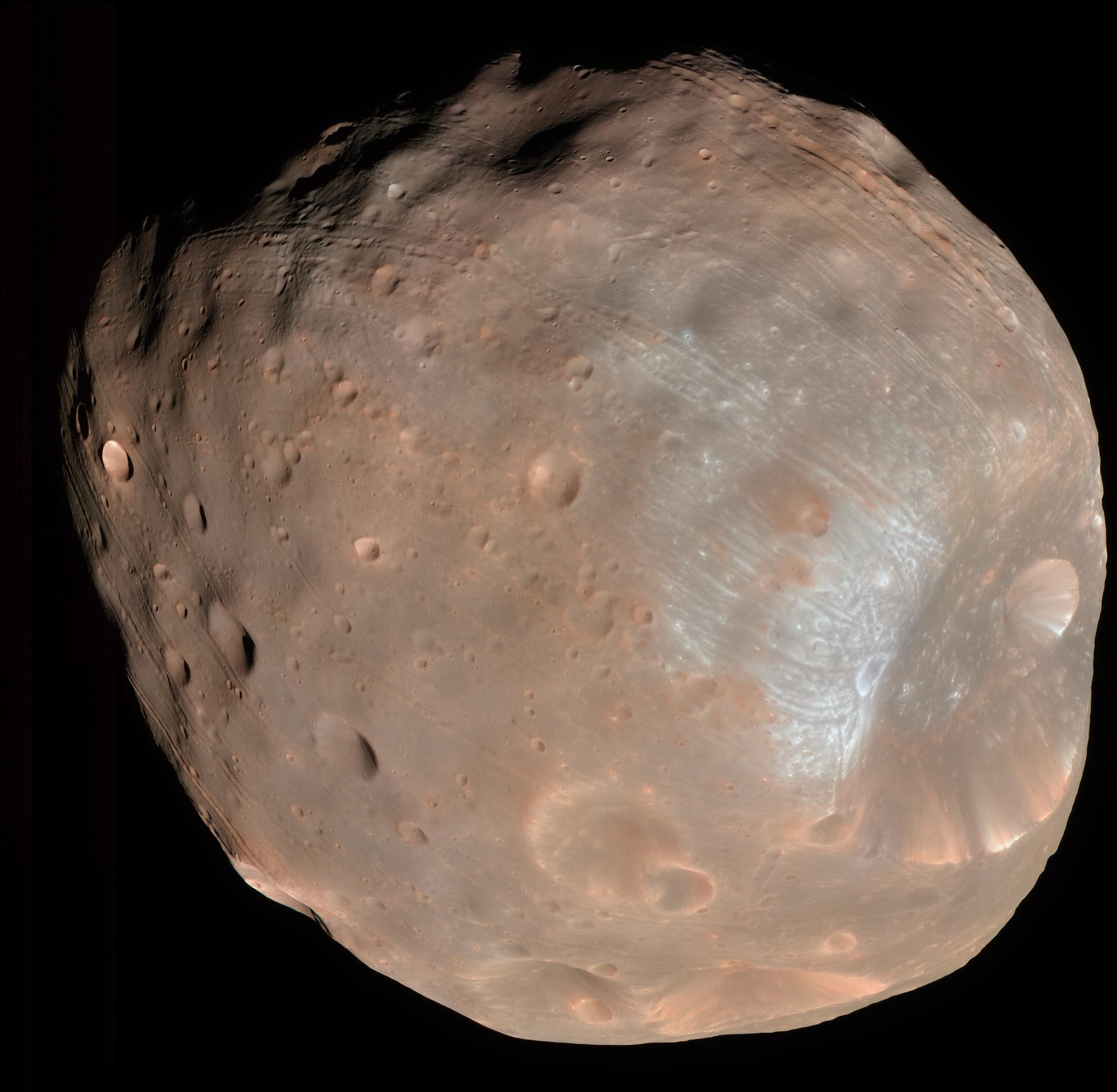
The numbers are the answer. Phobos, the inner moon, has an average radius of 11.08 plus or minus 0.04 km on the best current shape model, so a mean diameter of about 22.2 km, and it is nothing like round: the best-fit ellipsoid is 12.95 by 11.30 by 9.16 km in radius. It orbits 9,377 km from the centre of Mars, which is only about 6,000 km above the ground, on a nearly circular path tilted just 1.08 degrees to the Martian equator, and it goes round in 7 hours 39 minutes. Deimos, the outer one, has an average radius of 6.27 plus or minus 0.07 km, a mean diameter of about 12.5 km, sits 23,463 km out, and takes 30 hours 18 minutes. Both are locked so that one face points permanently at Mars. Both are extremely dark, with a geometric albedo of 0.06, and both are far too light for solid rock: Phobos comes out at about 1.86 g/cm3 and Deimos somewhere between 1.47 and 1.76, depending on which mass and which shape you combine. That low density is why both are treated as rubble piles rather than single stones, with a quarter to a third of Phobos's volume being empty space. Mercury and Venus have no moons at all, so these two and our own are the only moons of the rocky planets.
The strangest thing about Phobos is what it does to the sky. Mars turns once every 24 hours 37 minutes; Phobos goes round in 7 hours 39 minutes. A moon that orbits faster than its planet spins overtakes the ground beneath it, so from the surface Phobos comes up over the western horizon, hurries across the sky in the wrong direction, and sets in the east, doing this about twice per Martian day. It is also small enough that it never quite manages a proper eclipse. English Wikipedia gives its apparent width as 8 arcminutes when rising and about 12 overhead, roughly a third of a full Moon from Earth, and the Sun's disc from Mars is wider than that, so what you get is an annular eclipse: a ragged black lump sliding across the Sun with light still showing all round it. Perseverance filmed one with Mastcam-Z on 2 April 2022, and JPL says it lasted a little over 40 seconds, while English Wikipedia says no Phobos eclipse runs longer than about thirty seconds; neither figure states where the count begins. Curiosity caught one on 20 August 2013. Deimos does not eclipse anything. At no more than about 2.5 arcminutes it is a bright dot, about as bright at full phase as Venus looks from Earth, and because its 30-hour orbit barely outruns the rotating ground it takes roughly two and a half days to cross from horizon to horizon. Anyone standing on Mars would see one moon racing backwards and one almost standing still.
The surfaces are as odd as the orbits. Phobos is dominated by Stickney, a crater the IAU gazetteer lists at 9.00 km across, which on a body 22 km wide means the impact that made it came close to destroying the moon; NASA's own page gives 9.7 km and says it takes up about half the surface, which overstates it, but the point stands. The rest of Phobos is scored with grooves: parallel troughs less than 30 m deep, 100 to 200 m wide, up to 20 km long, in a dozen or more distinct families. Where they come from is a live argument with at least four positions on the table. Ramsley and Head, in 2019, tested the model in which boulders flung out by the Stickney impact rolled, slid and bounced their way around a low-gravity body and ploughed the grooves. Nayak and Asphaug, in 2016, showed that ejecta which escapes Phobos, orbits Mars briefly and falls back reproduces exactly the grooves that do not point at Stickney. Hurford and colleagues, also 2016, showed that most prominent grooves align with the stress field of a body being tidally stretched by its own decaying orbit, which requires a weak interior under a shell 10 to 100 m thick. Cheng and colleagues, in 2022, simulated millions of grains and got regolith draining into tidally opened fissures. These are not mutually exclusive and none has won.
Then there is the question the whole thing hangs on, which is where the moons came from. Two families of answer have been argued for decades and Kiyoshi Kuramoto's 2024 review sets them out plainly: capture, supported by reflectance spectra that look like primitive carbonaceous asteroids, and formation in place from a debris disc, supported by circular orbits lying almost exactly in the Martian equatorial plane. Each explains what the other cannot. Capture leaves you with an eccentric, inclined orbit that is hard to circularise; a giant impact explains the orbits but has to produce a disc whose surviving moons look like outer-belt asteroids. Robin Canup and Julien Salmon showed in 2018 that an oblique impact by a Vesta-to-Ceres-sized body, about a thousandth of Mars's mass, gives a low-mass disc that works. Jacob Kegerreis and colleagues proposed in 2024 that an asteroid could be tidally torn apart on a close pass and partially captured, tens of per cent of its mass surviving to form a proto-satellite disc, which needs a far smaller parent body than a giant impact and still yields circular orbits. Ryo Matsuoka and Kuramoto argued in 2025 that gas drag on temporarily captured bodies naturally produces the low inclinations that killed the old capture models. Antonin Wargnier and colleagues, comparing spectra in 2025, found the closest matches among D-type and Z-type asteroids and no match at all among Martian terrains, and suggested capture from the inner main belt. The honest summary is that remote sensing has been unable to decide, because a few microns of space-weathered, impact-darkened surface looks much the same whatever is underneath.
Phobos is also visibly doomed, though the details are contested. Because it orbits inside the synchronous radius, at about 6 Mars radii, the tidal bulge it raises on Mars lags behind it and drags it inward. The measurement itself is an acceleration in longitude, and the shrinking distance has to be derived from it: Bills and colleagues got a fractional rate of change in orbital angular velocity of 6.631 x 10^-9 per year from the shadow Phobos casts, and called it the highest measured for any natural satellite. Turning that into centimetres is where the sources part company. The 2025 ephemeris fit by Brozovic, Jacobson and Park states that the semi-major axis migrates about 3.8 cm a year; NASA's public page still says 1.8 metres per century, which is 1.8 cm a year; older literature said 5. Benjamin Black and Tushar Mittal argued in 2015 that Phobos comes apart in 20 to 40 million years into a ring lasting between a million and a hundred million years. Harrison Agrusa and Patrick Michel, in February 2026, argued that Black and Mittal overestimated Phobos's strength and therefore underestimated how far out it will fail, putting surface stripping at about 2.2 Mars radii and destruction beyond 2, against Phobos's present 2.76. Matija Cuk and colleagues showed in 2025 that the moon's past is equally undecided: a Phobos billions of years old and a Phobos only 100 million years old, formed at the fluid Roche limit as the latest turn of an ongoing ring and moon cycle, are both fully consistent with the orbit we see. Deimos, outside the synchronous radius, is going nowhere.
All of that is inference from a distance, which is the real state of play. No spacecraft has ever landed on either moon. The Soviet Phobos 1 and 2 pair tried in 1988 and 1989 and got as far as some close imaging before Phobos 2 was lost days before releasing its landers; Phobos-Grunt and Yinghuo-1, a sample return of the same ambition as today's, never left Earth orbit in 2011. Since then the moons have been observed from passing hardware: Mars Express and Mars Reconnaissance Orbiter imaging, Trace Gas Orbiter colour spectroscopy, the Hope orbiter flying close to Deimos through 2023 and mapping its craters and boulders, and Hera catching the anti-Mars side during a gravity assist on 12 March 2025. That last one has already paid off. On 18 August 2026 Sabina Raducan and colleagues published in Nature Astronomy that one oblique impact by a 320 m projectile can account for Deimos's south polar depression, its regolith blanket and its filled craters, and that the moon's outer layers are extremely weak and its interior highly porous. Everything below the top few microns of either moon remains a model. That is precisely why MMX exists: JAXA's spacecraft is targeted to launch on 20 October 2026 (as of 24 August 2026), land on Phobos, drop the Idefix rover, and bring back over 10 g in Japanese fiscal 2031. What returned grains can do is narrow the field rather than close it. A clearly non-Martian isotopic signature would favour a captured parent body and a Martian one would favour impact debris, but neither reading is clean. Kegerreis's partial-capture route and a giant impact both end with material reaccreting in Mars orbit; Phobos's regolith is expected to hold Martian ejecta whatever the moon itself is made of; and Wargnier's own spectral match points at the inner main belt rather than the outer belt the simple capture story assumes. Ten grams is the best shot anyone has had at a 149-year-old question. It guarantees nothing.
What we know
Phobos: size and shape
Not a sphere and not close to one. The current best shape model, built by Carolyn Ernst and colleagues in 2023 from Viking Orbiter, Phobos 2, Mars Global Surveyor, Mars Express and MRO images, gives a best-fit ellipsoid of 12.95 by 11.30 by 9.16 km in radius and an average radius of 11.08 plus or minus 0.04 km, which is a mean diameter of about 22.2 km. Willner, Shi and Oberst's 2014 Mars Express model gives radii of 13.03, 11.40 and 9.14 km, a volume of 5,742 plus or minus 35 cubic km and a mean radius of 10.993 km. JPL Horizons lists 13.1 by 11.1 by 9.3 km. NASA's public Phobos page quotes diameters of 27 by 22 by 18 km. The figure of 22.5 km that circulates is at the high end of these; 22.0 to 22.2 km is what the shape models actually give.↗
Phobos: orbit
JPL Horizons, on the MAR099 ephemeris, gives a semi-major axis of 9,377.2 km, eccentricity 0.0151, inclination 1.082 degrees to the Martian equator, and an orbital period of 0.319 days, which is 7 hours 39 minutes. Mars's equatorial radius is 3,396.19 km, so Phobos flies roughly 6,000 km above the surface. Its rotation is synchronous: the long axis points at Mars and one face is permanently turned toward the planet.↗
Deimos: size and shape
Ernst and colleagues' 2023 model gives a best-fit ellipsoid of 8.04 by 5.89 by 5.11 km in radius, average radius 6.27 plus or minus 0.07 km, so a mean diameter of about 12.5 km. Horizons lists radii of 7.8 by 6.0 by 5.1 km, which works out at about 12.4 km mean. NASA's public page rounds to 15 by 12 by 11 km across. The 2023 Ernst model was the first shape model of Deimos to resolve geological features at all.↗
Deimos: orbit
Horizons gives a semi-major axis of 23,463.2 km, eccentricity 0.00033, inclination 1.791 degrees and a period of 1.263 days, which is 30 hours 18 minutes. That is 20,067 km above the Martian equator, which is the 20,068 km ESA quotes. Deimos is also in synchronous rotation. Its orbit is very nearly a perfect circle: an eccentricity of three ten-thousandths is one of the things any theory of its origin has to explain.↗
Mass and density, with a live disagreement
Horizons gives Phobos 1.08 x 10^16 kg and a density of 1.90 plus or minus 0.08 g/cm3; Willner's 2014 volume brings the density down to 1.860 plus or minus 0.013. For Deimos, Horizons gives 1.80 x 10^15 kg and 1.76 plus or minus 0.30 g/cm3, while English Wikipedia's infobox, working from the 2023 Ernst shape, gives 1.51 x 10^15 kg and 1.465 plus or minus 0.051. The uncertainty on Deimos is genuinely large because nothing has ever flown close enough for long enough to weigh it well. Both numbers are far below solid rock, which is why both moons are treated as rubble piles; Wikipedia puts the void fraction inside Phobos at 25 to 35 per cent.↗
Why Phobos rises in the west
Mars turns on its axis once every 24.622962 hours, which is 24 h 37 m 23 s, and its mean solar day is 88,775.244 seconds, 24 h 39 m 35 s. Phobos goes round in 7 h 39 m, so it overtakes the ground beneath it. From the surface it comes up over the western horizon, crosses the sky against the direction everything else moves, and sets in the east, about twice per Martian day. Deimos, at 30 h 18 m, is slower than the planet turns, so it rises in the east like the Sun.↗
What they look like from the ground
English Wikipedia's Phobos article, citing Richardson's 1943 handbook, gives Phobos an angular diameter of 8 arcminutes when rising and about 12 arcminutes overhead, roughly a third the width of a full Moon seen from Earth. Its Deimos article, from the same 1943 source, gives Deimos no more than about 2.5 arcminutes, star-like to the naked eye and, at full phase, about as bright as Venus looks from Earth. Phobos cannot be seen at all from Martian latitudes above about 70.4 degrees, because the planet's own curve hides it. Deimos takes about 2.48 days between rising and setting for an observer on the equator, because it barely outpaces the rotating ground; that article puts 5.466 days between one Deimos-rise and the next.↗
Eclipses and transits
Neither moon can cover the Sun, so what happens is an annular eclipse or, in the literature, a transit. NASA's Perseverance rover filmed one with Mastcam-Z on 2 April 2022, sol 397, and JPL's release says the eclipse lasted a little over 40 seconds. English Wikipedia's article on Martian solar eclipses says they last no longer than about thirty seconds. Those are not the same measurement: one is a specific event timed on video, the other a general figure, and neither states where the count begins. The other dates here come from that same Wikipedia article rather than from the JPL release: Curiosity's eclipse of 20 August 2013, and the Deimos and Phobos transits Perseverance recorded on 19 January and 8 February 2024 and NASA released on 5 March 2024.↗
Stickney crater
The big one. The IAU Gazetteer of Planetary Nomenclature gives Stickney a diameter of 9.00 km, centred at 1 N, 49 W, approved in 1973 from Mariner 9 images, and names it for Angeline Stickney (1830 to 1892), the wife of Asaph Hall, who discovered the moons. NASA's own public page gives two different figures in two places: a diameter of 5.6 miles (9 kilometers) in one, and about 6 miles (9.7 kilometers) wide, taking up about half the moon's surface, in another. On a body whose mean diameter is 22.2 km, a 9 km crater is roughly 40 per cent of the mean diameter and about a third of the longest axis. A smaller crater, Limtoc, 2.00 km across, sits inside it.↗
The grooves
Phobos is scored with long parallel troughs. English Wikipedia gives them as typically less than 30 m deep, 100 to 200 m wide and up to 20 km long, in twelve or more families, and notes that they appear centred on the leading apex of Phobos rather than radiating from Stickney. At least four published mechanisms compete: rolling, sliding and bouncing boulders thrown out by the Stickney impact (Ramsley and Head, Planetary and Space Science 165, 2019); reaccreted ejecta from later impacts falling back as chains of small craters (Nayak and Asphaug, Nature Communications 7, 2016); tidal stress from the decaying orbit cracking the surface (Hurford and colleagues, JGR Planets 121, 2016); and regolith draining into tidally opened fissures in a cohesive layer (Cheng and colleagues, Planetary Science Journal 3, 2022). Deimos has nothing like them.↗
Phobos is falling, and the rate is disputed
What is actually measured is an acceleration in longitude. Nobody watches the distance shrink directly. Bills and colleagues in 2005 used the shadow Phobos casts, tracked by the laser altimeter on Mars Global Surveyor, and got s = (dn/dt)/2 = (136.7 plus or minus 0.6) x 10^-5 deg/yr2, a fractional rate of change in orbital angular velocity of (6.631 plus or minus 0.029) x 10^-9 per year, which they state is the highest measured for any natural satellite in the Solar System. The 2025 ephemeris fit by Brozovic, Jacobson and Park, on 142 years of astrometry from 1877 to 2019, gives s = 1.258 plus or minus 0.058 x 10^-3 deg/yr2 and states plainly that Phobos's semi-major axis migrates about 3.8 cm per year toward the planet. NASA's public Phobos page still says 1.8 metres per century, which is 1.8 cm a year, and English Wikipedia records an older estimate of 5 cm a year revised to 1.8. We could not find a source reconciling 1.8 with 3.8.↗
How Phobos ends
Not agreed. NASA's page says the moon will either crash into Mars in 50 million years or break up into a ring. Black and Mittal's 2015 Nature Geoscience paper argued that the weakest material will disperse tidally in 20 to 40 million years to form a ring that persists for 10^6 to 10^8 years, with stronger fragments hitting Mars; they put the disruption distance near 1.6 Mars radii, assuming a cohesive strength around 0.1 MPa. Agrusa and Michel's February 2026 paper argues that strength was overestimated, that material should be stripped from the surface at about 2.2 Mars radii and the body destroyed beyond about 2 Mars radii unless it holds tens of kilopascals of cohesion, and that runaway collisional erosion may finish it before any clean tidal disruption. Phobos today sits at 2.76 Mars radii.↗
Deimos is not falling
The synchronous radius of Mars, where an orbit takes exactly one Martian day, sits at about 6 Mars radii according to Agrusa and Michel. Phobos at 2.76 Mars radii is inside it, which is why the tide it raises on Mars drags it inward. Deimos at 23,463 km is about 6.9 Mars radii, outside the synchronous radius, so the same physics acts in the opposite direction and its orbit is not decaying. Agrusa and Michel also place the fluid Roche limit for a body of Phobos's density at about 3.1 Mars radii, meaning Phobos is already inside the distance at which a fluid body would come apart, and is held together by friction and whatever cohesion it has.↗
Discovery
Asaph Hall found Deimos on 12 August 1877 at about 07:48 UTC and Phobos on 18 August 1877, working the 26-inch (66 cm) refractor at the United States Naval Observatory during a close opposition of Mars. Contemporary records, using the pre-1925 astronomical convention where the day began at noon, log them as 11 August 14:40 and 17 August 16:06 Washington mean time, which is why the dates you see quoted differ by a day. The names were suggested by Henry Madan (1838 to 1901), science master at Eton, from Book XV of the Iliad, where Ares calls on Fear and Rout.↗
The names on them
Phobos's craters are named for astronomers who worked on Martian satellites and for characters and places in Jonathan Swift's Gulliver's Travels: Hall, D'Arrest, Roche, Kepler Dorsum, and Clustril, Drunlo, Flimnap, Grildrig, Gulliver, Limtoc, Laputa Regio, Lagado Planitia. Deimos has exactly two named features in the whole IAU gazetteer, both approved in 1973 and both 2 km or smaller: Swift, 1.00 km, and Voltaire, 1.90 km, named for the two writers who put two moons around Mars in fiction before anybody saw them.↗
Colour, and what it does and does not tell you
Both moons have a geometric albedo of 0.06, about as dark as fresh asphalt. Phobos's surface splits into a red unit and a blue unit, the blue concentrated around Stickney, with a transitional unit between them in the more recent work. Wargnier and colleagues in 2025 compared their spectra with asteroids, Martian terrains and laboratory samples and found matches to D-type and Z-type asteroids, Jupiter Trojans, centaurs and possibly extinct comets, with no Martian terrain resembling either moon, and proposed capture from the inner main belt. Beccarelli and colleagues, using CaSSIS on the Trace Gas Orbiter in February 2026, found the blue unit explained by ferrous minerals and the red by ferric ones, an absorption near 1000 nm only in the blue unit which they read as exogenous, and Deimos's surface matching Phobos's red units. Dyer and colleagues in August 2026 (arXiv:2608.11779) found Phobos's infrared-to-visible albedo ratios compatible with primitive asteroid populations, most closely the D and T types, but wrote that elevated ratios do not uniquely indicate a specific composition and that Martian material may contribute, particularly to the red unit. None of that is one-way traffic. Glotch and colleagues in 2018 read MGS-TES mid-infrared spectra as showing a basaltic component in Phobos's regolith, and Giuranna and colleagues in 2011 read thermal-infrared spectra as phyllosilicates of a kind familiar from the Martian surface. Agrusa and Michel cite both as complications for a capture origin.↗
What happened, and when
- 1726Jonathan Swift gives Mars two moons in Part 3 of Gulliver's Travels, at 3 and 5 Martian diameters with periods of 10 and 21.5 hours. The real values are 1.4 and 3.5 diameters, 7.66 and 30.35 hours. Voltaire repeats the two-moon idea in Micromegas in 1752. Both craters on Deimos are named after them.
- 12 Aug 1877Asaph Hall, at the 26-inch refractor of the United States Naval Observatory, finds the outer moon at about 07:48 UTC during a close opposition. Six nights later he finds the inner one. Henry Madan of Eton supplies the names Phobos and Deimos from Book XV of the Iliad.
- 1959Iosif Shklovsky, working from a reported acceleration in Phobos's orbit, calculates that a body decelerating that fast in the upper Martian atmosphere would have to be nearly empty, and suggests a hollow iron shell 16 km across and less than 6 cm thick. Fred Singer replies in 1960 that the measurement is probably in error. By 1969 better orbit determinations confirm Singer was right and the acceleration is tidal.
- 1971 to 1973Mariner 9 returns the first close images. They show a cratered, grooved, irregular body dominated by one enormous crater. In 1973 the IAU names it Stickney, for Angeline Stickney Hall, along with D'Arrest, Roche and Hall on Phobos and Swift and Voltaire on Deimos.
- 1976 to 1977The Viking Orbiters, supporting Viking 1 and Viking 2, image both moons repeatedly and closely. Deimos turns out to be smoother than Phobos, with craters partly filled by regolith, and to have no grooves at all. Those images are still part of the data set used to build the moons' shape models half a century later.
- Mar 1989The Soviet Phobos 2 reaches Mars orbit, returns images and spectra of Phobos, and then falls silent days before it was to drop two landers. Phobos 1 had already been lost on the way. Its images are still part of the data set used to build the 2023 shape models, and nothing has been sent to the moons since that got close and worked.
- 2005Two results in the same year change what can be measured. Bell, Lemmon and colleagues publish rover observations of Phobos and Deimos crossing the Sun, seen from the Martian surface by Spirit and Opportunity, in Nature. Bills, Neumann, Smith and Zuber use the shadow of Phobos, caught by the laser altimeter on Mars Global Surveyor, to pin the secular acceleration of its orbit and call it the highest measured for any natural satellite in the Solar System.
- 2015 to 2016The modern argument about Phobos's grooves and its end takes shape. Black and Mittal argue Phobos will be pulled apart into a ring in 20 to 40 million years. Hurford and colleagues show that most of the prominent grooves line up with the stress field of a body being tidally stretched, requiring a weak interior under a shell 10 to 100 m thick. Nayak and Asphaug show that ejecta thrown off Phobos, orbiting Mars and falling back, reproduces the grooves that do not fit the tidal model.
- 2023 to Jul 2026The Emirates Mars Mission, Hope, flies close to Deimos repeatedly and images it with the Emirates Exploration Imager, covering ground earlier missions barely saw. Shimizu and colleagues publish the global crater and boulder maps in Geophysical Research Letters in July 2026: craters on Deimos have not reached saturation equilibrium, implying recent resurfacing, and the crater densities run contrary to theoretical prediction and to what Phobos shows, which the authors read as recent reorientation of Deimos and/or dust reaccumulating across the Martian system.
- 12 Mar 2025ESA's Hera spacecraft, on its way to the Didymos asteroid system, swings past Mars for a gravity assist and images Deimos with its framing camera, a 25-band visible and near-infrared imager and a thermal infrared imager, catching the anti-Mars side of the tidally locked moon that earlier missions had barely seen. ESA's own caption gives a distance of 1,000 km in one place and 300 km in another. Those images become the basis of the 2026 reinterpretation of the whole moon.
- 2025Three papers reset the baseline. Brozovic, Jacobson and Park publish the MAR099 ephemerides from 142 years of astrometry and state Phobos migrates about 3.8 cm a year inward. Cuk, Anand and Minton show that an ancient Phobos and a Phobos only 100 million years old, the latest in a ring and moon cycle, are both fully consistent with the orbit we see, with no way at present to tell them apart. Wargnier and colleagues propose capture from the inner main belt on spectral grounds.
- 18 Aug 2026Raducan and colleagues publish in Nature Astronomy that a single oblique impact by a 320 m projectile can account for Deimos's south polar depression, its global regolith blanket, its bright streaks and its filled craters, and that its upper layers are extremely weak and its interior highly porous, more like a rubble-pile asteroid than lunar regolith. Two days later JAXA fixes the MMX launch for 20 October 2026.
In pictures
Tap a photo to enlarge.
Sources
- C. M. Ernst et al., High-resolution shape models of Phobos and Deimos from stereophotoclinometry, Earth, Planets and Space 75, 103 (2023)
- M. Brozovic, R. A. Jacobson and R. S. Park, Revised Ephemerides of the Martian Satellites, Phobos and Deimos, Astronomical Journal 170, 42 (2025)
- B. G. Bills, G. A. Neumann, D. E. Smith and M. T. Zuber, Improved estimate of tidal dissipation within Mars from MOLA observations of the shadow of Phobos, JGR Planets 110, E07004 (2005)
- K. Kuramoto, Origin of Phobos and Deimos Awaiting Direct Exploration, Annual Review of Earth and Planetary Sciences 52, 495-519 (2024)
- R. M. Canup and J. Salmon, Origin of Phobos and Deimos by the impact of a Vesta-to-Ceres sized body with Mars, Science Advances 4, eaar6887 (2018)
- J. A. Kegerreis, J. J. Lissauer, V. R. Eke, T. D. Sandnes and R. C. Elphic, Origin of Mars's moons by disruptive partial capture of an asteroid, Icarus 425, 116337 (2024)
- A. Wargnier et al., Insights into the origins of Phobos and Deimos based on a spectral comparison with small bodies and Martian materials, Astronomy and Astrophysics 694, A304 (2025)
- B. A. Black and T. Mittal, The demise of Phobos and development of a Martian ring system, Nature Geoscience 8, 913-917 (2015)
- H. Agrusa and P. Michel, Tidal disruptions of rubble piles: The case of Phobos, Astronomy and Astrophysics 706, A353 (2026)
- M. Cuk, K. P. Anand and D. A. Minton, Two Possible Orbital Histories of Phobos, Planetary Science Journal 6, 89 (2025)
- T. A. Hurford et al., Tidal disruption of Phobos as the cause of surface fractures, JGR Planets 121, 1054-1065 (2016)
- M. Nayak and E. Asphaug, Sesquinary catenae on the Martian satellite Phobos from reaccretion of escaping ejecta, Nature Communications 7, 12591 (2016)
- S. D. Raducan et al., Deimos's shape and geology explained by a subcatastrophic impact, Nature Astronomy, published 18 August 2026
- IAU Gazetteer of Planetary Nomenclature, approved features on Phobos
- K. Willner, X. Shi and J. Oberst, Phobos' shape and topography models, Planetary and Space Science 102, 51-59 (2014)
- R. Matsuoka and K. Kuramoto, Origin of Phobos and Deimos: gas-drag capture of temporarily captured bodies, MNRAS 543, 2613-2632 (2025)
- K. R. Ramsley and J. W. Head, Origin of Phobos grooves: Testing the Stickney Crater ejecta model, Planetary and Space Science 165, 137-147 (2019)
- B. Cheng, E. Asphaug, R.-L. Ballouz, Y. Yu and H. Baoyin, Numerical Simulations of Drainage Grooves in Response to Extensional Fracturing, Planetary Science Journal 3, 249 (2022)
- J. Beccarelli et al., Spectral variability of Phobos and Deimos from TGO/CaSSIS multiband observations, Astronomy and Astrophysics 707, L6 (26 February 2026)
- T. J. Dyer et al., Infrared-to-visible albedo ratio of Phobos: Comparison with primitive asteroids, arXiv:2608.11779 (12 August 2026)
- T. D. Glotch, C. S. Edwards, M. Yesiltas et al., MGS-TES Spectra Suggest a Basaltic Component in the Regolith of Phobos, JGR Planets 123, 2467-2484 (2018)
- M. Giuranna, T. L. Roush, T. Duxbury et al., Compositional interpretation of PFS/MEx and TES/MGS thermal infrared spectra of Phobos, Planetary and Space Science 59, 1308-1325 (2011)
- J. F. Bell III, M. T. Lemmon, T. C. Duxbury, W. B. Hubbard and M. J. Wolff, Solar eclipses of Phobos and Deimos observed from the surface of Mars, Nature 436, 55-57 (2005)
- R. Shimizu et al., Emirates Exploration Imager (EXI) Reveals Crater and Boulder Distribution on Deimos, Geophysical Research Letters 53, e2025GL117346 (18 July 2026)
- JAXA MMX mission site
- English Wikipedia, Solar eclipses on Mars
- English Wikipedia, Deimos (moon)
Checked on 24 August 2026. Where the science is unsettled this page says so rather than picking a winner.