Getting to Mars
Mars windows open for weeks every 26 months, the crossing takes 6 to 11 months, and landing takes 7 minutes. Why each part is hard.
TL;DR· 28 min read
Mars is reachable for a few weeks about every 26 months, the crossing takes six to eleven months for anything that means to stop there, and the landing takes about seven minutes, less time than a radio signal needs to reach Earth. Mars has enough atmosphere to burn a spacecraft and not enough to stop one, so every lander has needed a heat shield, a parachute and rockets or airbags. Counting this catalogue, 28 of 47 launches returned data from Mars and 11 of 18 attempts to reach the surface produced a working spacecraft there.
You get to Mars by leaving Earth on a curved path that arrives where Mars is going to be instead of where it is now, and that path only exists when the two planets are correctly arranged. That arrangement comes round about every 26 months, which is why spacecraft leave for Mars in clusters and then nothing goes for two years. The crossing itself takes between six and eleven months for anything that means to stop at Mars, and can be as little as four and a half for a flyby that does not. Then comes the part that has killed most of the spacecraft that failed: Mars has enough atmosphere to burn you and not enough to stop you, so every lander ever sent has needed a heat shield, a parachute and rockets, in that order, inside about seven minutes, with nobody on Earth able to intervene.
- 779.94 daysMars's synodic period, the gap between one launch window and the next, about 26 months
- ~7 minfrom the top of the atmosphere to the ground on a US lander; on every landing so far, shorter than the radio delay back to Earth
- 11 of 18attempts to reach the Martian surface that produced a working spacecraft on it
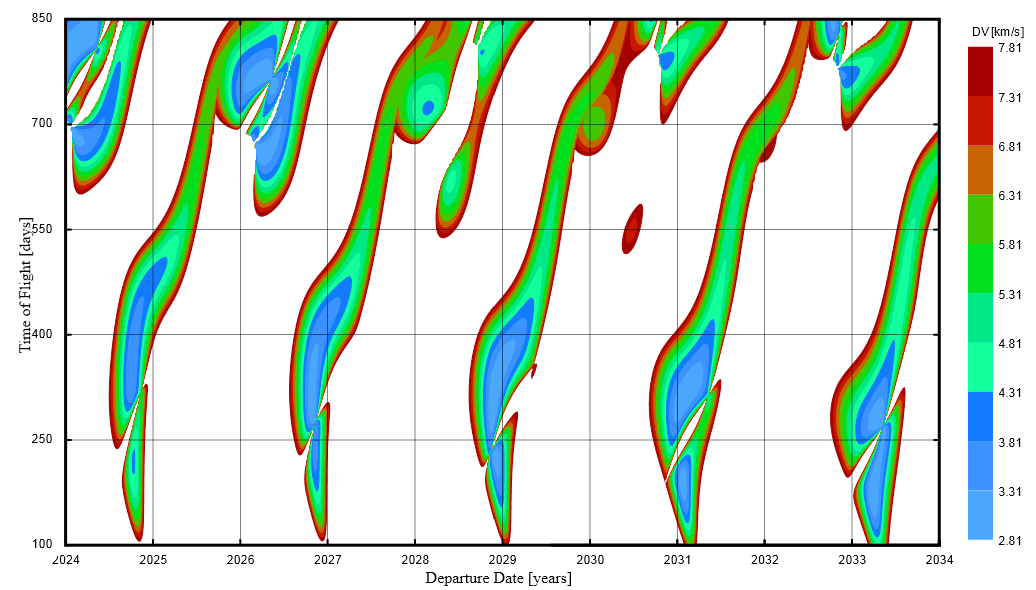
Earth goes round the Sun in 365 days and Mars takes 687, so Earth laps Mars roughly every 26 months. The precise figure is Mars's synodic period, 779.94 days, and it is why spacecraft leave for Mars in clusters and then nothing goes for two years. The cheapest way across was worked out by Walter Hohmann, a structural engineer in Essen, in a 1925 book called Die Erreichbarkeit der Himmelskoerper. It is an ellipse that touches Earth's orbit at one end and Mars's orbit at the other: you fire once to leave, coast for months, and fire again to arrive. Because the coast is half an ellipse and takes a fixed length of time, you have to leave at the moment when Mars will have reached the far end by the time you get there. Get the timing wrong and the ellipse no longer meets anything useful. So a launch window is not really a gate that opens and shuts. It is a cost gradient. Departure energy is quoted as C3, the square of the speed a spacecraft still has after escaping Earth, and around the optimum date C3 is at a minimum and rises steeply on either side. The practical window is the few weeks in which your particular rocket can still lift your particular spacecraft. Everything else follows from that: how much mass you can send, which launcher you have to buy, whether an orbiter and a lander can travel together. In the 1973 Soviet campaign the window was expensive enough that a Proton could no longer carry both, so the USSR split them and flew four spacecraft instead of two. The Mars 4, 5, 6 and 7 page tells that story.
Not all windows cost the same, because neither orbit is a circle. Mars's eccentricity is 0.0935, about five and a half times Earth's, and its distance from the Sun swings between 206.7 and 249.3 million km, so every meeting has a different geometry. NASA Glenn's Interplanetary Mission Design Handbook plots the minimum departure energy for every opportunity from 1990 to 2045 and the values run from 7.7 to 15.5 km2/s2, a factor of two. Its table for the coming decades gives 9.144 for the 2026 window, 7.781 for 2033, which is the cheapest of the next twenty years, and 14.84 for 2037, the dearest. The pattern nearly repeats every 15 to 17 years, because that is roughly when Earth and Mars return to the same relative positions. Doubling C3 does not double the difficulty in any simple way. Converted into the burn a rocket has to make from low Earth orbit, the difference between the best and worst windows is about 3.6 against 3.9 km/s, under ten per cent, which is azmth's own arithmetic and not a published figure. But the rocket equation is exponential, so a tenth of a kilometre per second is a large slice of payload. Each window also offers two families of route: Type I trajectories sweep less than half way round the Sun and get there faster, Type II sweep more than half way, take longer, and usually cost less. Nine of the ten optimal missions the handbook tabulates for 2026 to 2045 are Type II.
The cruise is uneventful and the navigation is not. A launch vehicle upper stage is not sterilised and must not hit Mars, so the rocket deliberately aims to miss: Curiosity's Centaur left it on a path that would have passed about 40,000 km from the planet and arrived fourteen hours late. The spacecraft then removes that bias itself in a handful of corrections that get smaller as they go, from 59 minutes of thruster firing for 5.5 m/s in January 2012 down to 40 seconds in June to move the entry point by 200 km. Arriving is the expensive part, because a spacecraft reaches Mars going faster than Mars is going and must shed the difference or fly straight past, which is exactly what happened to Mars 4 in 1974 when its engine would not light. ExoMars TGO's insertion burn on 19 October 2016 ran 139 minutes and took off more than 1.5 km/s, and even that only bought a long capture ellipse. Circularising on rockets would cost about as much again, so ever since Mars Global Surveyor orbiters have used the atmosphere instead. Aerobraking dips the closest approach into the top of the air and lets drag shave a little energy off every orbit for months. Mars Odyssey made 332 drag passes over 77 days, cutting an 18.6-hour orbit to 1.8 hours and saving more than 200 kg of spacecraft mass, which is the only reason it fitted on a Delta II. TGO made 952 passes for about 1.02 km/s. Doing the whole capture in a single pass, called aerocapture, has never been flown at any planet.
Then there is landing, and this is where Mars is genuinely peculiar. Braun and Manning put it in one sentence in 2007: the atmosphere is thick enough to create substantial heating but not thick enough to produce a low terminal descent velocity. Surface density is about a hundredth of Earth's and the whole column is so thin that a vehicle is still doing hundreds of metres per second when it runs out of sky. Mariner 4 is where this stopped being an argument and became a design problem. Its radio occultation on 15 July 1965 measured surface pressure at 4.1 to 7.0 millibars against pre-flight expectations of the order of 85, and every lander anybody had drawn became too heavy overnight. The deciding number is ballistic coefficient: mass divided by drag coefficient times frontal area. Braun and Manning calculate that at Mars only entry systems below about 50 kg per square metre can reach subsonic speed on drag alone, and even then only within about 10 km of the ground. Every vehicle actually flown has been far above that, from 63 for Pathfinder to 115 for Curiosity. Without its parachute, Curiosity's entry capsule would have hit the ground at roughly Mach 1. On an airless world you need no heat shield at all and rockets do everything; in a thick atmosphere a parachute alone can finish the job. Mars demands a heat shield and a parachute and rockets, and gives you about seven minutes to use all three in the right order.
On the American missions the parachute hands the vehicle over at 55 to 90 metres per second within a kilometre of the ground, and that last kilometre has been solved three different ways. Viking's answer was throttled hydrazine engines and three crushable legs, arriving at about 2.4 m/s with 20 cm of clearance under it; Phoenix and InSight are its descendants. Pathfinder's answer, chosen because it was cheap and forgiving of rocks and slopes, was to wrap the lander in airbags and let it bounce, and the same architecture toughened for higher speeds carried Spirit and Opportunity. Braun and Manning note that airbags and similar mechanical attenuators top out near 0.6 tonnes, which is why the third answer had to exist. The sky crane holds the rockets well above the ground rather than letting them dig a crater under the payload, lowers the rover 7.6 metres on nylon cords, and lets the rover's own wheels be the landing gear; touchdown is at about 0.75 m/s. Curiosity and Perseverance both came down that way. Two landings sit outside those three: Mars 3 cut its parachute away just above the ground and hit at a reported 20.7 m/s inside a shock-absorbing shell, and Zhurong hovered on its engines while it looked for a safe spot. All of it is autonomous because it has to be. Curiosity's landing signal took 13.8 minutes to cross 248 million km and Perseverance's took 11 minutes 22 seconds, so the famous seven minutes of terror had already finished, one way or the other, before anyone on Earth knew they had begun. Perseverance added Range Trigger, which opens the parachute by position rather than speed, and Terrain-Relative Navigation, which recognises the ground during descent and can move the touchdown point by up to 600 metres.
So how often does this work? Counting from this catalogue rather than repeating the statistic that circulates: 47 launches have been aimed at Mars with a settled outcome, and 28 of them returned data from the planet or its immediate vicinity. That is 60 per cent, and it conceals a sharp change. Of the 23 launches up to Viking, 11 worked. Of the 24 from 1988 onward, 17. Of the 15 since 2001, 14, and the one failure never left Earth orbit. Landing has not improved as much. Eighteen spacecraft have entered the atmosphere meaning to reach the surface and 11 produced a working machine there, one of those only briefly, for a length of time that is still disputed, which the Mars 3 entry sets out. Nine of twelve American attempts worked, the single Chinese attempt worked, one of three Soviet attempts worked briefly, and neither of the two European attempts worked at all. Nothing has landed on Mars since Zhurong on 14 May 2021. The empty windows are part of the answer too. ESA suspended the ExoMars rover on 17 March 2022 and the window passed with nothing launched; 2024 passed the same way after ESCAPADE came off its rocket and MMX slipped. The 2026 window carries JAXA's MMX and ESCAPADE's departure burn, but not the five uncrewed Starships that had been promised for it, which SpaceX gave up in February 2026. The Starship and Mars page covers that.
What we know
Why the window comes back every 26 months
Earth takes 365.256 days to circle the Sun and Mars takes 686.980, so Earth laps Mars every 779.94 days, which is Mars's synodic period: about 25.6 months, or 2.14 years. NASA Glenn's mission design handbook derives the same figure independently as 779.935 days from the two orbital rates. A minimum-energy departure is only possible near the moment when Mars will have reached the far end of your transfer ellipse by the time you get there, and that phasing repeats once per synodic period.↗
Where the idea comes from
Walter Hohmann, a German structural engineer born on 18 March 1880, published Die Erreichbarkeit der Himmelskoerper (The Attainability of the Celestial Bodies) in 1925. In it he worked out the orbital manoeuvre that moves a spacecraft between two orbits for the smallest expenditure of energy, an ellipse tangent to both. It is still called a Hohmann transfer and it is still what a Mars mission flies.↗
What a window costs, and what C3 means
Departure energy is quoted as C3, the square of the speed a spacecraft still has after it has escaped Earth's gravity, in km2/s2. C3 of zero is a bare escape. NASA Glenn's Interplanetary Mission Design Handbook tabulates the optimal ballistic mission for each opportunity from 2026 to 2045: 9.144 for 2026, 8.928 for 2028, 8.237 for 2031, 7.781 for 2033, 10.19 for 2035, 14.84 for 2037, 12.17 for 2039, 9.818 for 2041, 8.969 for 2043 and 8.587 for 2045. Its Figure 1 plots the minimum for every opportunity from 1990 to 2045 and the values run from 7.7 to 15.5 km2/s2.↗
Why one window costs twice as much as another
Neither orbit is a circle. Mars's eccentricity is 0.0935, about five and a half times Earth's, so its distance from the Sun swings between 206.65 and 249.26 million km and every meeting has a different geometry. The handbook notes that Earth and Mars nearly return to their original relative heliocentric positions every 7 to 8 synodic periods, that is every 15 to 17 years, so the pattern of cheap and expensive windows nearly repeats on that cycle. The 1973 Soviet campaign is the clearest illustration in this catalogue: Lavochkin's own account says departure that year needed 250 to 300 m/s more than 1971, enough that a Proton could no longer send an orbiter and a lander together. That campaign is covered under Mars 4, 5, 6 and 7.↗
Type I and Type II
Each window offers two families of route. A Type I trajectory sweeps less than 180 degrees around the Sun: shorter trip, lower sensitivity to error, usually more expensive. A Type II sweeps more than 180 degrees: longer trip, usually cheaper. Between them sits a ridge of trajectories that pass through almost exactly 180 degrees, which are very expensive because they would need a near-polar transfer plane to reach a planet whose orbit is tilted 1.85 degrees out of Earth's. Of the ten optimal missions the handbook tabulates for 2026 to 2045, nine are Type II.↗
How long the crossing actually takes
Azmth's own computation from the launch and arrival dates of every spacecraft in this catalogue that reached Mars. The full spread is 131 to 333 days. The fast end belongs to flybys, which never have to slow down and so can accept a punishing arrival speed: Mariner 7 crossed in 131 days and Mariner 6 in 156. For anything that stops, the record is Mariner 9's 168 days, then Mars 3 at 188 and Mars 2 at 192. The modern cluster sits just past 200: Odyssey 200, Opportunity 201, Tianwen-1 202, Perseverance 203, Hope and InSight 205, Mars Express 206, Spirit 208, Mars Reconnaissance Orbiter 210, Pathfinder 212, ExoMars TGO 219. Longer Type II routes ran to 254 days for Curiosity, 295 for Phoenix, 304 for Viking 1, 308 for MAVEN, 309 for Mars Global Surveyor, 323 for Mangalyaan and 333 for Viking 2. Six to eleven months is the honest range for a mission that intends to stay. The link on this entry supports Curiosity's arrival only; every other figure here is arithmetic on launch and arrival dates held in this catalogue, and arrival is defined as closest approach for a flyby, insertion for an orbiter and entry for a lander.↗
The rocket is deliberately aimed to miss
An upper stage is not sterilised, so it must not hit Mars. Curiosity was released on a course that would have missed the planet by about 40,000 km and arrived roughly 14 hours late; the spacecraft then removed that bias itself. Its first correction on 11 January 2012 used about 59 minutes of thruster firing for a velocity change of 5.5 m/s. Its third, on 26 June, used 40 seconds to shift the entry point by about 200 km and advance entry by about 70 seconds. Six corrections were scheduled in all, three of them in the final 45 days.↗
Arriving costs more than departing
A spacecraft reaches Mars going faster than Mars is going, and must shed the difference or fly past, which is what happened to Mars 4 in 1974 when its engine would not light. ExoMars TGO's Mars orbit insertion on 19 October 2016 burned from 13:05 to 15:24 UTC, 139 minutes, and changed its velocity by more than 1.5 km/s. That buys a long capture ellipse; it does not buy a working orbit. Early missions such as Mariner 9 reached their science orbit entirely on rockets, at a total of roughly 1.6 km/s; later orbiters such as Mars Global Surveyor and Mars Reconnaissance Orbiter split the job, spending about 1 km/s on insertion and letting the atmosphere do the rest. Those last two figures are Isoletta and colleagues', so this entry links their paper; the ESA release, listed in the sources, covers only the TGO burn.↗
Aerobraking, and what it is worth
Aerobraking dips a spacecraft's closest approach into the top of the atmosphere and lets drag shave a little energy off every orbit, for months. Mars Odyssey made 332 successive drag passes over 77 days after its 24 October 2001 insertion, cutting an 18.6-hour orbit to about 1.8 hours. NASA Langley records that the propellant saved reduced the required spacecraft mass by more than 200 kg, which is what let the mission fly on a Delta II class rocket at all. ExoMars TGO aerobraked from 15 March 2017 to 20 February 2018, 952 atmospheric transits for a total velocity change of about 1.02 km/s, taking a one-sol orbit down to about two hours. ESA's flight dynamics team puts the typical saving for a low Mars orbiter at around 1 km/s, and credits the technique to Magellan at Venus in 1993 before JPL brought it to Mars with Mars Global Surveyor, Odyssey and Mars Reconnaissance Orbiter. The Odyssey figures here are NASA Langley's, from Tartabini, Munk and Powell.↗
Aerocapture has never been flown
Aerobraking takes months of shallow passes after a propulsive capture. Aerocapture would do the whole capture in a single deep pass, saving the insertion burn entirely. It has never been used at any planet. Isoletta and colleagues state it plainly in the Journal of Spacecraft and Rockets in 2021: the obstacles are the uncertainty in Martian atmospheric density and its variability, plus navigation error, because a single pass leaves no room to correct. Aerocapture was carried in the early design of Mars Odyssey and dropped for aerobraking when aeroshell packaging and mass became problems. The same paper is fairer to the technique than that summary suggests: it reports a NASA study finding aerocapture ready to be employed for science missions at Venus, Mars and Titan. Not flown is not the same as not ready. We found no report of a flight demonstration since.↗
Direct entry versus entry from orbit
Three spacecraft have entered the Martian atmosphere from orbit rather than straight off the approach. Viking 1 and Viking 2 each spent weeks circling while their sites were photographed and certified, then released the landers at an inertial entry speed of about 4.7 km/s. Tianwen-1 did the same thing in 2021: it captured into Mars orbit on 10 February, surveyed its landing region from a parking orbit for about three months, and only then released the entry capsule, on 14 May. Every US lander since Mars Pathfinder has gone straight in off the approach hyperbola without stopping, which is faster and cheaper but commits you to the site chosen before launch: Pathfinder entered at about 7.26 km/s, Spirit 5.4, Opportunity 5.5, Phoenix 5.59 and Curiosity under 6.0. The Soviet Mars 2, 3 and 6 descent modules also entered directly, separating from their carrier hours out and firing a solid motor to drop off the flyby path; Mars 7's module separated too but missed the planet and never entered the atmosphere at all. The entry speeds are Braun and Manning's; the Tianwen-1 sequence comes from azmth's own Tianwen-1 and Zhurong entries, and the Soviet descent modules are covered under Mars 3 and Mars 4, 5, 6 and 7.↗
Why Mars is the awkward case
Braun and Manning state the problem in one line: the Martian atmosphere is thick enough to create substantial heating but not thick enough to produce a low terminal descent velocity. Surface density is about one hundredth of Earth's, roughly 0.020 kg/m3, at a mean surface pressure of 6.36 millibars. What decides an entry vehicle's fate is its ballistic coefficient, mass divided by drag coefficient times frontal area. Braun and Manning calculate that at Mars only systems below about 50 kg/m2 can reach subsonic speed on drag alone, and only within about 10 km of the ground. Every vehicle actually flown has been well above that: 63 kg/m2 for Pathfinder, 64 for Viking, 65 for Phoenix, 94 for the Mars Exploration Rovers and 115 for Curiosity. Without a parachute, a Curiosity-class entry vehicle would reach the ground at roughly Mach 1. The same shortage of air puts most of Mars off limits. Braun and Manning recorded in 2007 that every successful landing had been below minus 1.4 km on the MOLA elevation scale, which ruled out most of the ancient southern highlands, where the average is about plus 2 km, and they describe fully half the surface as having been out of reach for that reason. Practice has barely moved: Perseverance landed at minus 2,570 m, InSight at minus 2,613 m and Zhurong at minus 4,099 m.↗
The parachute nobody has replaced
Every US Mars landing has used a disk-gap-band parachute descended from the Viking programme, and Braun and Manning record that the Viking-era 70 degree sphere-cone aeroshell shape has been used on every US Mars landed mission. The heat shield material is a different story and their 2007 table is now out of date on it: SLA-561V flew from Viking through Phoenix, but Curiosity and Perseverance both flew heat shields tiled with phenolic impregnated carbon ablator instead, because the entry profile and vehicle size could drive the surface to about 2,100 C. The Mars 2020 press kit puts SLA-561V on the back shell only. The shape is Viking's; the ablator on the two heaviest landers is not. Note the scope: that lineage is American. The Soviet descent modules predate Viking altogether, and ESA's Beagle 2 and Schiaparelli and China's Zhurong flew independently developed aeroshells and thermal protection. The Viking design was qualified in 1972 by high-altitude tests in Earth's atmosphere at Mars-relevant conditions, between Mach 1.4 and 2.1 and dynamic pressures of 250 to 700 pascals. Everything flown between Viking and Curiosity was then qualified by similarity to that programme. That stopped being true for Perseverance. NASA's Advanced Supersonic Parachute Inflation Research Experiments project flew three sounding rockets from Wallops Island across 2017 and 2018, deploying full-scale disk-gap-band parachutes high over Earth at Mars-relevant Mach numbers and dynamic pressures; NASA's own accounts say plainly that the ASPIRE tests of 2017 to 2018 qualified the Mars 2020 parachute. Two designs were flown, a build-to-print copy of Curiosity's canopy and a strengthened version of the same geometry. NASA's summary of the intervening decades is blunt: subscale development tests and subsonic low-altitude qualification, no new supersonic qualification, from Pathfinder through Curiosity. A follow-on campaign, ASPIRE2, was to qualify a Mars Sample Return parachute at Mach 2.1 and higher loads in early 2026; NASA's own description of it is written in the past conditional and azmth has found no record of a flight. Flown US nominal diameters run from 11.7 m for Phoenix to 21.5 m for Curiosity and Perseverance, deploying between Mach 1.1 and 2.2. Watch the convention: those are constructed diameters, and the Curiosity press kit quotes the same canopy as opening to nearly 16 m, which is the inflated width. The 21.5 m figure is NASA's, from the Mars 2020 press kits; Braun and Manning's 2007 table gives 19.7 m, the size then planned for Curiosity. Braun and Manning judged in 2007 that about 0.8 tonnes may be the largest payload Viking-era parachute technology can put at 2 km MOLA elevation.↗
The last kilometre: three answers
Every US Mars landing system so far has started from the same place, hanging under a parachute at 55 to 90 m/s within a kilometre of the ground; that range is Braun and Manning's, and their table covers the US missions only. Viking answered with throttled hydrazine engines and three crushable legs, touching down at about 2.4 m/s vertically and under 1 m/s horizontally, with 20 cm of rock clearance; Phoenix and InSight are its descendants. Pathfinder answered with airbags, cheap and forgiving, rated for 16 m/s vertical and 22 m/s horizontal and tens of bounces over rocks up to 0.5 m, later toughened to 26 m/s for Spirit and Opportunity. Braun and Manning note that airbags and similar mechanical attenuators top out near 0.6 tonnes. The sky crane is the third answer: rockets held well above the ground, the rover lowered 7.6 m on nylon cords, touching down at about 0.75 m/s on its own wheels. Those are the three American answers. Mars 3 used a fourth: its parachute was pulled aside by a small rocket just above the ground and the station hit at a reported 20.7 m/s inside a shock-absorbing shell, then righted itself on four petals. Zhurong used a fifth, a hovering powered descent with hazard avoidance onto legs, closest to the Viking answer but independently built.↗
The record, counted from this catalogue
Azmth's own count of the mission entries here, covering every launch aimed at Mars whose outcome is settled, that is every window through 2020. There have been 47 such launches; 28 returned data from Mars or its immediate vicinity and 19 did not. Of the 23 launches up to and including Viking, 11 worked. Of the 24 from 1988 onward, 17. Of the 15 since 2001, 14, and the single failure, Phobos-Grunt and Yinghuo-1, never left Earth orbit. Landing is separate and worse: 18 spacecraft have entered the Martian atmosphere intending to reach the surface and 11 produced a working machine there, one of them only briefly. How briefly is not settled: published figures for Mars 3's transmission run 14.5, 20 and 40 seconds, a 2024 reconstruction argues from the surviving print that the lander worked longer than any of them, and azmth's own Mars 3 entry leads with 14.5 seconds rather than the 20 that Braun and Manning quote. By operator: 9 of 12 American attempts, 1 of 1 Chinese, 1 of 3 Soviet and 0 of 2 European. Braun and Manning's account of the record up to 2007 agrees with ours where the two overlap: five successful US landings, Mars 2 a failure and Mars 3 twenty seconds of transmission, that last being one of several published figures rather than a settled one. They do not publish a full attempt-by-attempt tally, so this is agreement on the parts they state; it is not an independent replication of our count.↗
The windows nobody used
On 17 March 2022 the ESA Council, meeting in Paris on 16 and 17 March, unanimously acknowledged the present impossibility of carrying out the ongoing cooperation with Roscosmos on the ExoMars rover mission with a launch in 2022, and mandated the Director General to suspend it. Nothing else was ready, so the 2022 window passed empty. The 2024 window passed empty too, after ESCAPADE was taken off its rocket in September 2024 and JAXA's MMX slipped two years. Those are the first consecutive empty Mars windows since the 1980s.↗
What happened, and when
- 1925Walter Hohmann, an Essen structural engineer, publishes Die Erreichbarkeit der Himmelskoerper and works out the minimum-energy transfer between two orbits: an ellipse tangent to both. It is the route every Mars mission has flown since.
- 15 Jul 1965Mariner 4 passes behind Mars and its radio signal, bent and dimmed by the atmosphere on the way in and out, gives the first direct measurement of Martian surface pressure: 4.1 to 7.0 millibars, against pre-flight expectations of the order of 85. Kliore and colleagues report that the density, temperature and scale height are all lower than predicted. Every landing system designed since starts from this result.
- 1972The Viking programme qualifies its supersonic disk-gap-band parachute in high-altitude, high-speed tests in Earth's atmosphere at Mars-relevant conditions, between Mach 1.4 and 2.1 and 250 to 700 pascals. The tests are expensive enough that nothing comparable is attempted for forty-five years, and every US Mars parachute from Viking to Curiosity is qualified by similarity to this one.
- 20 Jul 1976Viking 1 lands in Chryse Planitia after weeks in orbit certifying the site, entering at about 4.7 km/s and finishing on throttled engines and crushable legs at about 2.4 m/s. Viking 2 follows on 3 September. They are the only landers released from Mars orbit apart from Tianwen-1's, which separated from its orbiter on 14 May 2021 after about three months of surveying the site from a parking orbit. Everything else has entered straight off the approach. The Zhurong entry covers the Chinese landing.
- 4 Jul 1997Mars Pathfinder enters directly from the approach hyperbola at about 7.26 km/s, the first NASA lander to skip Mars orbit entirely, and lands inside airbags built to survive 16 m/s vertical and 22 m/s horizontal impacts and tens of bounces. The same architecture, toughened to 26 m/s, later carries Spirit and Opportunity.
- Oct 2001 to Jan 2002Mars Odyssey, propulsively inserted on 24 October 2001 and cleared after four checkout orbits, aerobrakes for 77 days and 332 drag passes, finishing in January 2002, taking an 18.6-hour orbit down to about 1.8 hours. NASA Langley records the propellant saved as reducing required spacecraft mass by more than 200 kg, which is what allowed a Delta II class launch. ESA's flight dynamics team lists the technique as pioneered by Magellan at Venus in 1993 and then used at Mars by Mars Global Surveyor, Odyssey and Mars Reconnaissance Orbiter; ExoMars TGO makes it a full year from 2017.
- 6 Aug 2012Curiosity flies the first guided hypersonic entry at Mars, steering its lift vector with an autonomous algorithm to shrink the landing ellipse to about 20 km, then lands on the sky crane. Entry at about 5,900 m/s, peak heating 75 seconds in at about 2,100 C on the heat shield, parachute at 254 seconds and 11 km, touchdown at about 0.75 m/s at entry plus 416 seconds. More than nine-tenths of the deceleration happens on the aeroshell before the parachute opens.
- 19 Oct 2016Two arrivals on one day show both halves of the problem. ExoMars TGO's insertion burn runs 139 minutes and takes off more than 1.5 km/s, putting it safely into a capture ellipse. Its passenger Schiaparelli, entering directly, jettisons its parachute early and is destroyed on impact.
- Oct 2017 to Sep 2018NASA's ASPIRE project flies three sounding rockets from Wallops Island, in October 2017, March 2018 and once more in the second half of 2018, and deploys full-scale disk-gap-band parachutes high over Earth at Mach numbers and dynamic pressures relevant to Mars. NASA's own documents give the third flight as July and as September 2018; azmth has not resolved which. Two canopies are tested, a build-to-print copy of Curiosity's and a strengthened version of the same geometry, and NASA records that the campaign qualified the parachute Perseverance would fly. It is the first supersonic Mars parachute qualification programme since Viking's, and it is why the claim that nothing has been re-qualified since 1972 no longer holds for the US.
- 18 Feb 2021Perseverance lands with two techniques never flown before: Range Trigger, which fires the parachute mortar based on where the vehicle is rather than how fast it is going, and Terrain-Relative Navigation, which photographs the ground during descent, matches it to an onboard map and can move the touchdown point by up to 600 m. One-way light time that day was 11 minutes 22 seconds.
- 17 Mar 2022The ESA Council suspends cooperation with Roscosmos on the ExoMars rover after Russia's invasion of Ukraine. Nothing else is ready and the 2022 window passes with no launch to Mars. The 2024 window passes the same way, the first consecutive pair of empty windows since the 1980s.
- 13 Nov 2025ESCAPADE lifts off on a Blue Origin New Glenn from Launch Complex 36 at Cape Canaveral at 3:55 p.m. EST, a full year before the window it is aiming at. Azmth's own ESCAPADE entry, which reads its trajectory from JPL Horizons, records a wide loiter loop that keeps the pair in Earth's neighbourhood, passing through the Earth-Sun L2 region around late February 2026 but nowhere near it the rest of the time (on 23 August 2026 they sat about 88 degrees off the L2 direction), a trans-Mars injection burn planned for November 2026 and arrival in September 2027. It is the clearest demonstration that the 26-month rhythm constrains departure from Earth's neighbourhood rather than departure from the ground.
In pictures
Tap a photo to enlarge.
Sources
- Robert D. Braun and Robert M. Manning, Mars Exploration Entry, Descent, and Landing Challenges, Journal of Spacecraft and Rockets 44(2), 310-323, March 2007, DOI 10.2514/1.25116
- NASA NSSDCA Mars Fact Sheet (D. R. Williams)
- Laura M. Burke, Robert D. Falck and Melissa L. McGuire, Interplanetary Mission Design Handbook: Earth-to-Mars Mission Opportunities 2026 to 2045, NASA/TM-2010-216764, NASA Glenn Research Center
- Paul V. Tartabini, Michelle M. Munk and Richard W. Powell, The Development and Evaluation of an Operational Aerobraking Strategy for the Mars 2001 Odyssey Orbiter, NASA Langley Research Center
- Gabriele Bellei, Francesco Castellini, Frank Budnik and Robert Guilanya Jane, Navigation Challenges during ExoMars Trace Gas Orbiter Aerobraking Campaign, 18th Australian Aerospace Congress / ISSFD 2019
- G. Isoletta, M. Grassi, E. Fantino, D. de la Torre Sangra and J. Pelaez Alvarez, Feasibility Study of Aerocapture at Mars with an Innovative Deployable Heat Shield, Journal of Spacecraft and Rockets, November 2021, DOI 10.2514/1.A35016
- A. Kliore, D. L. Cain, G. S. Levy, V. R. Eshleman, G. Fjeldbo and F. D. Drake, Occultation Experiment: Results of the First Direct Measurement of Mars's Atmosphere and Ionosphere, Science 149(3689), 1243, 10 September 1965
- E. Venkatapathy and D. Hash, The Impact of the Viking Entry, Descent, and Landing Legacy on Future Mars Exploration, Astrobiology, 24 June 2026, DOI 10.1177/15311074261464024
- NASA JPL, Mars Science Laboratory Landing Press Kit (2012)
- Suman Muppidi, Clara O'Farrell, John W. Van Norman and Ian G. Clark, ASPIRE Aerodynamic Models and Flight Performance, NASA Ames and JPL, NTRS 20210023511
- NASA JPL, Mars 2020 Perseverance Launch Press Kit (2020)
- NASA JPL, Mars 2020 Perseverance Landing Press Kit (2021)
- ESA press release, ExoMars suspended, 17 March 2022
- ESA press release, ExoMars TGO reaches Mars orbit while EDM situation under assessment, 19 October 2016
- NASA blog, 13 November 2025: Liftoff! NASA's ESCAPADE Begins Journey to Mars
- Linda Hall Library, Scientist of the Day: Walter Hohmann
Checked on 24 August 2026. Where the science is unsettled this page says so rather than picking a winner.