Getting to the Moon
A direct flight to the Moon takes about three to six days and a fuel-saving low-energy route roughly two and a half to four months, and both are routine. Landing is the unreliable step: as of 22 September 2026, only one of the six private landers that tried between 2019 and 2025, Firefly's Blue Ghost 1, came down upright as planned.
TL;DR· 22 min read
A direct flight to the Moon takes about three to six days; Apollo 11 coasted for about three. Spacecraft that can wait take two and a half to four months on low-energy routes that swing far beyond the Moon and use the Sun's gravity to arrive slowly, which saves fuel on the braking burn. Reaching lunar orbit is routine. Landing is not: most recent failures, from Beresheet in 2019 to ispace's second lander in 2025, involved how the lander sensed its own motion or measured its altitude.
Flying to the Moon takes about three days if you burn hard and go straight there, as Apollo did, and two and a half to four months if you would rather save fuel by looping out 1 to 2 million kilometres from Earth, far beyond the Moon, and letting the Sun's gravity do part of the work, as many small modern spacecraft do. Both routes are well understood; what has failed most often in recent years is the last few kilometres. The Moon has no air to slow a lander, so its engine must cancel all of its orbital speed while the lander works out, on its own, exactly how far away the ground is. Since 2019, landers from Israel, India, Japan, Russia and the United States have crashed or come to rest on their sides, most often because a sensor, or the software reading it, got the altitude or speed wrong. This page covers the fast and slow routes, the free-return loop that brought Apollo 13 home and that NASA planned for the Artemis II crew's flight in April 2026, the braking burn that turns a flyby into an orbit, the stretched halo orbit NASA chose for its Gateway station, and what the recent crashes have in common.
- Apollo 11's coast from Earth to the Moon on the fast, direct route (JPL puts it at about 3.05 days)
- ~3 daysApollo 11's coast from Earth to the Moon on the fast, direct route (JPL puts it at about 3.05 days)
- how far from Earth Japan's Hiten looped in 1991 before the Moon temporarily captured it with no braking burn at all
- 1.5 million kmhow far from Earth Japan's Hiten looped in 1991 before the Moon temporarily captured it with no braking burn at all
- private landers that tried to land between 2019 and 2025 and came down upright as planned (Firefly's Blue Ghost 1)
- 1 of 6private landers that tried to land between 2019 and 2025 and came down upright as planned (Firefly's Blue Ghost 1)
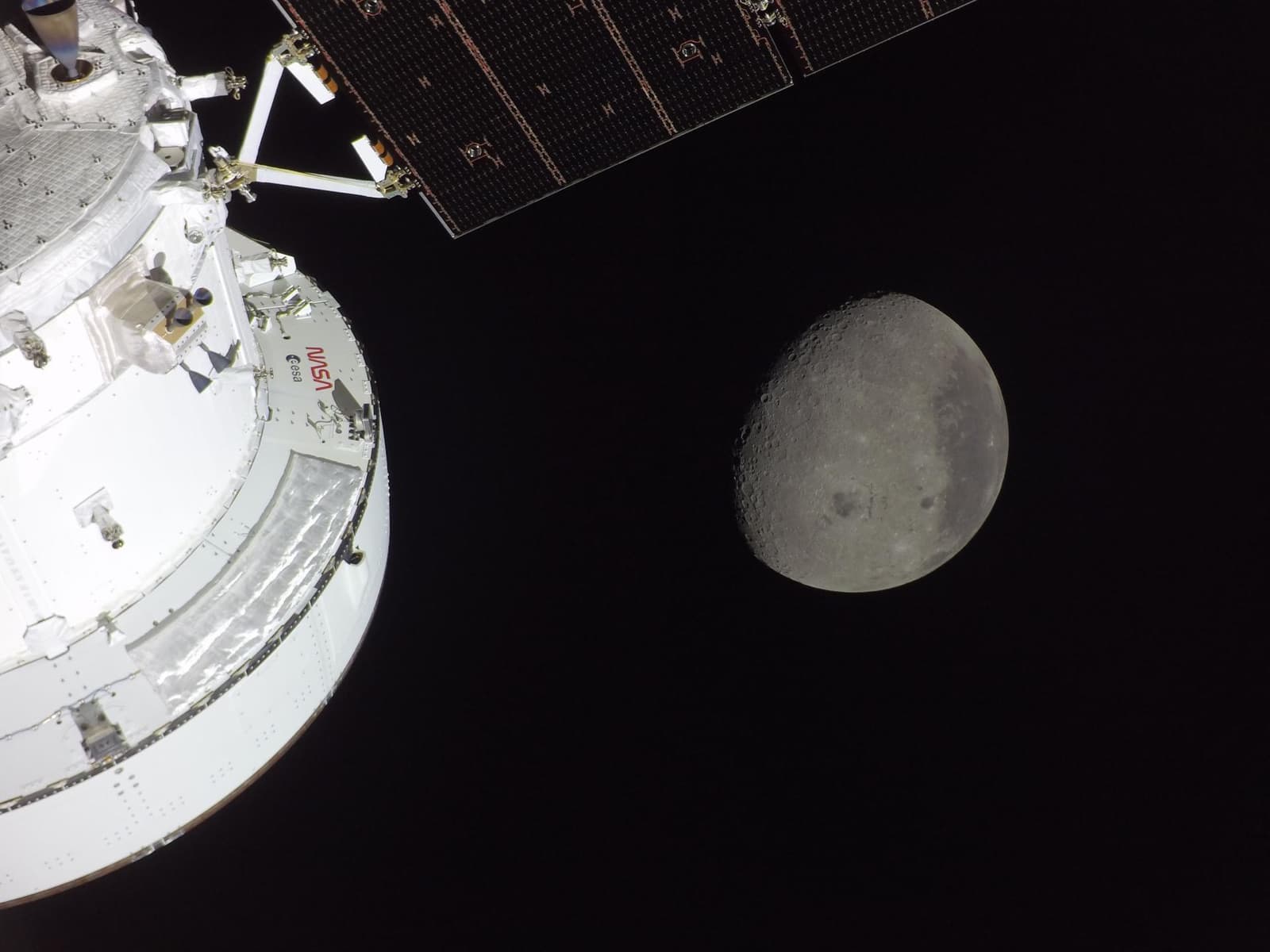
The shape of the trip explains most of what follows. The Moon circles Earth at an average distance of 384,400 km, and nothing flies to it in a straight line. A spacecraft is put on a long, stretched orbit around Earth whose far end reaches the Moon's path, and it coasts most of the way, slowed all along by Earth's pull. The engine work happens at the two ends: a burn near Earth to stretch the orbit, and a burn at the Moon to avoid sailing straight past. How long the coast lasts and how hard that second burn must be are the real choices, and they pull against each other.
Apollo chose speed. On Apollo 11 the Saturn V's third stage reignited 2 hours 44 minutes after launch and burned for 5 minutes 48 seconds. About three days later, after flying behind the Moon and out of contact with Earth, the crew fired their service module engine for 357.5 seconds, at about 75 hours 50 minutes into the flight. A JPL survey of lunar trajectories by Jeffrey Parker and Rodney Anderson describes the Apollo transfers as 3 to 3.5 days, as quick as possible without dramatically increasing the fuel needed. The most fuel-efficient direct transfers take about 4.5 days, which is what NASA's Lunar Reconnaissance Orbiter flew in 2009. Direct transfers can be built as short as a few hours or as long as a few weeks. Early probes that only had to hit or pass the Moon were quicker than Apollo: the same survey lists Luna 2, the first spacecraft to strike the Moon, as arriving 33.5 hours after its launch in September 1959. The quick routes carry a catch, though: Apollo and LRO could launch only within a short window each month.
Not every rocket can throw a spacecraft straight at the Moon, and not every mission wants it to. India's Chandrayaan-3 was put into orbit around Earth by its LVM3 rocket on 14 July 2023, and ISRO then raised that orbit in steps, reaching 71,351 by 233 km after the fourth firing on 22 July and firing once more on 25 July, before sending it toward the Moon on 1 August. It entered lunar orbit on 5 August and landed on 23 August. The JPL survey says such Earth phasing orbits widen the launch period, space out the manoeuvres or make up for a rocket not powerful or accurate enough to go direct, as with Chandrayaan-1, at the price of a longer trip and extra passes through the Van Allen radiation belts. China's heavy Long March 5 put Chang'e 6 straight onto an Earth-Moon transfer orbit instead: it left Wenchang on the evening of 3 May 2024 and braked into lunar orbit at 10:12 Beijing time on 8 May.
The slow road works differently. A spacecraft on a low-energy transfer is aimed well past the Moon, out to 1.5 to 2 million km from Earth, where the Sun's pull becomes strong enough to matter. Over two to four months the Sun gradually raises the low point of the spacecraft's orbit until it matches the Moon's distance, so that when the spacecraft falls back it meets the Moon almost alongside, moving at nearly the Moon's own speed. According to the JPL survey, the braking burn into a 100 km lunar orbit is then at least 120 m/s smaller than after a direct transfer, and a spacecraft heading for a halo orbit around one of the Earth-Moon balance points saves 400 m/s or more, arriving with essentially no insertion burn at all. The long route buys time as well as fuel: launch periods of 21 days or more become cheap, and NASA's twin GRAIL spacecraft, launched on 10 September 2011, made their first course correction only 20 days after launch and reached the Moon 25 hours apart. The costs are a long cruise and a radio link stretched to as much as 2 million km.
The technique was first flown to rescue a mission. Japan's Hiten, launched on 24 January 1990, was built to test lunar swing-bys and to release a small orbiter, Hagoromo, whose transmitter had already failed by the time it was released that March. Hiten did not carry the fuel for a conventional trip into lunar orbit, so Edward Belbruno and James Miller designed a new route that it could afford. After a ninth lunar swing-by raised its apogee to 1,532,000 km, it drifted back and on 2 October 1991 was temporarily captured by the Moon. NASA's space science data archive records this as the first use of a low-energy, or weak stability boundary, transfer to modify an orbit and the first transfer to the Moon requiring no velocity change for capture. Hiten entered lunar orbit on 15 February 1992 and was steered into the surface on 10 April 1993 (11 April in Japan).
What was improvised for Hiten is now common for smaller spacecraft. South Korea's Danuri, launched in August 2022, was switched from a plan of loops around Earth to a ballistic lunar transfer, a change that ESA's eoPortal mission description, written before launch, credits with saving about 165 m/s in the design. NASA's microwave-oven-sized CubeSat CAPSTONE was released on 4 July 2022 after Rocket Lab's Photon stage had fired seven times to raise the high point of its orbit to about 810,000 miles (1.3 million km), then spent four months falling back to the Moon. JAXA's SLIM left Earth orbit on 1 October 2023, swung past the Moon on 4 October and sailed out to about 1.3 million km; its trajectory planner Satoshi Ueda wrote that out there the Sun's gravity could pull on the spacecraft and cut the fuel spent entering lunar orbit. It arrived on 25 December and landed on 20 January 2024 (Japan time).
There is a third way, slower again, that trades thrust for efficiency. ESA's SMART-1, launched on 27 September 2003, fired an ion engine to expand its orbit gradually and spiral out toward the Moon. It was captured on 15 November 2004 after a cruise of about 13 months and began science operations in January 2005. ESA says the engine delivered 3.5 km/s of velocity change to reach the observation orbit while consuming just 74 kg of xenon.
Crews add a different requirement: a way home if something breaks. Apollo's answer was the free-return trajectory, a path around the Moon aimed so that lunar gravity swings the spacecraft back toward Earth without another engine burn. NASA describes it as providing a ready abort at any time before lunar orbit insertion, and notes that Apollo 11 was to be the last Apollo mission to fly one. Later Apollo crews left it early in the flight with what NASA's Apollo 13 account calls the normal midcourse correction.
On Apollo 13 that choice nearly mattered. A course correction on the second day moved the spacecraft onto a hybrid trajectory to reach Fra Mauro. When an oxygen tank burst, about 56 hours into the flight, the landing was off and the damaged service module forced the crew to use the lunar module as a lifeboat. At 61 hours 30 minutes, about five and a half hours after the accident, they fired the lunar module's descent engine for 34 seconds to put themselves back on a free-return course, raising their closest pass behind the Moon from 69 to 156 miles. Two hours after rounding the far side, a five-minute burn sped up the return and cut the voyage to about 142 hours.
In April 2026 NASA went back to the old answer. Artemis II carried Reid Wiseman, Victor Glover, Christina Koch and Jeremy Hansen around the Moon from 1 to 10 April. NASA's press kit described the path set by the translunar injection burn, which Orion's main engine made on the flight's second day, as a fuel-efficient free-return trajectory: one that would harness the Earth-Moon gravity field to pull Orion back to Earth without propulsion on the way home. The lunar flyby came on 6 April, with a closest approach 4,067 miles (about 6,545 km) above the surface, and the crew reached 252,756 miles from Earth, farther than any people before them.
Arriving is the next problem. A spacecraft on a direct transfer reaches the Moon moving too fast to stay: the JPL survey calculates that a path like Apollo 11's, passing 100 km above the surface at about 2.57 km/s, would need a braking burn of roughly 0.94 km/s to settle into a circular 100 km orbit. Xinhua's account of Chang'e 6's braking burn states the stakes most clearly: brake too little and the probe slides off into deep space, brake too hard and it may hit the Moon. Chang'e 6's orbiter carried a single 3,000-newton orbit-control engine to do the braking. Apollo made the burn behind the Moon, out of contact with Earth; Apollo 8's first insertion burn, at 69 hours 8 minutes 52 seconds, lasted 4 minutes 2 seconds and cut its speed by 2,994 feet per second. Shrinking this burn is the first benefit the JPL survey lists for the low-energy routes.
Where to stop is a choice too. Low circular orbits, like the 100 km orbits used by many mapping spacecraft, are close to the surface, but NASA notes that the Moon's gravity means more propellant is needed to maintain them. For its planned Gateway station NASA picked something stranger: a near-rectilinear halo orbit, or NRHO, one of a family of orbits that loop around one of the balance points near the Moon (for Gateway, the L2 point beyond the Moon) and that, seen in a frame turning with the Moon, look like a long, narrow ellipse. NASA's 2019 reference trajectory has it dipping to a perilune radius of 3,196 to 3,557 km from the Moon's centre, about 1,500 to 1,800 km above the surface, and ESA gives its far point as about 70,000 km. It completes a lap every 6.56 days on average.
The reasons are practical, and NASA's white paper lists them. Orion's existing service module can reach the orbit; its neutral stability makes it cheap to maintain; trips to the surface take about half a day; and the southern version of the orbit gives very good radio coverage of sites near the south pole. NASA's 2022 explainer adds that the orbit keeps a continuous line of sight to Earth. The period was tuned so the station would complete nine laps every two lunar months, a 9:2 resonance with the Moon's phases that keeps it out of Earth's shadow; an Earth eclipse in such an orbit could last nearly five hours, well beyond what Gateway and Orion hardware could tolerate. The orbit has since been flown. CAPSTONE entered it on 13 November 2022, the first spacecraft to do so, and NASA's work with it concluded in June 2026 after nearly four years, with its operator Advanced Space continuing to use it as a testbed (as of July 2026). The station has not: on 24 March 2026 NASA said it intends to pause Gateway in its current form.
Landing is where the recent record turns poor, and the Moon itself is part of the reason. Its atmosphere is so thin that NASA's fact sheet gives a night-time surface pressure of 3 x 10^-15 bar, so there is nothing for a parachute or heat shield to push against; all of the orbital speed has to be taken off by the engine. The Chandrayaan-2 lander was still moving at 1,683 m/s at 30 km altitude when its descent began. The lander has to do this itself, measuring its own height and speed and correcting as it goes. Xinhua's account of Chang'e 6's far-side landing put it plainly: 完成落月只有一次机会, there was only one chance to complete the landing, a sequence of main braking, approach, hovering to avoid obstacles and slow descent carried out within 15 minutes.
The failures since 2019 read like a catalogue of ways to lose track of the ground. Beresheet, a private lander from the Israeli non-profit SpaceIL, lost one of its inertial measurement units while braking on 11 April 2019; the command sent to restart it set off a chain reaction that shut down the main engine, and it struck Mare Serenitatis at a low angle. India's Vikram lander from Chandrayaan-2 descended normally to 2.1 km on 6 September 2019 (7 September in India), ISRO said, but, in the government's later written answer to parliament, its second braking phase slowed it more than designed, so the fine-braking phase began outside its design conditions and it hard-landed within 500 m of its target. In April 2023 ispace's first Hakuto-R lander passed over a crater-rim cliff about 3 km high. Its software took the sudden jump in measured altitude for a faulty sensor, rejected the readings, and concluded it was on the surface while still about 5 km up, descending slowly until its propellant ran out and it fell. ispace traced the gap to a landing-site change made after its February 2021 design review, whose effects its simulations had not captured.
Russia's Luna 25 never began its descent. On 19 August 2023, during a burn to lower its orbit before landing, the engine ran for 127 seconds instead of the planned 84. Roscosmos said the accelerometer unit in its BIUS-L instrument had not switched on, probably because commands with different priorities had entered a single data array, so the control system received null signals and could not register when the required speed was reached; NASA's orbiter later found a new crater, likely Luna 25's, about 400 km short of the landing site. Intuitive Machines' Odysseus went down in February 2024 with its laser rangefinders out of action. Engineers patched in a NASA lidar but missed a data flag, so the lander flew on its inertial unit and camera alone, came in too fast both downward and sideways, broke a leg and tipped over. Its successor Athena landed on its side in a crater in March 2025, more than 400 m from its target, after what the company described as signal noise and distortion in its laser altimeter, long shadows and low sun at the south pole, and difficulty matching craters to orbital maps in that light. ispace's second lander, RESILIENCE, crashed on 6 June 2025 (Japan time); the company traced it to its laser rangefinder hardware and cleared its software and propulsion.
Even the landings that worked show how thin the margins are. JAXA says conventional Moon landings were accurate to several to tens of kilometres; SLIM was within about 10 m of its target, possibly 3 to 4 m, at its 50 m checkpoint, yet it came down 55 to 60 m away at an attitude that at first left its solar cells unable to generate power; it resumed operating only as the direction of the Sun changed. At about 50 m altitude one of its two main engines lost its nozzle to an ignition shock, which JAXA concluded was most likely caused by low propellant pressure in its weight-saving blowdown system combined with twelve smaller thrusters firing at the same moment. The fault struck, JAXA says, about 98 per cent of the way through all the propulsion SLIM needed from separation to touchdown.
Set the causes side by side and a pattern shows. In six of these eight cases the trouble involved an instrument that measures motion or distance, or the software reading it: Beresheet's inertial unit, Luna 25's accelerometers, Hakuto-R's altitude filter, and the rangefinders and altimeters on Odysseus, Athena and RESILIENCE. An external task force that ispace commissioned after its second crash reported on 27 March 2026 with seven recommendations, the first of them to adopt terrain relative navigation, and ispace said it would draw on JAXA's SLIM experience to do it. Landings do succeed. India's Chandrayaan-3 touched down on 23 August 2023, four years after Vikram; Chang'e 6 landed on the far side on 2 June 2024; and Firefly's Blue Ghost 1 landed upright within its 100 m target in Mare Crisium on 2 March 2025. Of the six private landers that attempted a landing between 2019 and 2025, from SpaceIL, ispace, Intuitive Machines and Firefly, it is the only one that came down upright and working.
More attempts are coming. NASA's update of 4 August 2026 says Griffin-1 plans to launch in late 2026, and on 23 August 2026 the China Manned Space Engineering Office said Chang'e 7, bound for the south pole, could not launch in its scheduled window this year. Their routes to the Moon are the solved part of the problem. Each lander will still get one chance at the last few kilometres.
What we know
How far it is
The Moon's orbit around Earth has a semimajor axis of 384,400 km. Its mean perigee and apogee are about 363,300 km and 405,500 km, and because the orbit changes over the year the Earth-Moon distance ranges roughly from 357,000 km to 407,000 km.↗
The fast route, as flown
On Apollo 11 the third stage reignited 2 hours 44 minutes after launch for a burn of 5 minutes 48 seconds. After flying behind the Moon and out of contact, the crew fired the service module engine for 357.5 seconds at about 75 hours 50 minutes into the flight, entering a 69 by 190 mile lunar orbit.↗
Three days is a trade-off
JPL's Jeffrey Parker and Rodney Anderson describe the Apollo transfers as 3 to 3.5 days, as quick as possible without dramatically increasing fuel. The most fuel-efficient direct transfers take about 4.5 days, as LRO flew in 2009. Direct transfers can take anything from hours to a few weeks, and the quick ones allow only a short launch window each month.↗
Quicker early arrivals
JPL's table of historical direct transfers lists Luna 2 (launched 12 September 1959) reaching the Moon in 33.5 hours, the first lunar impact, and Luna 1 passing it after 34 hours; the survey notes that early flybys and impacts took under 1.5 days. The Apollo flights in the table took 2.76 days (Apollo 8) to 3.46 days (Apollo 17); Kaguya took 5.29 days in 2007.↗
How a low-energy transfer works
The spacecraft travels beyond the Moon's orbit, as far as 1.5 to 2 million km from Earth, and stays out there for 2 to 4 months while the Sun's gravity raises the low point of its orbit to the Moon's distance. It then meets the Moon on a nearly tangential path at low relative speed. Typical transfers take 70 to 120 days.↗
What the slow route saves
Per the JPL survey, a low-energy transfer cuts the insertion burn into a 100 km lunar orbit by at least 120 m/s, and saves 400 m/s or more when the destination is a halo or other libration orbit, which it can reach with essentially no insertion burn. It also allows launch periods of 21 days or more.↗
The first to do it
Japan's Hiten used a ninth lunar swing-by to raise its apogee to 1,532,000 km. NASA's archive records this as the first use of a low-energy (weak stability boundary) transfer to modify an orbit and the first transfer to the Moon requiring no velocity change for capture. The Moon captured it temporarily on 2 October 1991, and it entered lunar orbit on 15 February 1992.↗
SLIM's route, in its planners' words
JAXA's SLIM left Earth orbit on 1 October 2023 and swung past the Moon on 4 October. Its trajectory planner Satoshi Ueda wrote: 月軌道の外側では太陽の重力の影響を大きく受けるのでその力に引っ張ってもらうことで、軌道への投入時の消費燃料を節約することができます (beyond the Moon's orbit the Sun's gravity has a strong effect, so letting it pull the spacecraft saves fuel at orbit insertion). SLIM flew out to about 1.3 million km.↗
Danuri's saving
South Korea's Danuri was switched from a plan of 3.5 phasing loops around Earth to a weak stability boundary, or ballistic lunar, transfer to save velocity change. The mission description on ESA's eoPortal, last updated before launch, says such routes save about 160 m/s on average compared with a conventional transfer and puts Danuri's saving in the mission design at about 165 m/s.↗
The ion-engine spiral
ESA's SMART-1, launched on 27 September 2003, spiralled out to the Moon on its ion engine and was captured on 15 November 2004, reaching its operational lunar orbit on 22 January 2005. ESA says the thruster delivered a total of 3.5 km/s of velocity change to reach that orbit, using 74 kg of xenon.↗
Free return, defined by NASA
NASA says Apollo 11 was to be the last Apollo mission to fly a free-return trajectory, which would enable a return to Earth with no engine firing, providing a ready abort at any time before lunar orbit insertion.↗
How Apollo 13 got back on it
A course correction on Apollo 13's second day moved it onto a hybrid trajectory for the Fra Mauro landing. After the accident, at 61 hours 30 minutes and about five and a half hours after the explosion, the crew fired the lunar module's descent engine for 34 seconds to regain a free return, raising their closest pass behind the Moon from 69 to 156 miles.↗
Artemis II's free return
NASA's Artemis II press kit: after swinging around the far side, Orion's fuel-efficient free return trajectory would harness the Earth-Moon gravity field to pull it back to Earth naturally, without propulsion on the return. The translunar injection burn was to start an outbound trip of about four days.↗
Braking into orbit
Xinhua on Chang'e 6's braking burn of 8 May 2024: 如果刹车力度不够,速度没有降下来,嫦娥六号探测器将滑入外太空。反之,如果刹车过猛,则可能与月球碰撞 (if the braking is too weak and the speed does not come down, the probe slides into outer space; if it is too hard, it may collide with the Moon). The orbiter carried one 3,000-newton orbit-control engine to brake for capture.↗
Gateway's orbit
NASA selected a near-rectilinear halo orbit (NRHO) of the L2 southern family with a 9:2 lunar synodic resonance: on average nine laps for every two lunar months. NASA's 15-year reference trajectory has an average period of 6.562 days and a perilune radius of 3,196 to 3,557 km from the Moon's centre, which is about 1,500 to 1,800 km above the surface.↗
Why that orbit
NASA's white paper: NRHOs can be reached by Orion within the capability of its existing service module, have neutral stability and so low orbit-maintenance costs, allow trips to the surface of about half a day and, in the southern family, give very good communications coverage of the south pole. The resonance was chosen to avoid eclipses by Earth, which in this orbit can approach five hours.↗
The orbit has been flown
NASA's CAPSTONE became the first spacecraft to fly and characterise this kind of orbit, after arriving in November 2022. NASA's activities with it concluded in June 2026 after nearly four years, and Advanced Space continues to use the spacecraft as a technology testbed (as of July 2026).↗
No air to brake against
NASA's Moon fact sheet gives a night-time surface pressure of 3 x 10^-15 bar and a total atmospheric mass of about 25,000 kg, far too little for a parachute or heat shield. A lander has to cancel its orbital speed with its engine.↗
How precise landings have been
JAXA puts conventional Moon-landing precision at several to tens of kilometres. SLIM targeted about 100 m and, at its 50 m altitude checkpoint, was within about 10 m of its target, possibly about 3 to 4 m, before a propulsion fault made it drift east and land about 60 m away.↗
Luna 25, in Roscosmos's words
Roscosmos, 3 October 2023, as quoted by iXBT: в бортовой комплекс управления приходили нулевые сигналы с акселерометров прибора БИУС-Л (null signals from the BIUS-L accelerometers reached the onboard control complex), so the moment the required speed was reached could not be registered and the engine was not shut down in time. The engine ran for 127 seconds instead of the planned 84, and Luna 25 entered an unplanned orbit and struck the Moon.↗
What happened, and when
- 16 to 24 Jul 1969Apollo 11 reaches lunar orbit about 75 hours 50 minutes after launch, the last Apollo mission to fly a free-return trajectory.
- 13 to 17 Apr 1970After an oxygen tank bursts, Apollo 13's crew fires the lunar module engine for 34 seconds to regain a free-return path, then burns again after rounding the Moon to speed the trip home.
- 2 Oct 1991Hiten is captured temporarily by the Moon after looping out to 1,532,000 km, which NASA's archive records as the first use of a low-energy transfer to modify an orbit and the first transfer to the Moon requiring no velocity change for capture.
- 11 Apr 2019Beresheet crashes when a command to restart a failed inertial measurement unit sets off a chain reaction that shuts down its main engine.
- 6 Sep 2019 (7 Sep in India)Vikram, the Chandrayaan-2 lander, slows more than designed in its second descent phase and hard-lands within 500 m of its target, the government later tells parliament.
- 13 Nov 2022CAPSTONE enters a near-rectilinear halo orbit, the first spacecraft to fly one.
- 26 Apr 2023 (JST)ispace's first Hakuto-R lander rejects valid altitude readings after passing a 3 km crater-rim cliff, believes it has landed while about 5 km up, runs out of propellant and falls.
- 19 Aug 2023Luna 25's pre-landing orbit-lowering burn runs 127 seconds instead of 84 and the spacecraft hits the Moon.
- 20 Jan 2024 (JST)SLIM is within about 10 m of its target at its 50 m checkpoint, JAXA finds, but loses thrust on one of its two main engines, drifts east and comes to rest at an unplanned attitude; its solar cells cannot generate power until the Sun's direction changes.
- 22 Feb 2024Intuitive Machines' Odysseus lands without working laser rangefinders, comes in too fast, breaks a leg and tips over.
- 2 Mar 2025Firefly's Blue Ghost 1 lands upright within its 100 m target in Mare Crisium after a 45-day trip, the first fully successful commercial soft landing by Firefly's account.
- 6 Mar 2025Intuitive Machines' Athena touches down more than 400 m from its target near the south pole and ends up on its side in a crater; the mission ends the next day.
- 6 Jun 2025 (JST)ispace's second lander, RESILIENCE, crashes after a laser rangefinder hardware anomaly delays valid altitude readings.
- 24 Mar 2026NASA says it intends to pause the Gateway station in its current form and shift its focus to infrastructure for sustained surface operations.
- 1 to 10 Apr 2026Artemis II flies four astronauts around the Moon and home, passing 4,067 miles (about 6,545 km) above the surface on 6 April and reaching 252,756 miles from Earth. NASA's press kit had described the route set by its translunar injection burn as a free return.
In pictures
Tap a photo to enlarge.
Sources
- JPL DESCANSO: Parker and Anderson, Low-Energy Lunar Trajectory Design (July 2013, PDF)
- NASA: Apollo 11 mission overview
- NASA: Apollo 8 mission details
- NASA: 50 years ago, Houston, we've had a problem (Apollo 13)
- NASA: Apollo 13 mission details
- NASA NSSDCA: Hiten spacecraft details
- JAXA ISAS: ひてん (Hiten) mission page (Japanese)
- JAXA ISAS News, April 2024: SLIMは1日にして成らず!軌道計画系, Satoshi Ueda (Japanese)
- JAXA: SLIM lunar orbit insertion, 25 December 2023 (Japanese)
- JAXA: SLIM landing results, 25 January 2024
- JAXA ISAS: SLIM project review press briefing, 26 December 2024 (PDF)
- ESA: SMART-1 overview
- ESA: Ion engine gets SMART-1 to the Moon
- ESA eoPortal: KPLO (Danuri) mission description
- NASA: CAPSTONE leaves Earth orbit, headed to the Moon (4 July 2022)
- NASA: CAPSTONE arrives to orbit at the Moon (13 November 2022)
- NASA: CAPSTONE completes extended mission (July 2026)
- NASA NTRS: Gateway Destination Orbit Model, a continuous 15-year NRHO reference trajectory (white paper, August 2019)
- NASA Johnson: A lunar orbit that's just right for the international Gateway (May 2022)
- ESA: Angelic halo orbit chosen for humankind's first lunar outpost (July 2019)
- NASA: initiatives to achieve America's national space policy, including the Gateway pause (24 March 2026)
- NASA: Artemis II press kit
- NASA: Artemis II mission leaves Earth orbit for flight around Moon (2 April 2026)
- NASA: record-setting Artemis II crew returns (10 April 2026)
- Xinhua, 8 May 2024: 嫦娥六号探测器成功实施近月制动, as printed in Jinan Daily, 9 May 2024 (Chinese, PDF)
- Xinhua: 月背挖土 广寒探秘, Chang'e 6 mission record (25 June 2024, Chinese)
- ISRO: Chandrayaan-3 mission updates
- ISRO: Chandrayaan-2 mission page
- Outlook India (PTI): Chandrayaan-2's Vikram lander had hard landing, government tells Lok Sabha (21 November 2019)
- NASA: Vikram lander found (December 2019)
- The Planetary Society: Software command doomed Beresheet (17 April 2019)
- NASA: Beresheet impact site spotted
- ispace: HAKUTO-R Mission 1 landing results (26 May 2023, Japanese)
- ispace: Results of the HAKUTO-R Mission 1 lunar landing (26 May 2023)
- JST Science Portal: HAKUTO-R landing failure caused by software misjudging altitude (29 May 2023, Japanese)
- ispace: Technical cause analysis for HAKUTO-R Mission 2 (24 June 2025)
- ispace: External Review Task Force report after Mission 2 (27 March 2026)
- RIA Novosti: Roscosmos names the main cause of the Luna-25 accident (3 October 2023, Russian)
- iXBT: Roscosmos names the main cause of the Luna-25 crash, failure in the BIUS-L unit (3 October 2023, Russian)
- NASA: LRO observes crater likely from Luna 25 impact (August 2023)
- SpaceNews: Intuitive Machines lands on the Moon (February 2024)
- SpaceNews: Intuitive Machines and NASA call IM-1 a success as mission winds down (29 February 2024)
- NASA: NASA receives some data before Intuitive Machines ends lunar mission (March 2025)
- SpacePolicyOnline: IM-2's imperfect landing due to altimeter interference, south pole lighting conditions (13 May 2025)
- Firefly Aerospace: first commercial company to successfully land on the Moon (2 March 2025)
- NASA: Moon fact sheet (NSSDCA)
- NASA: updates on Moon Base cargo landers and tech demonstrations (August 2026)
- China Manned Space Engineering Office: Chang'e 7 launch notice (23 August 2026, Chinese)
Checked on 22 September 2026. Where the science is unsettled this page says so rather than picking a winner.