What We Left on the Moon
No complete official inventory or measured total mass exists: the most-quoted figure, 209 tons (Forbes citing the BBC, 5 August 2026), is an estimate with no stated method. As of 23 September 2026 the newest known arrival is a Falcon 9 upper stage that struck the far side near Einstein crater on 5 August 2026.
TL;DR· 21 min read
Humans have left hardware at dozens of places on the Moon since Luna 2 hit it in 1959: Apollo descent stages, rovers, science stations, flags, memorials and waste; Soviet landers and Lunokhods; Chinese, Indian, Japanese, Israeli and commercial landers; and the craters of rocket stages and retired orbiters. NASA's 2012 catalogue lists the older items but no masses, and the most-quoted total, 209 tons, is an estimate without a published method. As of 23 September 2026 the newest known arrival is a Falcon 9 stage that hit on 5 August 2026.
Humans have left hardware at dozens of places on the Moon, from the Soviet Luna 2 crash in 1959 to a SpaceX rocket stage that hit the far side near Einstein crater on 5 August 2026, and nobody keeps a complete official list or has published a measured total mass. What is there runs from six Apollo descent stages, three rovers and flags that orbital images showed still standing in 2012, down to golf balls, a family photograph, a memorial to dead astronauts and cosmonauts, and bags of waste; from Soviet landers and the two Lunokhod rovers to Chinese, Indian, Japanese, Israeli and commercial spacecraft; and from craters dug on purpose by 14-tonne Saturn V stages to craters made by stages nobody aimed. NASA's 2012 catalogue records the older objects and where they are, but gives no masses, and the most-quoted total, 209 tons, reported by Forbes from the BBC in August 2026, comes without a method. Much of this hardware has since been photographed from orbit and precisely mapped. Some of it has never been found.
- of hardware on the Moon, the most-quoted recent total (Forbes citing the BBC, 5 Aug 2026): an estimate with no published method
- 209 tonsof hardware on the Moon, the most-quoted recent total (Forbes citing the BBC, 5 Aug 2026): an estimate with no published method
- mass at impact of Apollo 14's S-IVB stage, one of five Saturn V upper stages crashed into the Moon on purpose
- 14,016 kgmass at impact of Apollo 14's S-IVB stage, one of five Saturn V upper stages crashed into the Moon on purpose
- reflectors in the Paris Observatory's lunar laser ranging archive (Apollo 11, 14, 15 and both Lunokhods), which holds observations from 1969 to 21 December 2024
- 5reflectors in the Paris Observatory's lunar laser ranging archive (Apollo 11, 14, 15 and both Lunokhods), which holds observations from 1969 to 21 December 2024
How much is up there? No space agency publishes a total mass for the hardware on the Moon. The figures in circulation are estimates made by adding up published spacecraft masses. The most-quoted recent one appeared in Forbes on 5 August 2026, the day a SpaceX stage hit the Moon: citing the BBC, it put the total at around 3,000 objects weighing a combined 209 tons, without saying how either number was reached or whether the tons are metric. Any such sum has to make choices that move the answer by tonnes: whether a lander counts at launch mass or after burning most of its propellant, what to do with impactors that were partly vaporised, and how to weigh hundreds of small items nobody ever weighed. The fair summary is that the widely quoted total is about two hundred tonnes, and that it comes without its method.
One category dominates any such sum. From Apollo 13 onward, NASA steered each spent Saturn V third stage, the S-IVB, into the Moon so that seismometers left by earlier crews could record the blow. The Lunar Reconnaissance Orbiter Camera (LROC) team gives the Apollo 14 stage, 17.8 m tall, a mass of 14,016 kg at impact, arriving at 2.54 km/s with the energy of just over 10 tons of TNT. If the other four stages were similar, the five together account for roughly 70 tonnes. With their tanks empty, each hit like a huge, light shell and dug a shallow crater 35 to 40 m across. Radio contact with the Apollo 16 stage was lost before it hit, and its crater was only identified in LROC images in December 2015, about 30 km from where Apollo-era tracking had put it.
At each of the six Apollo landing sites the biggest object is the lunar module's descent stage, the lower half of the lander, which served as the launch pad for the crew's ascent and carries a plaque on one leg. Around it lie the scientific stations: a seismometer and a laser reflector on Apollo 11, full experiment packages with a central station and a radioisotope power supply from Apollo 12 onward. On Apollo 15, Apollo 16 and Apollo 17 the crews also left their Lunar Roving Vehicles, parked where they last climbed off. LROC's 2016 coordinate update, built from images taken between 2009 and 2015, gives coordinates for every lunar module, science station and rover with stated uncertainties of a few metres at most; by those coordinates the three rovers sit roughly 80 to 140 m from their landers.
Then there is everything else. NASA's History Program Office compiled a 22-page Catalogue of Manmade Material on the Moon, dated 5 July 2012, and for Apollo it reads like a packing list in reverse: portable life support backpacks, overshoes and boots, Hasselblad cameras and lenses, television cameras and cables, hammocks, red and blue utility towels, earplugs, tongs, scoops and hammers, the cask that held the fuel for a science station's radioisotope generator and, from Apollo 14, two golf balls and a "javelin". The golf balls were Alan Shepard's, struck with a six-iron head on the end of a sample-collection handle; the javelin was a solar wind experiment staff that Edgar Mitchell threw into a crater. The catalogue also lists waste. Totalling its entries across the six landings gives 25 defecation collection devices, 15 urine collection assemblies, 3 urine receptacle systems and 20 emesis bags. It gives no masses at all, and as a 2012 document it knows nothing of the landers since.
Six American flags were planted, one per landing. Buzz Aldrin reported that the Apollo 11 flag was blown over by the ascent engine's exhaust at liftoff. In July 2012 Mark Robinson, principal investigator of the LRO camera, wrote that images taken at different times of day, in which a flag's shadow can be watched circling it, made it certain that the flags at the other five sites were still standing, and that Aldrin appeared to have been right about the first. What the cloth looks like is another matter. The flags were bought off the shelf, with no requirement to survive, and experts quoted in the Apollo Lunar Surface Journal's 2012 review, Robinson among them, expected decades of unfiltered ultraviolet light and temperature swings of hundreds of degrees to have bleached, darkened or damaged them. No one has seen one up close since December 1972, so the bleaching remains an expectation that nobody has been able to check.
The personal items are the ones people remember. NASA's release of 13 July 1969 says Apollo 11 would leave a silicon disc about the size of a 50-cent piece, etched with statements by four US presidents and goodwill messages from the leaders of 73 countries, alongside the flag and the plaque on the descent stage leg. NASA's catalogue adds a gold olive branch, an Apollo 1 patch honouring Gus Grissom, Ed White and Roger Chaffee, and two medals honouring the cosmonauts Yuri Gagarin and Vladimir Komarov. On Apollo 15, David Scott set a small aluminium figurine and a card naming fourteen dead astronauts and cosmonauts beside the parked rover. Who made the figurine is disputed: the Apollo Lunar Surface Journal's image library credits the Belgian artist Paul van Hoeydonck, while Scott wrote in a 2021 memorandum that NASA personnel designed it and machined it from a single block of aluminium alloy. Apollo 15 also left a falcon feather from Scott's demonstration that a hammer and a feather fall together in a vacuum, and a small Bible on the rover's control panel (NASA's catalogue says James Irwin left it; Scott told the Surface Journal he placed it himself). On Apollo 16, Charlie Duke laid a photograph of his family on the ground and photographed it.
After each crew had rejoined the command module, the empty ascent stage was usually sent into the Moon as well. NASA's catalogue gives impact points for those of Apollo 12, 14, 15 and 17, and the Apollo 12 stage, striking about 60 km from the landing site on 20 November 1969, made what NASA's space science archive calls the first recorded artificial moonquake. NASA's History Office says the ascent stages of Apollo 11 and Apollo 16 were left in lunar orbit and later hit the Moon at unknown locations, as did the descent stage of Apollo 10's lunar module, Snoopy, which never landed. For Apollo 11 that statement is not settled. In a 2021 paper in Planetary and Space Science, the researcher James Meador published simulations suggesting that Eagle's ascent stage might have stayed in lunar orbit to the present day. Until someone finds either the spacecraft or its crater, both outcomes remain possible.
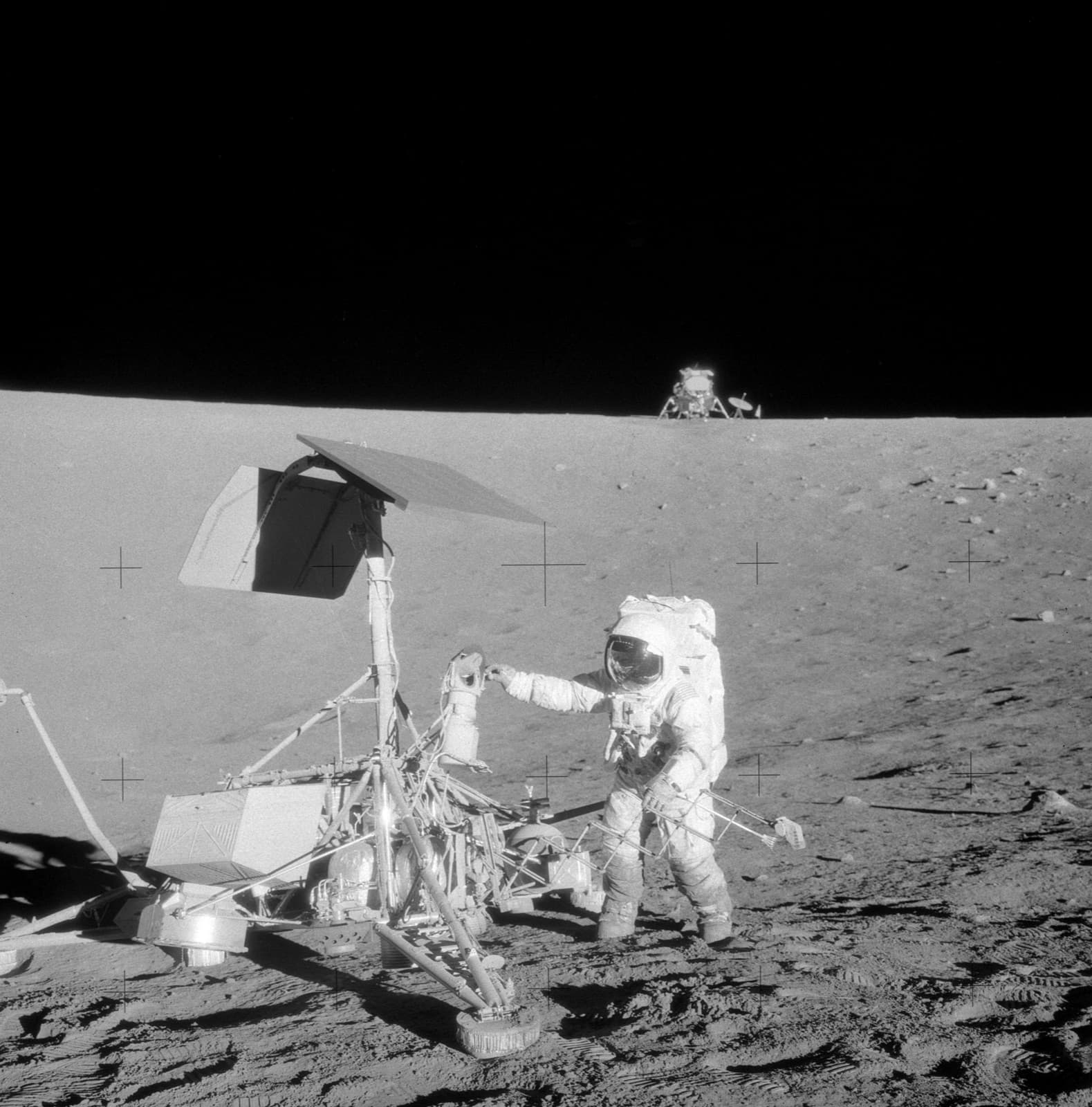
The first human object on the Moon arrived a decade before Apollo. According to Russia's Presidential Library, Luna 2 struck the Sea of Rains near the craters Aristillus, Archimedes and Autolycus at 00:02:24 Moscow time on 14 September 1959, travelling at 3.3 km/s, and 72 pentagonal pennants were left at the site: twelve stamped with the Soviet coat of arms and the letters СССР, sixty with a five-pointed star, the letters and the launch date. America's Ranger probes followed as deliberate impactors; Rangers 7, 8 and 9 radioed close-up pictures on the way in, and LROC has found Ranger 7's crater, 14 m across, in Mare Cognitum. Then came the Surveyors, five of which soft-landed and are still there, and the five Lunar Orbiters, all of which ended on the surface. On Apollo 12, Pete Conrad and Alan Bean walked to Surveyor 3, which had been standing in Oceanus Procellarum since April 1967, and brought about 10 kg of its parts back to Earth for study.
The later Soviet hardware is easier to find. The sample-return landers Luna 16, Luna 20 and Luna 24 left their descent stages behind when small ascent rockets carried the soil home, and around Luna 24 LROC sees bright specks up to a kilometre away that its team thinks are most likely pieces of insulation blown off by the ascent stage's blast. Luna 23, which came down too fast in 1974, lies on its side with its unused return rocket still attached, 2.3 km from Luna 24. Luna 17 and Luna 21 delivered the Lunokhod rovers, and LRO has photographed both landers and both rovers: Lunokhod 1 on Mare Imbrium after driving 10.5 km, and Lunokhod 2 about 37 km of driving away from its lander in Le Monnier crater. Not everything has been found. In 2012 the LROC team listed the early landers Luna 9 and Luna 13 among spacecraft whose locations were still unknown, and NASA's catalogue gives no coordinates at all for seven Luna spacecraft, among them the orbiters Luna 10, 11 and 12 and the failed sample-return lander Luna 15.
Some of this hardware has done useful work for decades. The laser reflectors left by Apollo 11, Apollo 14 and Apollo 15, and those carried by the two Lunokhods, are the five targets in the Paris Observatory's public archive of lunar laser ranging, which runs from 1969 to 21 December 2024. The archive notes that Lunokhod 1's reflector was lost in 1971 and found again in 2010. Newer reflectors have joined them: the Chang'e 6 lander, for example, carries an Italian corner-cube reflector on its top deck, which CNSA says has become a position control point for distance measurement on the far side. The LROC team also uses the old hardware, the reflectors above all, as fixed benchmarks for mapping the Moon.
Many lunar orbiters end up on the surface, and several were steered into it for one last experiment. Lunar Prospector was aimed into a permanently shadowed crater near the south pole on 31 July 1999 in the hope of throwing up detectable water vapour; no plume was seen. It carried some of the ashes of the planetary geologist Eugene Shoemaker, in a capsule designed by Carolyn Porco. LCROSS sent a spent Centaur upper stage, nominally 2,305 kg, into the shadowed floor of Cabeus crater in 2009 and followed it down with its own shepherding spacecraft. The twin GRAIL probes, about 130 kg each, hit a mountain in the far north on 17 December 2012, at a site NASA named for Sally Ride. LADEE, 248 kg at the end, was steered in April 2014 so that it would hit the far side, partly out of concern that an uncontrolled spacecraft might come down near an Apollo site. Europe's SMART-1, Japan's Hiten and Kaguya, China's Chang'e 1 and the 45 kg Longjiang-2 all ended the same way.
China's hardware traces the growth of its programme. Chang'e 3 landed in Mare Imbrium on 14 December 2013 with the Yutu rover, and Chang'e 4 put a lander and the Yutu-2 rover in Von Kármán crater on the far side in January 2019. The two sample-return missions left their landers behind. Chang'e 5's lander unfurled what CNSA calls the first free-standing Chinese national flag on the Moon, in December 2020; its ascender, after handing its samples over in orbit, was commanded down at 06:59 Beijing time on 8 December and landed near 0 degrees longitude and 30 degrees south, which experts at CNSA's lunar exploration centre said kept it from becoming space junk. Chang'e 6's flag, raised on the far side on 3 June 2024, is woven from basalt fibre. According to CNSA's account, the flag system had been built in 2017 as part of Chang'e 5's backup, its fabric face needed replacing after long storage, and a team from Wuhan Textile University proposed basalt, a material that tolerates heat, cold and radiation.
NASA's 2012 catalogue lists two Indian objects on the Moon: the Moon Impact Probe, released from Chandrayaan-1 to strike near the south pole, and the Chandrayaan-1 orbiter itself. The orbiter was not there, at least in 2016: JPL radar found it still circling the Moon in July that year, seven years after contact was lost. Chandrayaan-2's Vikram lander crashed in September 2019; the first piece of its debris was spotted in public LRO images by Shanmuga Subramanian, and the LROC team then confirmed the impact site at 70.881 S, 22.784 E. The Chandrayaan-3 lander, which touched down on 23 August 2023, stands about 600 km from the south pole. Japan's SLIM landed on 20 January 2024 within its 100 m accuracy goal, but one of its two main engines probably lost thrust at about 50 m altitude, JAXA reported, and the lander came to rest in an attitude it was not designed for; just before touchdown it released two small probes, LEV-1 and LEV-2, which stayed on the Moon with it. Israel's Beresheet hit Mare Serenitatis on 11 April 2019, about 1 km/s faster than intended, leaving a dark smudge that LRO found eleven days later.
Since 2024 most arrivals have been commercial. Intuitive Machines' IM-1 Odysseus came to rest at 80.13 degrees south on 22 February 2024, inside a degraded crater on a 12-degree slope. Firefly's Blue Ghost 1 stands in Mare Crisium on the rim of a 12 m crater, where it landed in March 2025, while IM-2 Athena reached Mons Mouton, near the south pole, on 6 March 2025 faster than intended and, LRO images show, ended up on its side in a 20 m crater. ispace has lost two landers: its first, near Atlas crater in April 2023, and Resilience, which made a hard landing in Mare Frigoris on 5 June 2025 and left a dark smudge with a faint bright halo. Government landers crash too: Russia's Luna 25 hit the steep inner rim of Pontecoulant G crater on 19 August 2023, about 400 km short of its target, and LRO found a new crater about 10 m across that is probably its impact site.
Not every arrival was planned. On 4 March 2022 a rocket body nobody had aimed at the Moon hit the far side near Hertzsprung crater and left a double crater, 18 m and 16 m wide. The LROC team wrote that the double shape may mean the object had heavy masses at both ends, and that its identity remains unclear (WE0913A sets out the competing attributions). The newest known arrival came on 5 August 2026, when the second stage of the Falcon 9 that had launched Blue Ghost 1 in January 2025 struck the far side near Einstein crater. NASA's Center for Near Earth Object Studies predicted the site, Korea's Danuri imaged the fresh crater within hours, and LRO imaged it on 11 and 12 August: 18 m across, less than 3 m deep, centred at 19.4759 N, 266.7138 E. The stage came in about 31 degrees from horizontal and left a V-shaped ejecta pattern of the kind natural low-angle impacts make.
Some objects are known to be on the Moon without anyone knowing where. NASA's catalogue gives no position for Surveyor 4, Lunar Orbiter 4, the Explorer 35 and Explorer 49 satellites, or the Apollo 15 subsatellite, and the Apollo 10 descent stage and Apollo 16 ascent stage came down somewhere unrecorded. Each crater LRO pins down, like that of Apollo 16's booster in 2015, takes an object off that list. On a map such as the Luna globe, a pin can only be as good as its source: some rest on LRO measurements good to a few metres, others on 1960s tracking.
All of this is heritage as well as litter, and the two readings pull in different directions. In July 2011 NASA published recommendations asking visiting spacecraft to keep their descent paths out of a 2 km radius around Apollo and Surveyor sites, and setting artifact boundaries of 75 m around the Apollo 11 descent stage and 225 m around Apollo 17's. The hardware is also a slow experiment. The LROC team studies the bright blast zones that landers' exhaust scoured into the soil, and uses craters made by objects of known mass and speed to test models of how craters form. Taken together, the objects are a record of who went to the Moon, how they got there and what went wrong, kept in a place with no wind or rain to erase it.
What we know
The closest thing to an inventory
NASA's History Program Office published a 22-page Catalogue of Manmade Material on the Moon dated 5 July 2012. It lists US, Soviet, Chinese, Indian, Japanese and European objects with coordinates where known, itemises Apollo equipment down to earplugs and towels, and gives no masses. It predates every landing since 2012.↗
What the total mass really is
An estimate. On 5 August 2026 Forbes reported, citing the BBC, that there are around 3,000 human-made objects on the Moon weighing a combined 209 tons. Neither article's method is given, nor whether the tons are metric. No space agency publishes a total; any sum depends on choices such as launch mass versus mass at landing, and how to count impactors that were partly vaporised.↗
The heaviest category: Saturn V third stages
From Apollo 13 onward, each spent S-IVB stage was steered into the Moon as a seismic source. LROC gives the Apollo 14 stage (S-IVB-509, 17.8 m tall) as 14,016 kg at impact, arriving at 2.54 km/s with an energy of 5.54 x 10^10 J, just over 10 tons of TNT. If the other four were similar, the five account for roughly 70 tonnes.↗
The lost booster crater
Radio contact with the Apollo 16 S-IVB was lost before impact. LROC identified its crater, about 40 by 30 m, on Mare Insularum at 1.921 N, 335.377 E and announced it on 2 December 2015, about 30 km from the Apollo-era estimate. The other four S-IVB craters were all within 7 km of their predicted positions.↗
Where the Apollo hardware sits
LROC's 2016 coordinate update, from images taken 2009 to 2015, lists every Apollo lunar module, science station and rover with a stated uncertainty of 0.3 to 3.7 m; for example the Apollo 11 LM at 0.67416 N, 23.47314 E (0.3 m). By those coordinates, the rovers of Apollo 15, 16 and 17 are parked roughly 80 to 140 m from their landers.↗
Lunar module ascent stages
NASA's History Office: the ascent stages of Apollo 12, 14, 15 and 17 were deliberately crashed near their landing sites; those of Apollo 11 and Apollo 16 were left in lunar orbit and "later impacted the Moon, but the precise location is unknown", as did the descent stage of Apollo 10's lunar module, Snoopy.↗
Eagle may still be in orbit
In a 2021 paper in Planetary and Space Science (volume 205), James Meador reported simulations suggesting the Apollo 11 ascent stage "might have remained in lunar orbit to the present day". NASA's History Office says it impacted at an unknown place. No detection of the object or its crater had been announced as of 23 September 2026, so the question is open.↗
The flags
On 27 July 2012 LROC principal investigator Mark Robinson wrote that it is "now certain" the American flags are still standing and casting shadows at every Apollo site except Apollo 11, where Buzz Aldrin reported the flag blown over by the ascent engine exhaust. What the flags now look like, Robinson added, is another question.↗
Faded, or not?
The flags were bought off the shelf, with no requirement to last. Experts quoted in the Apollo Lunar Surface Journal's 2012 review, including Robinson, historian Anne Platoff and lunar scientist Paul Spudis, expected decades of unfiltered ultraviolet light and temperature swings to have bleached, darkened or damaged them. That is an expectation; nobody has seen one up close since 1972.↗
Apollo 11's messages
NASA release 69-83F (13 July 1969): a silicon disc "about the size of a 50-cent piece", etched with statements by four US presidents and goodwill messages from leaders of 73 countries, would be left with a flag and the descent-stage plaque. The 2012 catalogue also lists a gold olive branch, an Apollo 1 patch and two medals honouring Gagarin and Komarov.↗
The Fallen Astronaut
At the final rover parking place on Apollo 15, David Scott left a card naming fourteen astronauts and cosmonauts who had died and a small aluminium figurine. Its maker is disputed: the Apollo Lunar Surface Journal's image library credits the Belgian artist Paul van Hoeydonck, while Scott's September 2021 memorandum says NASA personnel designed and machined it from a single block of aluminium alloy 6061.↗
Waste, counted from NASA's own list
Totalling the 2012 catalogue's entries across the six Apollo landings gives 25 defecation collection devices, 15 urine collection assemblies, 3 urine receptacle systems and 20 emesis bags. The catalogue lists items by type, not by bag, and the popular figure of 96 bags does not appear in it.↗
Luna 2's pennants
Russia's Presidential Library: Luna 2 reached the Moon at 00:02:24 Moscow time on 14 September 1959, in the Sea of Rains near Aristillus, Archimedes and Autolycus, at 3.3 km/s, and 72 pentagonal pennants remained at the site, twelve with the Soviet coat of arms and "СССР", sixty with a star, "СССР" and the launch date (original: «В месте приземления осталось 72 пятиугольных вымпела»).↗
Reflectors ranged for decades
The Paris Observatory's POLAC archive holds lunar laser ranging observations from 1969 to 21 December 2024 to five reflectors: Apollo 11 (July 1969), Lunokhod 1 (November 1970, "lost in 1971 and found again in 2010"), Apollo 14, Apollo 15 and Lunokhod 2 (January 1973).↗
Chang'e 5's ascender
CNSA: after handing its samples over in lunar orbit, the Chang'e 5 ascender left orbit on command at 06:59 Beijing time on 8 December 2020 and came down at about 07:30 near 0 degrees longitude, 30 degrees south (原文: 7时30分左右降落在月面经度0度、南纬30度附近的预定落点). Experts at CNSA's lunar exploration centre said the controlled descent kept it from becoming space junk.↗
Chang'e 6: a basalt flag
The Chang'e 6 flag system was built in 2017 as part of Chang'e 5's backup; after long storage its flag face had to be replaced, and in August 2022 a Wuhan Textile University team proposed basalt fibre (原文: 用玄武岩纤维制造月面国旗). The flag was deployed on the far side on 3 June 2024.↗
Human remains
Some of the ashes of planetary geologist Eugene Shoemaker reached the Moon on 31 July 1999 aboard Lunar Prospector, in a capsule designed by Carolyn Porco whose brass foil is inscribed with Comet Hale-Bopp, Barringer Crater and lines from Romeo and Juliet.↗
The newest arrival
The Falcon 9 upper stage that launched Blue Ghost 1 hit on 5 August 2026 (6:35 UTC). LROC measured the crater at 18 m across and under 3 m deep, at 19.4759 N, 266.7138 E, 511 m elevation; the stage struck about 31 degrees from horizontal and left a V-shaped ejecta pattern like a low-angle natural impact.↗
A crater nobody has claimed
A rocket body hit the far side near Hertzsprung on 4 March 2022 and left a double crater, 18 m and 16 m wide, at 5.226 N, 234.486 E. The LROC team wrote that its identity "remains unclear" and that the double shape may mean heavy masses at both ends. See WE0913A for the competing attributions.↗
Keep-out zones
NASA's recommendations of 20 July 2011 ask visiting spacecraft to keep their descent paths out of a 2.0 km radius around Apollo and Surveyor sites (0.5 km around impact sites) and set artifact boundaries of 75 m around the Apollo 11 descent stage and 225 m around Apollo 17's.↗
What happened, and when
- 14 Sep 1959Luna 2 hits the Sea of Rains at 3.3 km/s, the first human object to reach the Moon, carrying pentagonal Soviet pennants.
- 31 Jul 1964Ranger 7 photographs its target until impact in Mare Cognitum; LROC later finds its 14 m crater.
- 20 to 21 Jul 1969Apollo 11 leaves its descent stage with plaque, a flag, the goodwill disc, an Apollo 1 patch and medals for Gagarin and Komarov.
- 20 Nov 1969Apollo 12's crew brings about 10 kg of Surveyor 3 home; their ascent stage is crashed about 60 km away, the first recorded artificial moonquake.
- 14 Apr 1970Apollo 13's S-IVB stage hits north of Mare Cognitum, 135 km from the Apollo 12 seismometer: the first of five deliberate booster impacts.
- 17 Nov 1970Luna 17 lands on Mare Imbrium; Lunokhod 1 drives 10.5 km and is still parked where it stopped.
- Jul to Aug 1971On Apollo 15, David Scott leaves the Fallen Astronaut figurine and a card naming fourteen dead astronauts and cosmonauts beside the rover.
- 31 Jul 1999Lunar Prospector is aimed into a shadowed south polar crater at 1.69 km/s, carrying some of Eugene Shoemaker's ashes; no plume is seen.
- 17 Dec 2012The twin GRAIL probes, about 130 kg each, hit a far-northern massif; NASA names the site for Sally Ride.
- 2 Dec 2015LROC announces the Apollo 16 S-IVB crater, about 30 km from where Apollo-era tracking had placed it.
- 8 Dec 2020Chang'e 5's ascender is commanded out of lunar orbit and lands near 0 degrees longitude, 30 degrees south (Beijing time).
- 4 Mar 2022A rocket body of disputed identity (WE0913A) leaves a double crater on the far side near Hertzsprung.
- 19 Aug 2023Luna 25 crashes into the rim of Pontecoulant G crater, about 400 km short of its target; LRO finds a new 10 m crater that is probably its impact site.
- 3 Jun 2024Chang'e 6 deploys a basalt-fibre Chinese flag on the far side before its ascender lifts off.
- 5 Aug 2026A Falcon 9 upper stage nobody aimed at the Moon hits it; Korea's Danuri images the fresh crater within hours and LRO six days later: 18 m across.
In pictures
Tap a photo to enlarge.
Sources
- NASA History Program Office, Catalogue of Manmade Material on the Moon (5 July 2012)
- NASA History Office, A Compilation of Human Artifacts on the Moon (2012)
- Wagner et al. via LROC, Spacecraft Related Coordinates, 2016 Update (Icarus, 2016)
- LROC, Apollo 14 S-IVB Impact Crater
- LROC, Found! Apollo 16 S-IVB Impact Crater (2 December 2015)
- LROC, Question Answered! (Apollo flags, 27 July 2012)
- Apollo Lunar Surface Journal, Six Flags on the Moon: What is Their Current Condition? (2012)
- Apollo Lunar Surface Journal, Apollo 15 EVA-3 closeout (Fallen Astronaut memorial)
- Apollo Lunar Surface Journal, Apollo 14 EVA-2 closeout and the golf shots
- NASA release 69-83F, Apollo 11 Goodwill Messages (13 July 1969)
- NSSDCA, Apollo 12 Lunar Module
- NSSDCA, Lunar Prospector
- Meador, Long-term orbit stability of the Apollo 11 "Eagle" Lunar Module Ascent Stage, Planetary and Space Science 205, 105304 (2021), doi:10.1016/j.pss.2021.105304 (open preprint on arXiv)
- Presidential Library (Russia), Luna 2 (in Russian)
- Paris Observatory POLAC, Lunar laser ranging observations 1969 to 2024
- CNSA, Chang'e 5 ascender controlled impact (8 December 2020, in Chinese)
- CNSA, Chang'e 5 reentry capsule lands with moon samples (in English)
- CNSA, Twenty years of China's lunar programme (Chang'e 6 basalt flag, in Chinese)
- CNSA, Chang'e 6 completes sampling and ascender lifts off (in Chinese)
- JAXA, Results of the SLIM lunar landing (25 January 2024, in Japanese)
- NASA, Vikram Lander Found (2 December 2019)
- NASA JPL, New NASA Radar Technique Finds Lost Lunar Spacecraft (9 March 2017)
- The Planetary Society, Eugene Shoemaker profile
- LROC, Falcon 9 Impact! (2026)
- NASA Science, NASA's LRO Images Falcon 9 Crater on Moon (18 August 2026)
- LROC, Mystery Rocket Body Found! (23 June 2022)
- Forbes, SpaceX Rocket Hits Moon As Lunar Junk Tops 209 Tons (5 August 2026)
- NASA, Recommendations to Space-Faring Entities on U.S. Government Lunar Artifacts (20 July 2011)
- LROC, Mare Crisium: Failure then Success (Luna 23 and 24, 16 March 2012)
- LRO/LCROSS press kit (Centaur impact mass)
- NASA, NASA Will Attempt to Observe Rocket Part's Lunar Impact (4 August 2026)
- Apollo Lunar Surface Journal, Apollo 15 image library (Fallen Astronaut credit)
- LROC, Making an Impact on History (Ranger 7, 7 November 2013)
- LROC, Rocket impacts recorded by the Apollo seismic network (22 March 2010)
- LROC, Lunokhod 1 Revisited (14 March 2012)
- LROC, Lunokhod 2 Revisited (13 March 2012)
- LROC, Impact! (GRAIL, 19 March 2013)
- LROC, LADEE Impact Crater Found! (28 October 2014)
- LROC, Longjiang-2 Impact Site Found! (14 November 2019)
- LROC, Chang'e 3 Lander and Rover From Above (30 December 2013)
- LROC, First Look: Chang'e 4 (6 February 2019)
- LROC, Beresheet Crash Site Spotted! (15 May 2019)
- LROC, Chandrayaan-3 Landing Site (5 September 2023)
- LROC, Luna 25 Impact Crater (29 November 2023)
- LROC, Intuitive Machines IM-1 On The Moon! (26 February 2024)
- LROC, Blue Ghost Lunar Lander Seen From Above (7 March 2025)
- LROC, IM-2 Athena Seen Obliquely (10 March 2025)
- LROC, Impact Site of the HAKUTO-R Mission 1 Lunar Lander (23 May 2023)
- LROC, HAKUTO-R Venture Moon Mission 2 Landing Site (Mare Frigoris, 16 May 2025)
- LROC, ispace Mission 2 RESILIENCE Impact Site (20 June 2025)
Checked on 23 September 2026. Where the science is unsettled this page says so rather than picking a winner.